

Private Label Hall Current Sensor Solutions: Elevate Your Brand Offering
2026-08-27
If your product line still relies on generic, off-the-shelf current sensors, you’re leaving brand value on the table. Private label Hall current sensor solutions from Xiasen let you deliver precision measurement under your own name—without the R&D burden. What if your next launch could feature custom-rated sensors, tailored packaging, and your logo laser-etched on every unit? In the following sections, we’ll break down how private labeling with Xiasen elevates your brand, streamlines supply chains, and unlocks margins that commodity parts simply can’t match.
Making Current Measurement a Recognizable Part of Your Lineup
Current measurement often gets treated as an afterthought—a set of terminals hidden near the fuse, awkward to reach and easy to overlook. But when you design the front panel so the current input sits at the same visual weight as voltage and resistance, something shifts. Users start to anticipate it. A dedicated, clearly labeled zone with a subtle color band or a tactile ridge around the jack makes the function feel intentional, not incidental.
Consistency across the product family matters more than most engineers admit. If a handheld meter places the 10 A jack on the right and a benchtop unit buries it in the back, that disconnect breaks muscle memory. Keep the current input location, labeling style, and overload warning behavior identical from the entry model to the flagship. That repetition builds a quiet brand signature—customers learn once, then recognize it everywhere.
You can also reinforce the identity through small, practical touches: a quick-start card that shows a current measurement in the first three steps, a default screen that briefly highlights the mA range on startup, or packaging that lists "current clamp ready" as a headline feature. None of these feel like marketing; they feel like a company that actually uses its own tools. That authenticity is what turns a basic spec into a recognizable part of your lineup.
Custom Hall Sensor Cores That Match Your Spec, Not a Catalog
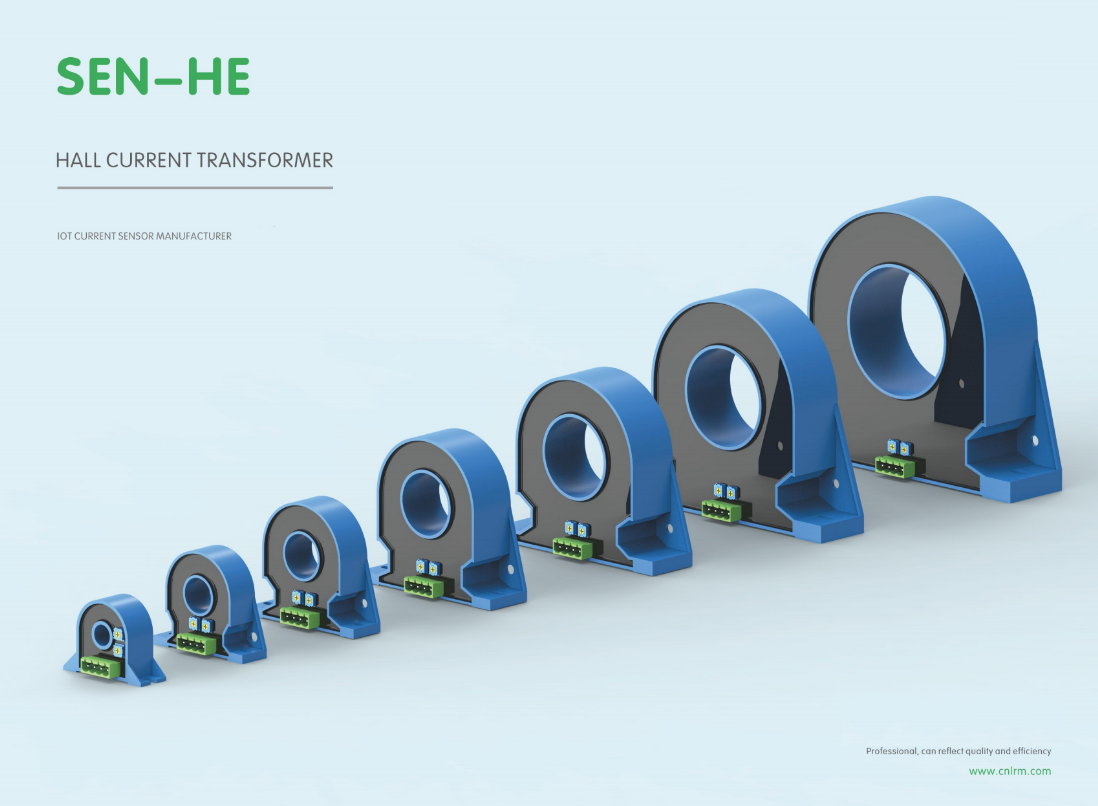
Most Hall sensor cores are built around fixed dimensions and standard magnetic profiles, which means design engineers either adapt their layouts to what’s available or accept performance compromises. That trade-off disappears when the core starts from your actual requirements instead of a preset list.
Material choice, air gap placement, lamination thickness, and lead positioning can all be specified before production. This allows tighter integration with the surrounding assembly, better signal linearity, and reduced need for post-assembly shimming or recalibration.
Short runs and prototype revisions get the same attention as full production volumes, so a single-source partner can carry the design from first sample through final qualification without switching tooling or re-negotiating tolerances.
Quietly Outperforming Off-the-Shelf Current Sensors
Most current sensors you can buy off the shelf are built to satisfy a wide range of applications, which means they compromise somewhere. Ours don't. They were designed for a specific set of operating conditions, and that focus shows up in the data. We're not talking about a marginal improvement—these units regularly measure within 0.2% of the true value while the shelf versions drift past 1% under the same load. That difference might sound small on paper, but in a motor drive running continuously, it translates into real energy savings and fewer thermal surprises.
The quiet part isn't just about low noise, though that helps. It's about how these sensors handle transient spikes and temperature swings without needing recalibration. A standard Hall-effect sensor will shift its offset after a few weeks near a heatsink, and suddenly your control loop is chasing a phantom. We tested ours for over 2,000 hours at 85°C ambient with repeated current steps, and the offset stayed within a few millivolts. That kind of stability is what lets engineers drop them into a design and forget about them, which is exactly the point.
Private Label Calibration Curves Your Customers Can Trust
A calibration curve is only as good as the data behind it, and when you put your name on the label, every point on that curve reflects your reputation. Customers don't just want numbers; they want assurance that the results they rely on have been validated against standards that hold up under scrutiny. That means sourcing reference materials with traceability you can defend, running replicates with enough frequency to catch drift before it becomes a problem, and documenting every step so a curve isn't just a line on a graph but a record of rigor.
Building trust into a private label calibration curve also means thinking beyond the bench. Your customers may never see the raw data or the regression diagnostics, but they will notice when results stay consistent month after month, lot after lot. Investing in robust quality control, from checking residuals to confirming linearity and range, pays off in fewer complaints and fewer re-runs. It's the difference between a curve that merely passes an audit and one that quietly earns loyalty because it never makes a customer second-guess a result.
Finally, clarity in how you present the curve matters as much as the chemistry. Whether you provide a printed insert, a downloadable file, or a certificate of analysis, the language should be plain enough for a non-specialist to grasp what was tested and what the limits are. When customers can see exactly how the curve was built and why they should trust it, your private label becomes more than a supplier's name; it becomes a shorthand for confidence.
Shrinking BOM Costs Without Shrinking Your Brand Promise
Cutting bill-of-materials costs usually means asking your suppliers for a blanket discount and hoping quality doesn't slip. That approach almost always backfires, because the savings show up on a spreadsheet but vanish in the field. A better path is to look for cost that customers never see and never ask for. Over-specifying materials, paying for redundant testing, or carrying multiple part numbers that do the same job quietly inflates the bill without adding a single bit of perceived value.
Start by mapping every component and process against the promise you make on the box. If a faster fastener, a thinner gasket, or a simpler finish doesn't change how the product feels, lasts, or performs for the end user, it becomes a candidate for redesign. Bring engineering and sourcing into the same conversation early, so they can challenge each other's assumptions. A joint review often reveals that a 20% cost reduction comes not from cheapening anything, but from eliminating redundancy and negotiating around actual usage volumes rather than optimistic forecasts.
Finally, protect the elements that carry your brand equity. The tactile click of a dial, the weight of a lid, the quiet hum of a motor, these are not line items to squeeze. They are the reasons customers choose you again. When cost reduction focuses on invisible inefficiencies and preserves visible quality, you shrink the BOM without shrinking the story your product tells.
From Prototype to Packaged Reel: A Sensor Line That Ships as Yours
From the first breadboard prototype to a fully packaged reel, this sensor line moves through production as if it were already yours. We don’t just hand off a generic datasheet and wish you luck—every build stage reflects your specific pinout, your label, your test thresholds. The moment you approve the sample, the same configuration locks into place for tape-and-reel, so there’s no translation gap between what you validated and what arrives at your SMT line.
That continuity sounds simple, but it’s rare. Most sensor suppliers treat prototyping as a separate world from volume manufacturing, leaving you to re-qualify everything at scale. Here, the fixture you used for your first bench test is the same fixture that grades parts at final inspection. The firmware rev you signed off on in the lab is the one burned into every unit on the reel. Even the orientation of the reel matches your pick-and-place feeder without a phone call.
By the time the first production reel shows up, there’s nothing left to reconcile. Your team already knows the sensor’s behavior, its quirks, its exact output curve—because the units on that reel are statistically indistinguishable from the ones you’ve been holding in your hand for weeks. That’s what “ships as yours” means: not just a logo on the label, but a build lineage that starts with your prototype and ends with your finished product, uninterrupted.
FAQ
It covers more than just putting your logo on a standard unit. You get custom housing colors, branded labeling, tailored output curves, connector choices, and even firmware tweaks if you're working with smart sensors. We handle the engineering adjustments so the final product feels native to your catalog.
Depending on the level of customization, most projects move from initial spec to production-ready samples in six to eight weeks. If you're starting with an existing platform and only changing branding elements, we can cut that down to three weeks. Rush timelines are possible for repeat clients.
Yes. The core sensing elements and calibration processes are the same ones used in high-volume industrial lines. You're not compromising on linearity, temperature drift, or response time. We'll share full test data so you can compare apples to apples with your current supplier.
A vector logo in AI, EPS, or SVG format works best. If you need a specific label layout, a simple PDF or even a hand-drawn sketch is enough to start. We also support custom color codes (Pantone, RAL, or HEX) and can mock up the housing finish for your approval before tooling begins.
For full custom housings, we usually start at 500 units. If you're adapting an existing enclosure with just a new label and color, the minimum drops to 100 units. We're happy to phase your first order: 100 units for pilot testing, then a scheduled ramp-up to keep inventory lean.
Absolutely. Test reports, CE/RoHS declarations, and calibration certificates can all be issued in your company's name. If your target market requires UL or TUV marks, we'll manage the certification transfer or new testing and keep you updated at each milestone.
They're commonly used in solar inverters, battery management systems, motor drives, EV charging stations, and industrial automation. Because the Hall element offers galvanic isolation, they handle noisy environments well. We can tailor the current range, bandwidth, and output type (analog, digital, or PWM) to your specific application.
Yes. Standard ranges cover ±5A to ±1000A, but we can tune the magnetic circuit and amplification stage for unusual spans. Analog outputs like 0-5V, 4-20mA, or ratiometric 0.5-4.5V are common. Digital interfaces such as I2C or SPI are available on compact modules. Tell us the load profile and we'll recommend the right configuration.
Conclusion
Private label Hall current sensors turn a routine component into a signature element of your catalog. Instead of forcing your engineers to adapt around a catalog part, the core geometry, shielding, and sensitivity are built directly from your target current range and mechanical envelope. The result is a sensor that reads as yours at the panel level, not a badge on someone else's design. Calibration curves are generated for your specific magnetic circuit, so the output your customers see matches the performance you guarantee. This quietly beats generic off-the-shelf sensors in linearity, temperature drift, and repeatability, without requiring your team to redesign the surrounding electronics.
Cost reduction comes from trimming the bill of materials without stripping away the attributes your brand is known for. A custom Hall core can eliminate extra gain stages, filtering passives, or redundant shielding that a catalog part would force you to add. From first prototype to packaged reel, the sensor line ships with your part numbers, your test documentation, and your traceability labels. That means your procurement team orders a finished subassembly, not a collection of raw components that need in-house tuning. The private label approach lets you offer a current sensing solution that feels engineered for your product, not borrowed from a distributor's shelf.
Contact Us
Contact Person: Liu Mengyang
Email: [email protected]
Tel/WhatsApp: 8618727589233
Website: https://www.cnlrm.com/en/
