

Can an AC Circuit Breaker Curve C 63A 3P 6kA Replace a B-Curve Breaker in Residential Panels
2026-07-03
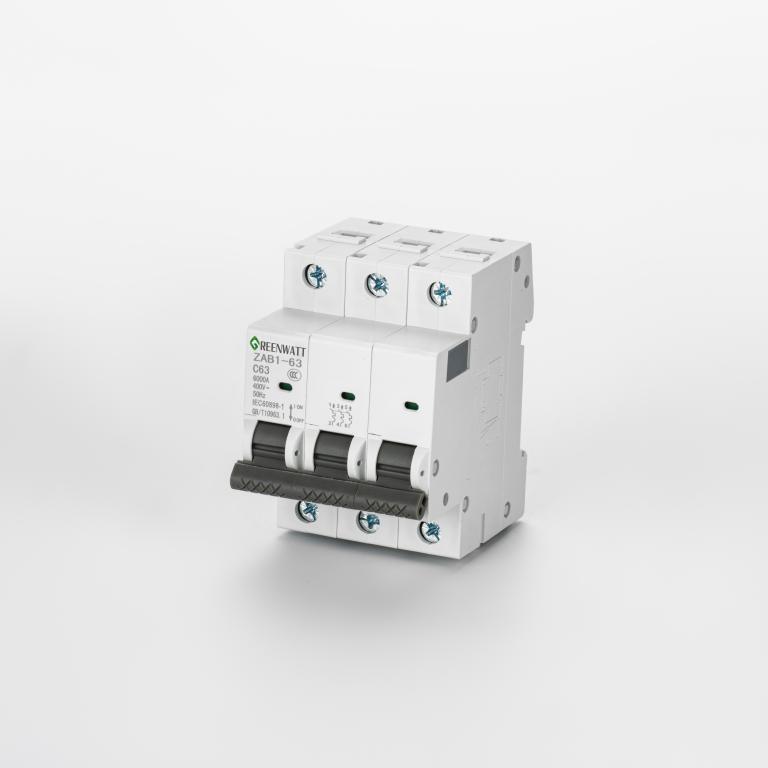
When upgrading or troubleshooting a residential electrical panel, homeowners and electricians often ask whether a AC Circuit Breaker Curve C 63A 3P 6kA can directly substitute an existing B-curve device. The short answer is sometimes yes, but with critical caveats. This guide examines the technical, safety, and code implications of such a replacement, while introducing GreenWatt’s reliable solutions for modern distribution boards.
Understanding the Curves: B vs. C
The trip curve defines how quickly a breaker responds to overcurrent. Replacing a B-curve with a AC Circuit Breaker Curve C 63A 3P 6kA alters the protection profile for downstream circuits.
| Characteristic | B-Curve (Typical Residential) | C-Curve (Light Commercial/Industrial) |
|---|---|---|
| Magnetic trip range | 3–5 × In | 5–10 × In |
| Typical applications | Lighting, outlets, small appliances | Motors, transformers, HVAC, pumps |
| Inrush tolerance | Low | High (up to 10× rated current) |
| Fault clearance speed | Faster for low-level shorts | Slightly delayed for moderate overcurrents |
| Suitability for residential | Standard | Conditional |
Key Technical Factors to Evaluate
Before swapping, consider these three pillars:
-
Cable protection – The 63A rating requires minimum 10 mm² copper (for 70°C PVC) per IEC 60364. A AC Circuit Breaker Curve C 63A 3P 6kA does not protect smaller gauge wiring – this is non-negotiable.
-
Earth loop impedance (Zs) – For a C-curve, maximum Zs must be low enough to allow magnetic tripping within 0.4s. At 63A, Zs ≤ 0.23 Ω (for 230V TN system). Residential installations often exceed this, rendering the C-curve ineffective for fault clearance.
-
Selectivity coordination – Upstream RCDs and main breakers must be coordinated. The higher magnetic threshold of the AC Circuit Breaker Curve C 63A 3P 6kA may reduce discrimination with downstream B-curve devices.
When Is Replacement Permissible?
Replacement is technically valid if:
-
The entire branch circuit wiring is rated for 63A continuously.
-
The load is predominantly inductive (e.g., central air conditioning, elevator, or workshop machinery).
-
The prospective short-circuit current at the panel does not exceed 6kA – which is exactly the breaking capacity of this model.
GreenWatt recommends using their AC Circuit Breaker Curve C 63A 3P 6kA specifically for sub-panels feeding garages or outbuildings with heavy motor loads, not for general lighting or socket circuits.
Practical Comparison Table
| Parameter | B-Curve 63A (if exists) | AC Circuit Breaker Curve C 63A 3P 6kA |
|---|---|---|
| Magnetic trip | 189–315 A | 315–630 A |
| Response to surge (e.g., freezer start) | May nuisance trip | Tolerates well |
| Arc-flash energy | Lower | Higher (due to longer clearing time) |
| Typical panel type | Consumer unit | Distribution board |
| GreenWatt model availability | Limited | Standard stock |
FAQ – Common Questions About the AC Circuit Breaker Curve C 63A 3P 6kA
Q: Will a AC Circuit Breaker Curve C 63A 3P 6kA protect my 2.5 mm² lighting circuit?
A: Absolutely not. A 63A breaker, regardless of curve, offers no overload protection for 2.5 mm² cable (which maxes at ~27A). The cable will overheat and catch fire before the breaker trips. You must downgrade to a 16A or 20A breaker for such circuits. The C-curve only affects magnetic trip, not thermal protection – both B and C have identical thermal (overload) characteristics per IEC 60898.
Q: Can I use a AC Circuit Breaker Curve C 63A 3P 6kA as a main incoming breaker in a residential single-phase panel?
A: Technically yes, if your utility supply is rated for 63A and the service cable matches. However, in most countries, the utility meter fuse or main switch is B-curve or gG fuse. Replacing it with a C-curve may void your insurance and fail inspection because the earth fault loop impedance is rarely low enough for magnetic tripping. Always consult your DNO (Distribution Network Operator). GreenWatt advises using this model only for sub-distribution, not as the sole incoming protective device.
Q: How does the 6kA breaking capacity compare to residential requirements?
A: For most residential panels, the prospective short-circuit current (PSC) at the main switch ranges from 2kA to 5kA. A 6kA rating is therefore sufficient. However, if your transformer is within 50 meters, PSC may exceed 6kA – in that case, you need a 10kA device. The AC Circuit Breaker Curve C 63A 3P 6kA from GreenWatt is clearly marked with its interrupt rating; always verify your PSC before installation using a loop impedance tester.
Final Verdict – Proceed with Caution
Replacing a B-curve with a AC Circuit Breaker Curve C 63A 3P 6kA in a residential panel is not a like-for-like substitution. It is only justified when:
-
The circuit is dedicated to high-inrush loads.
-
All downstream wiring is upgraded to 63A capacity.
-
Earth loop impedance is verified with a certified instrument.
-
Local electrical regulations (e.g., BS 7671, NEC, VDE) explicitly allow it.
For 95% of residential lighting, socket, and mixed-use circuits, the B-curve remains the correct choice. The C-curve shines in workshops, EV chargers, and heat pumps – exactly where GreenWatt engineers have deployed hundreds of units with proven reliability.
Need Expert Advice on Your Panel Upgrade?
Every installation is unique. The GreenWatt technical team offers free load studies and curve-selection tools to match the right AC Circuit Breaker Curve C 63A 3P 6kA to your actual site conditions. Avoid nuisance trips, fire hazards, and failed inspections.
Contact us today with your panel schedule and loop impedance readings – we will respond within 4 business hours with a tailored recommendation, wiring diagram, and compliance checklist. Your safety is our priority, and we stand behind every breaker with a 5-year warranty. Reach out via our website or call your local GreenWatt distributor now.