

Can an AC Combiner Box 6 In 1 Out Handle Both 208V and 480V Grid Connections
2026-07-03
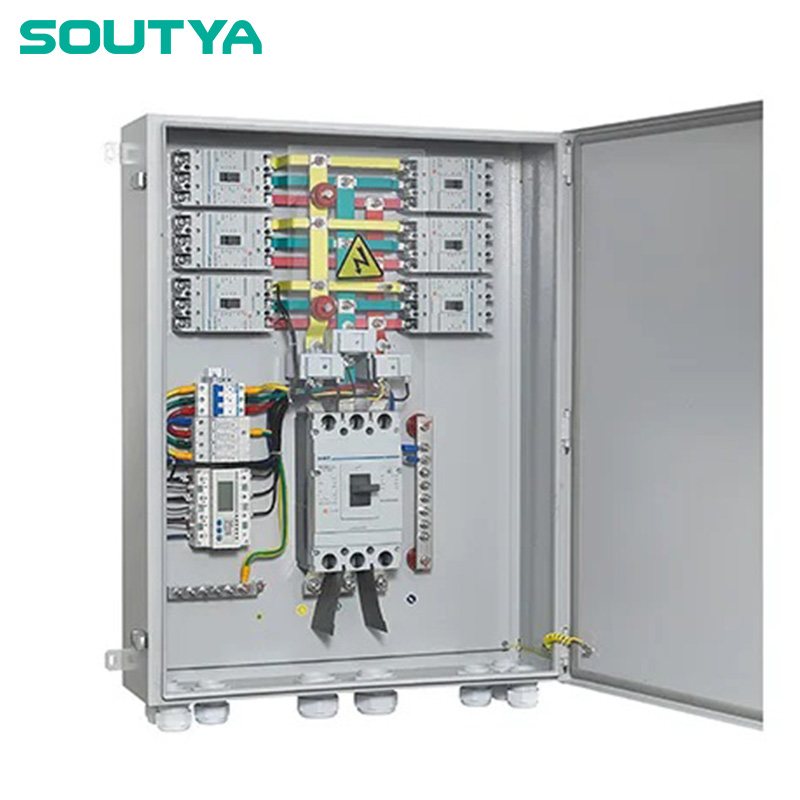
When designing commercial or utility-scale solar photovoltaic systems, one of the most frequent engineering questions revolves around voltage compatibility at the AC coupling point. The AC Combiner Box 6 In 1 Out serves as the critical junction where multiple inverter outputs merge into a single feeder to the main distribution panel. But can a single unit truly accommodate both 208V and 480V grid connections—two vastly different voltage classes? The short answer is yes, but with strict conditionals. This blog post, brought to you by Soutya, breaks down the technical realities, code implications, and best practices for deploying a AC Combiner Box 6 In 1 Out across dual-voltage scenarios.
Voltage Fundamentals: 208V vs. 480V
Before evaluating hardware capability, it is essential to distinguish between these two common AC voltage systems:
| Parameter | 208V System | 480V System |
|---|---|---|
| Configuration | Three-phase, 4-wire (Wye) | Three-phase, 4-wire (Wye) or 3-wire (Delta) |
| Line-to-Line Voltage | 208V | 480V |
| Line-to-Neutral | 120V | 277V |
| Typical Application | Light commercial, data centers, small rooftop solar | Heavy industrial, large-scale PV plants, motor loads |
| Inverter Output | Usually 208VAC L-L | Usually 480VAC L-L |
| Breaker Frame Size | 15A–100A (higher current) | 6A–50A (lower current for same power) |
Core Technical Answer: Hardware vs. Configuration
A AC Combiner Box 6 In 1 Out is fundamentally a passive power distribution assembly. The enclosure, busbars, and terminals do not “transform” voltage—they carry whatever voltage is applied, provided the insulation and clearances are rated for the highest possible potential.
What Determines Voltage Handling?
Three critical components dictate whether a AC Combiner Box 6 In 1 Out can support both 208V and 480V:
-
Insulation Voltage Rating (Ui): Must be ≥ 800V to safely cover 480V with safety margins.
-
Impulse Withstand Voltage (Uimp): Requires at least 4kV for 480V systems per IEC 60947.
-
Circuit Breaker Voltage Rating: Each input breaker must be explicitly rated for 480VAC or higher—a 240V-rated breaker will fail catastrophically on a 480V line.
Soutya designs its AC Combiner Box 6 In 1 Out series with a standard Ui of 1000V and Uimp of 6kV, making the busbar and enclosure inherently compatible with both systems. However, the field-configurable breaker selection determines the actual working voltage.
Practical Implementation: Two Distinct Builds
You cannot simply flip a switch to change voltage. For a AC Combiner Box 6 In 1 Out to handle both, you must configure it for one voltage at a time—or use dual-rated components that accept a range.
| Configuration Aspect | For 208V Grid | For 480V Grid |
|---|---|---|
| Main Output Breaker | 3-pole, 208V/240V rated, 100A–225A | 3-pole, 480V rated, 30A–100A |
| Input Breakers (6x) | 20A–60A, 208V/240V | 10A–30A, 480V |
| Busbar Ampacity | ≥ 225A (copper) | ≥ 100A (same copper bus, lower current) |
| Surge Protection Device (SPD) | 208V L-L configuration | 480V L-L configuration (different MOV clamping voltage) |
| Neutral Terminal | Required (solidly grounded) | Optional for Delta, required for Wye |
| Ground Fault Detection | Optional | Often mandatory per NEC 705 |
Critical Note: A AC Combiner Box 6 In 1 Out ordered with 480V-rated breakers and SPD cannot be “downgraded” to 208V without replacing those components. Conversely, a 208V-rated unit cannot be upgraded to 480V—the breakers and SPD would lack adequate interruption capacity.
NEC 2023 Compliance Considerations
Under the National Electrical Code, any AC Combiner Box 6 In 1 Out used at 480V must comply with additional requirements:
-
Article 705.31(B): All AC combiner enclosures must have a label indicating the maximum system voltage and short-circuit current rating (SCCR).
-
Article 110.9: Interrupting ratings must match the available fault current at 480V—typically much higher than at 208V.
-
Article 408.58: If the neutral is used (208V Wye), it must be fully rated and isolated from ground except at the source.
Soutya provides factory-installed SCCR labels up to 65kA at 480V, ensuring your AC Combiner Box 6 In 1 Out meets inspection requirements without aftermarket modifications.
Frequently Asked Questions (FAQ)
Q1: Can I use the same AC Combiner Box 6 In 1 Out for 208V today and switch it to 480V next year without buying a new enclosure?
A: Yes, the physical enclosure, busbars, and terminal blocks from Soutya are rated for 1000V and can be reused. However, you must replace all six input circuit breakers, the main output breaker, and the surge protection device with 480V-rated equivalents. Additionally, you must re-calculate the short-circuit current rating (SCCR) and update the nameplate label. The labor and component costs often approach 60–70% of a new unit, so many engineers prefer to purchase a dedicated AC Combiner Box 6 In 1 Out pre-configured for their target voltage from the start.
Q2: What happens if I accidentally connect a 480V inverter string to a AC Combiner Box 6 In 1 Out that was built with 208V breakers?
A: This is a critical safety hazard. A 208V-rated miniature circuit breaker (MCB) has a maximum interruption voltage of 240V. When exposed to 480V, internal arc extinguishing mechanisms fail, leading to contact welding, sustained arcing, and potential fire or explosion. The busbar insulation might also degrade if the clearance distances are insufficient for 480V (though Soutya designs all enclosures with 800V minimum creepage). Immediate consequences include tripped upstream feeders, damaged inverter outputs, and violation of NEC 110.10. Always verify the breaker voltage rating before energization—never rely on ampacity alone.
Q3: Does the AC Combiner Box 6 In 1 Out require different wire sizes for 208V versus 480V when the total power is the same?
A: Yes, absolutely. For a given power output—say 50kW—the current at 208V is approximately 240A (per phase), while at 480V it is only 104A. This means at 208V, you need larger gauge conductors for both the six inputs and the single output (e.g., 3/0 AWG copper vs. 2 AWG copper at 480V). The AC Combiner Box 6 In 1 Out from Soutya features oversized lug terminals that accept wire ranges from #14 AWG up to 350 kcmil, accommodating both scenarios. However, the terminal torque settings and bending radius must be adjusted per the manufacturer’s torque table—do not assume the same lugs work with both wire sizes without checking the lug’s UL listing range.
Final Verdict: One Enclosure, Two Missions
A properly specified AC Combiner Box 6 In 1 Out—particularly from Soutya—is mechanically and electrically capable of handling both 208V and 480V grid connections, provided you treat voltage as a configuration parameter, not a fixed attribute. The enclosure, busbars, and insulation offer the headroom; the breakers, SPD, and labeling do the actual voltage selection. For new projects, we strongly recommend ordering a voltage-specific factory assembly to avoid field errors and warranty voids. For retrofit or multi-site applications where voltage changes seasonally or by location, Soutya offers modular field-replacement kits with pre-tested components matched to each voltage.
Contact Us
Choosing the right AC Combiner Box 6 In 1 Out for your voltage environment is not a decision to make lightly—it impacts safety, code compliance, and system uptime. The engineering team at Soutya specializes in custom AC combiner solutions for 208V, 480V, and even 600V applications. We provide full SCCR calculations, 3D layout drawings, and 24-hour technical support. Let Soutya power your connection with confidence.