

How Are Medium Voltage Surge Arresters Installed and Grounded Correctly
2026-09-29
Medium Voltage Surge Arresters are among the most effective devices for limiting transient overvoltages in distribution networks, yet their performance depends almost entirely on correct installation and grounding. Huixing has supplied arresters to utilities and industrial projects for years, and field experience shows that most premature failures trace back to mounting or grounding errors rather than manufacturing defects. This guide explains the practical steps, clearances, and grounding rules that keep Medium Voltage Surge Arresters reliable across their full service life.
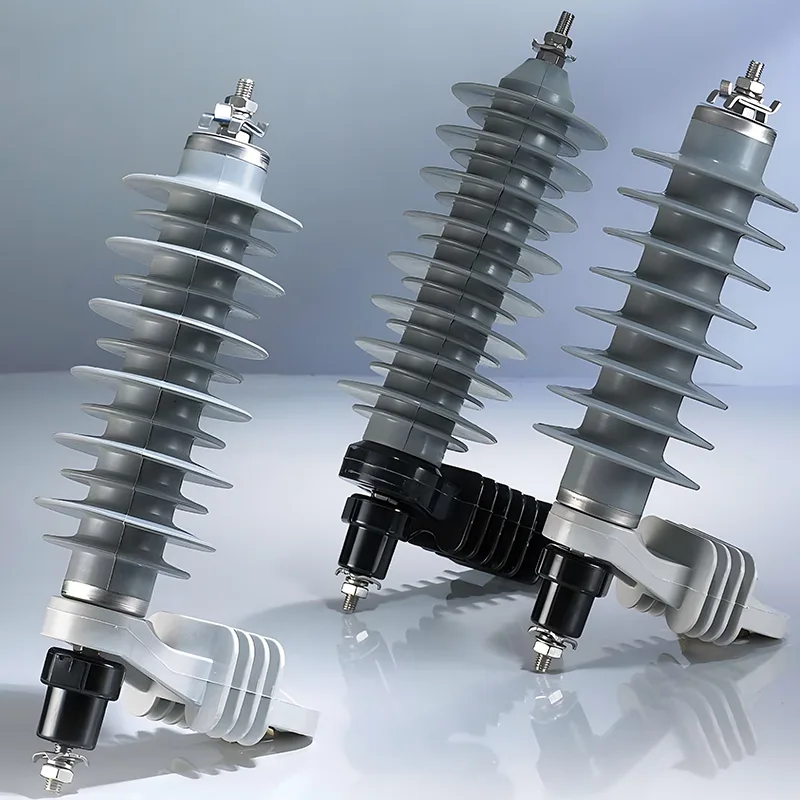
Why Installation and Grounding Decide Arrester Performance
An arrester only performs as designed when the surge current has a low-impedance path to earth. Poor grounding raises residual voltage, increases duty on the metal-oxide varistor (MOV) blocks, and can cause thermal runaway. Correct installation also keeps the arrester outside its maximum continuous operating voltage (MCOV) limits under normal system conditions.
Pre-Installation Checks
| Check Item | Requirement | Typical Value |
|---|---|---|
| Rated voltage | Match system line-to-ground voltage | ≥ 1.25 × system voltage |
| MCOV | Above normal operating voltage | Per IEC 60099-4 |
| Creepage distance | Suited to pollution level | 25–31 mm/kV |
| Mounting bracket | Galvanically compatible | Hot-dip galvanized steel |
| Grounding conductor | Low inductance | ≥ 25 mm² copper |
Step-by-Step Installation
-
Verify system parameters. Confirm voltage, neutral grounding method, and available fault current before selecting the arrester.
-
Mount the arrester vertically. Use the bracket supplied or a rigid structure. Keep the unit clear of obstructions and maintain the specified phase-to-ground and phase-to-phase clearances.
-
Keep the leads short. The line lead and ground lead should be as short and straight as possible; every additional 30 cm of lead adds roughly 1 kV/µs of inductive voltage drop.
-
Connect the line terminal. Use a torque-controlled connection and a conductor rated for the full surge current.
-
Bond the ground terminal directly. Run the ground lead to the station or structure ground grid without sharp bends.
-
Install a disconnect or counter. Optional, but useful for testing and for tracking surge events.
-
Torque all hardware. Follow the manufacturer's values to prevent loose connections that arc under surge.
Grounding Rules That Matter
-
Single-point, low-impedance ground. Bond the arrester ground terminal to the same ground grid as the protected equipment.
-
Avoid shared high-inductance paths. Never route the arrester ground lead through long cable trays or steel conduit.
-
Ground lead length. Keep it under 1 m where practical; shorter is always better.
-
Ground resistance. Target below 5 Ω for station class, below 10 Ω for distribution class where soil conditions allow.
-
Bonding of neutrals. For ungrounded or impedance-grounded systems, select an arrester rated for line-to-line voltage.
-
Inspection. Check ground connections annually and after any fault or lightning event.
Common Installation Mistakes
| Mistake | Consequence | Correction |
|---|---|---|
| Long ground lead | Higher residual voltage | Shorten and straighten lead |
| Separate ground from equipment | Potential difference during surge | Bond to same grid |
| Undersized conductor | Thermal damage | Use ≥ 25 mm² copper |
| Wrong MCOV selection | Overheating, failure | Recalculate per system voltage |
| Horizontal mounting | Poor drainage, pollution buildup | Mount vertically |
Frequently Asked Questions
Q: How far should a Medium Voltage Surge Arrester be installed from the protected equipment?
A: Mount the arrester as close as possible to the equipment terminals, ideally within 1 to 2 meters, because lead length adds inductive voltage drop that reduces protection margin.
Q: Can a Medium Voltage Surge Arrester share a ground with a transformer?
A: Yes, and it should. The arrester ground terminal must be bonded to the same ground grid as the transformer tank and neutral to avoid dangerous potential differences during a surge.
Q: How often should Medium Voltage Surge Arresters be inspected after installation?
A: Inspect visually every six to twelve months and after every significant lightning or switching event, checking for cracked housings, corrosion, and loose ground connections.
Working With Huixing
Huixing provides Medium Voltage Surge Arresters with documented MCOV ratings, test certificates, and installation guidance matched to IEC and IEEE requirements. Every unit ships with torque specifications and clearance drawings to simplify field work.
Contact us today to request datasheets, grounding recommendations, or a quotation for your next Medium Voltage Surge Arresters project.