

How Can an Optical Distribution Box Improve Modern Fiber Network Deployment?
2026-08-24
As fiber-optic networks continue to expand across residential, commercial, industrial, and telecommunications applications, efficient fiber management has become increasingly important. An Optical Distribution Box provides a centralized and protected point for fiber splicing, termination, splitting, distribution, and cable management. By organizing feeder and drop cables inside a compact enclosure, it helps installers build cleaner networks while making future maintenance easier. For network operators and project contractors, choosing a reliable Optical Distribution Box is therefore not simply a hardware decision—it can directly affect installation efficiency, protection, scalability, and long-term network performance.
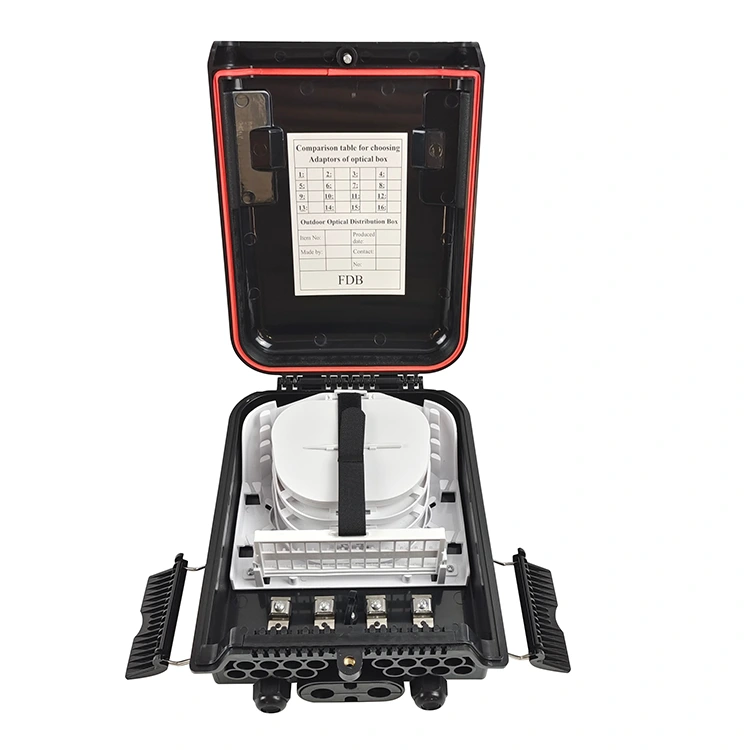
What Is an Optical Distribution Box?
An Optical Distribution Box, also commonly called a fiber distribution box or FDB, is a passive fiber-management enclosure used as a connection point between feeder cables and drop cables in FTTx and FTTH networks.
Depending on the design, it can integrate several functions into one enclosure:
-
Fiber splicing and termination
-
Optical splitting
-
Adapter and connector management
-
Fiber routing and storage
-
Feeder and drop cable fixation
-
Protection against dust, moisture, and environmental exposure
-
Convenient access for installation and maintenance
Modern designs can accommodate different capacities and splitter configurations, making them suitable for both small access networks and higher-density deployments.
Why Is an Optical Distribution Box Important?
A fiber network may contain hundreds or thousands of individual connection points. Without proper organization, installation and maintenance can become time-consuming and increase the possibility of fiber damage.
An Optical Distribution Box helps solve these problems by providing a structured environment for fiber management.
1. Better Fiber Protection
The enclosure protects sensitive optical fibers, splices, adapters, and connectors from accidental contact and environmental conditions. Outdoor models may use weather-resistant materials and sealing structures for protection against water, dust, UV exposure, and temperature changes.
2. More Efficient Fiber Management
Internal splice trays, routing guides, adapter panels, and storage areas help installers maintain appropriate fiber routing and bending radius. A well-organized internal structure also makes troubleshooting and future expansion easier.
3. Flexible Network Distribution
Some Optical Distribution Box designs support PLC splitters, allowing one feeder fiber to be distributed to multiple subscriber lines. Depending on the network architecture, splitter options may include configurations such as 1×8, 1×16, or 1×32.
4. Easier Installation and Maintenance
A properly designed box separates different fiber paths and provides convenient access to the splicing and connection areas. This reduces unnecessary fiber movement during maintenance and can improve installation efficiency.
Optical Distribution Box vs. Fiber Splice Closure
Although these products may appear similar, they serve different purposes.
| Feature | Optical Distribution Box | Fiber Splice Closure |
|---|---|---|
| Main purpose | Distribution and termination | Protection of fiber splices |
| Fiber distribution | Yes | Limited |
| Adapter ports | Commonly available | Usually not the main function |
| Splitter support | Often available | Usually limited |
| Subscriber connection | Suitable | Not the primary purpose |
| Maintenance access | Frequent access expected | Mainly splice protection |
| Typical application | FTTH/FTTx access points | Cable junctions and splice points |
An Optical Distribution Box is particularly useful when the project requires organized termination, splitting, and distribution rather than simply protecting a cable splice.
What Should You Look for When Selecting One?
The correct product should match the actual network architecture and installation environment.
Capacity
First determine the number of fibers and subscribers that need to be managed. Common product configurations range from compact low-core boxes to 48-core and higher-capacity solutions. Yuanyi, for example, manufactures Optical Distribution Box products in configurations including 12-core, 16-core, and 48-core versions.
Installation Environment
For indoor applications, compact ABS or similar enclosures may be sufficient. Outdoor projects generally require stronger sealing and environmental protection.
Consider:
-
Indoor or outdoor installation
-
Wall-mounted or pole-mounted installation
-
Required IP protection level
-
UV and weather resistance
-
Operating temperature
-
Cable entry and exit requirements
Connector and Splitter Compatibility
The box should be compatible with the required adapter type, such as SC or LC, as well as the project's preferred PLC splitter configuration.
Internal Fiber Management
A good internal design should provide enough space for splicing, routing, storage, and future maintenance without creating excessive fiber bending or congestion.
How Does Customization Make a Difference?
Standard products are useful for common deployments, but not every telecom project has identical requirements. This is where customization becomes an important competitive advantage.
Ningbo Yuanyi Communication Technology Co., Ltd. focuses on fiber-optic communication products and FTTH solutions, including Optical Distribution Box products, splice closures, splitters, adapters, patch cords, ODFs, cables, and related accessories. The company has been engaged in communication product development and manufacturing since its establishment in 2012.
One particularly valuable advantage is support for boat-shaped customization.
Boat-Shaped Customization for Specialized Projects
A boat-shaped enclosure or housing can be developed when a project requires a specific appearance, installation structure, internal arrangement, or space utilization. Instead of forcing a standard rectangular enclosure into an unsuitable installation position, a customized boat-shaped design can be developed around the customer's application requirements.
This can be especially valuable when customers require:
-
A distinctive housing shape
-
Special mounting requirements
-
Customized internal fiber routing
-
Specific cable-entry positions
-
Customized port arrangements
-
Special dimensions or installation space
-
OEM/ODM product development
-
Customized branding and packaging
For distributors, telecom contractors, and project integrators, this flexibility can make it easier to develop products for specific markets rather than relying exclusively on standard catalog models.
What Benefits Can Customers Expect from Yuanyi?
Choosing a manufacturer with both standard products and customization capabilities can simplify procurement and project development.
Ningbo Yuanyi Communication Technology Co., Ltd. offers a broad range of passive fiber-optic products, enabling customers to source multiple components from one supplier. Its product portfolio covers distribution boxes, splice closures, PLC splitters, connectors, adapters, pigtails, patch cords, ODFs, patch panels, cables, and cable accessories.
Key advantages include:
-
Professional manufacturing experience – Yuanyi was established in 2012 and specializes in communication network products.
-
Wide product range – Customers can integrate multiple FTTH components within one supply chain.
-
Customization capability – Special configurations and designs can be developed for different project requirements.
-
Boat-shaped customization – A useful option for customers requiring a non-standard enclosure structure.
-
FTTH/FTTx focus – Products are designed around practical fiber-access network applications.
-
International supply experience – Yuanyi reports supplying customers in markets across South America, Africa, and Southeast Asia.
Where Is an Optical Distribution Box Used?
An Optical Distribution Box can be used in many fiber-access environments, including:
-
FTTH networks
-
FTTB networks
-
Residential buildings
-
Apartment complexes
-
Commercial buildings
-
Telecom access networks
-
Smart-city infrastructure
-
Industrial communication networks
-
Outdoor pole-mounted fiber distribution
-
Data communication systems
Its core value is consistent: it provides a controlled location where optical fibers can be connected, protected, distributed, and maintained.
Conclusion
An Optical Distribution Box is a key component for creating organized, protected, and scalable fiber-optic access networks. The right design can improve cable management, simplify installation, protect optical connections, support splitting and termination, and make future maintenance more efficient.
However, network requirements are not always standard. Capacity, mounting method, connector type, splitter configuration, enclosure dimensions, cable routing, and even housing shape can vary from project to project. This makes customization an important consideration when selecting a supplier.
With its experience in FTTH products and broad fiber-optic product portfolio, Ningbo Yuanyi Communication Technology Co., Ltd. can provide both standard Optical Distribution Box solutions and customized options. Its ability to support boat-shaped customization offers an additional solution for customers who need a specialized enclosure rather than a conventional design.
If you are looking for a reliable Optical Distribution Box supplier or need a customized fiber distribution solution, including a boat-shaped design, Ningbo Yuanyi Communication Technology Co., Ltd. can help evaluate your technical requirements and develop a suitable solution. Contact us today to discuss your project, customization requirements, capacity, installation environment, and OEM/ODM needs.
