

Article Summary
Conductor stringing blocks are essential tools for installing overhead power transmission and distribution lines safely and efficiently. By guiding conductors along the planned route, these blocks help control bending, reduce friction, protect conductor surfaces, and support consistent stringing operations across towers and poles. Selecting the wrong block, overlooking sheave compatibility, or neglecting inspection can lead to conductor damage, installation delays, and costly rework. This guide explains how conductor stringing blocks work, which technical factors matter most when choosing them, and how proper handling and maintenance can improve jobsite performance. It also outlines practical considerations for different conductor types, terrain conditions, and stringing methods.
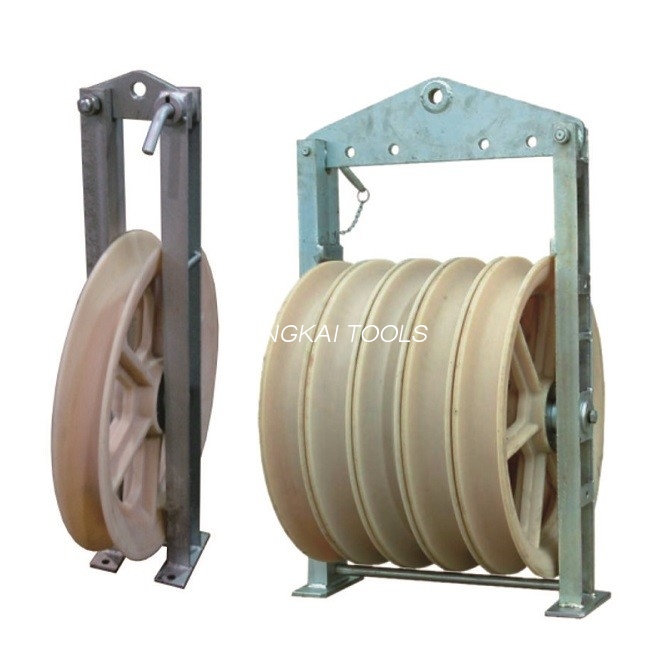
Why Do Conductor Stringing Blocks Matter in Overhead Line Construction?
Overhead transmission and distribution projects require conductors to be installed across long distances, often over uneven terrain, roads, rivers, forests, and developed areas. During installation, the conductor must pass through a series of supports while maintaining controlled tension and avoiding unnecessary contact with structures or the ground. This is where conductor stringing blocks become indispensable.
A conductor stringing block, also called a stringing pulley or conductor pulley, is a specialized tool designed to guide an electrical conductor during overhead line installation. It typically consists of one or more sheaves mounted in a frame, with a support or attachment arrangement that connects the assembly to a tower crossarm, pole, or other approved support point.
Although the equipment may appear simple, its performance directly affects conductor handling, installation quality, and construction efficiency. A suitable block helps maintain the intended conductor path, limits damaging contact, and allows the stringing team to manage the movement of the conductor under controlled tension.
Using an unsuitable block can create several problems:
- Conductor surface damage: Poorly finished sheaves or incompatible grooves can scratch, flatten, or deform the conductor.
- Excessive pulling resistance: Damaged bearings, poor alignment, or unsuitable sheave dimensions can increase friction during stringing.
- Installation delays: Equipment failures and incorrect configurations may require work to stop while components are inspected or replaced.
- Safety risks: Incorrect load ratings, weak attachment points, or poor installation practices can contribute to equipment failure.
- Higher project costs: Conductor repairs, repeated pulling operations, and unplanned downtime can increase total installation expenses.
For contractors, utilities, and equipment procurement teams, the objective is not simply to purchase a pulley. It is to select a stringing system that matches the conductor, route geometry, pulling method, and site conditions.
How Do Conductor Stringing Blocks Work?
During an overhead line installation, a pilot rope or pulling line is guided through the planned route and connected to the conductor or an appropriate pulling arrangement. The pulling system then draws the conductor through the stringing blocks positioned along the line route.
As the conductor moves, each sheave rotates to guide it around the support point. The sheave groove provides a controlled contact surface, while the frame and attachment assembly transfer the resulting loads to the supporting structure. Properly selected blocks help keep the conductor aligned with the intended path and reduce unnecessary resistance.
Key Components of a Stringing Block
- Sheave: The rotating wheel over which the conductor or pulling line passes. Its diameter, groove profile, material, and surface finish affect conductor handling.
- Frame: The structural assembly that supports the sheave and transfers operational loads to the mounting point.
- Bearing or bushing system: Allows the sheave to rotate. The appropriate design depends on the equipment specification, expected loading, operating environment, and maintenance requirements.
- Axle and retaining components: Support the sheave and help keep the rotating assembly properly secured.
- Attachment point: Connects the block to an approved tower, crossarm, pole, or other support arrangement.
- Opening or conductor-release mechanism: Available on some designs to simplify placement or removal of the conductor. Its locking arrangement must be secured before operation.
What Happens During Stringing?
- The installation team checks the route, support structures, equipment ratings, and stringing plan.
- Stringing blocks are installed at the designated support points using approved procedures.
- The pilot rope and pulling line are routed through the blocks according to the project plan.
- The conductor is connected to the pulling system using compatible pulling grips, swivels, or other specified fittings.
- The pulling and tensioning equipment moves the conductor through the route under controlled conditions.
- The team monitors alignment, equipment behavior, conductor condition, and operating loads throughout the pull.
- After the conductor reaches the required position, the crew completes the specified sagging, tensioning, clipping, and inspection procedures.
What Problems Can the Right Stringing Blocks Help Prevent?
1. Conductor Damage During Pulling
Conductors can be expensive, and surface damage may compromise installation quality or require sections to be repaired or replaced. Damage can result from sharp groove edges, contamination, incompatible groove dimensions, excessive bending, or contact with surrounding structures.
Choosing a block with a suitable groove profile and an appropriate sheave diameter helps reduce unnecessary mechanical stress. Before installation, the crew should verify that the sheave is compatible with the conductor type and diameter and that the contact surface is clean and free of defects.
2. Excessive Pulling Tension and Friction
Every support point can contribute resistance to conductor movement. Misalignment, seized bearings, unsuitable sheave dimensions, and incorrect installation can increase pulling forces. Excessive resistance may place additional demands on the pulling equipment and affect conductor handling.
Correct block selection, regular inspection, proper alignment, and coordinated control of pulling and tensioning equipment can help keep the operation within the limits established by the project plan.
3. Difficult Route Geometry
Transmission line routes do not always follow a straight path. Angle towers, elevation changes, and constrained working areas can create more demanding conductor paths. The blocks used at these locations must be suitable for the expected geometry and load conditions.
For significant line angles or other demanding locations, the engineering team should evaluate the resulting loads, the required equipment configuration, and the capacity of both the block and its supporting structure.
4. Unplanned Downtime
Stringing work often depends on coordinated teams, pulling equipment, tensioners, transport arrangements, and access to the worksite. A failed or incompatible block can interrupt the entire operation.
Pre-job inspections, spare-part planning, clear equipment identification, and confirmation of compatibility before mobilization help reduce preventable delays.
5. Uncertain Equipment Compatibility
Not every stringing block is suitable for every conductor or pulling setup. A product may have an appropriate outside diameter but an unsuitable groove profile, insufficient rated capacity, or an attachment arrangement that does not match the intended support.
Procurement teams should assess the complete specification rather than relying on a single dimension or a general product description.
Which Types of Conductor Stringing Blocks Serve Different Applications?
Stringing blocks are available in different configurations to accommodate conductor characteristics, installation methods, and route conditions. Product terminology can vary among manufacturers, so the exact design and intended use should always be confirmed in the technical documentation.
Single-Sheave Stringing Blocks
Single-sheave blocks guide one conductor or pulling line at a support point. They are commonly used where the installation arrangement requires an individual guiding sheave. Selection depends on conductor dimensions, bending requirements, loading, and attachment compatibility.
Multi-Sheave Stringing Blocks
Multi-sheave blocks are designed for configurations involving multiple conductors or specified stringing arrangements. They can help organize conductor paths at a support location, but the arrangement must match the project design. The allowable load and permitted use of each sheave should be checked rather than assumed from the overall appearance of the assembly.
Blocks for Different Conductor Materials
Overhead line projects may use aluminum conductors, aluminum-alloy conductors, steel-reinforced aluminum conductors, or other conductor constructions. Their mechanical characteristics and surface requirements can differ.
Groove dimensions, contact materials, and sheave geometry should therefore be confirmed for the specific conductor. A block suitable for one conductor type should not automatically be considered suitable for another.
Specialized Blocks for Challenging Routes
Some projects require blocks configured for particular tower arrangements, line angles, installation constraints, or specialized pulling methods. These applications may require additional engineering review, customized attachment arrangements, or specific capacity documentation.
| Block Configuration | Typical Application | Key Selection Consideration |
|---|---|---|
| Single-sheave block | Individual conductor or pulling-line guidance | Conductor compatibility, groove profile, and rated capacity |
| Multi-sheave block | Specified multi-conductor or multi-line arrangements | Configuration, individual sheave suitability, and load distribution |
| Large-diameter sheave block | Applications requiring a larger conductor bending radius | Required sheave diameter, route geometry, and clearance |
| Specialized angle or support block | Selected tower positions or demanding route conditions | Resulting forces, attachment design, and structural capacity |
| Blocks for specialized conductors | Projects using conductors with particular surface or dimensional requirements | Manufacturer-confirmed groove and contact compatibility |
How Can You Choose the Right Conductor Stringing Blocks?
The best choice starts with the project specification, not simply the purchase price. A block that is easy to transport but unsuitable for the conductor or working load can create far greater costs during installation.
1. Confirm the Conductor Type and Diameter
Start with the exact conductor designation, nominal diameter, construction, and any relevant manufacturer handling requirements. Confirm that the sheave groove accommodates the conductor correctly and provides an appropriate contact surface.
Do not select a block based only on a rough visual comparison. Ask the supplier for dimensional information and confirmation of intended compatibility.
2. Check the Sheave Diameter and Groove Profile
Sheave diameter influences the bending imposed on the conductor as it passes through the block. A larger sheave may be required where conductor handling requirements call for a larger bending radius. However, the correct diameter depends on conductor construction, manufacturer recommendations, route geometry, and the applicable project specification.
The groove must also suit the conductor and avoid sharp edges, damaging surface conditions, or unsuitable contact geometry.
3. Verify Rated Capacity
Understand the difference between working load limits, rated loads, breaking loads, and other capacity terms used in product documentation. They are not interchangeable.
Review the rated capacity of the complete block assembly and the relevant operating conditions. Consider expected loads at each support, line angles, dynamic effects, and the capacity of the attachment point and supporting structure. The system's permitted capacity is limited by its applicable weakest component and governing engineering requirements.
4. Evaluate Materials and Surface Finish
Sheaves and frames may be manufactured from different metals, alloys, or engineered materials depending on the application. The material must provide the necessary strength, wear resistance, environmental suitability, and conductor-contact characteristics.
Look for consistent machining, smooth groove surfaces, sound joints, secure fasteners, and a finish appropriate for the working environment. Where corrosion exposure is significant, ask about material protection and inspection requirements.
5. Consider Bearing Performance
Sheaves must rotate reliably under the expected operating conditions. Bearing design affects rotation, resistance, maintenance, and service life. Outdoor construction may expose the assembly to dust, moisture, mud, and temperature changes.
Confirm the manufacturer's lubrication instructions, bearing protection features, maintenance intervals, and available replacement components.
6. Match the Attachment Design to the Support Structure
The mounting arrangement must be compatible with the intended tower, crossarm, pole, or support fixture. Check clearances, connection dimensions, locking arrangements, and installation procedures before bringing the equipment to the site.
7. Assess Transport and Handling Requirements
Equipment weight, dimensions, lifting points, and storage needs affect transport and site logistics. For remote projects, ease of handling and the availability of service components can be important practical considerations.
8. Review Documentation and Supplier Support
Ask for product drawings, rated-capacity information, materials specifications, inspection instructions, and applicable conformity documents. Where the application is unusual, provide the supplier with sufficient project information for a meaningful technical review.
What Technical Specifications Should Buyers Compare?
A clear specification helps prevent misunderstandings between the project team, purchasing department, and manufacturer. It also makes it easier to compare products on a consistent basis.
| Specification | What to Confirm | Why It Matters |
|---|---|---|
| Applicable conductor | Type, construction, diameter, and handling requirements | Ensures suitable conductor contact and guidance |
| Sheave diameter | Specified diameter and dimensional reference | Supports appropriate bending and route clearance |
| Groove dimensions | Profile, width, radius, and surface finish | Helps reduce incompatible contact and conductor damage |
| Rated capacity | Documented capacity and applicable operating conditions | Supports safe equipment and system design |
| Materials | Sheave, frame, axle, and protective finish | Influences strength, durability, and environmental suitability |
| Bearing arrangement | Bearing type, protection, and service requirements | Affects rotation and maintenance planning |
| Attachment | Connection dimensions, retention, and mounting requirements | Helps confirm compatibility with the support structure |
| Inspection and service | Inspection criteria, lubrication, and replacement parts | Supports dependable operation throughout the equipment's service life |
There is no single set of dimensions or capacity values suitable for every conductor stringing block. The correct specifications depend on the project design, conductor, installation method, and applicable standards. Buyers should request the actual product data sheet and verify that all critical values meet the project requirements.
How Should Conductor Stringing Blocks Be Installed and Operated Safely?
Correct equipment selection is only one part of reliable stringing work. Safe performance also depends on the installation plan, competent personnel, approved procedures, and consistent monitoring.
Before Installation
- Confirm that the block model, configuration, and rated capacity match the approved stringing plan.
- Inspect the sheave, groove, frame, bearings, axle, retaining devices, and attachment components.
- Check for cracks, deformation, corrosion that may affect integrity, abnormal wear, and other visible damage.
- Verify that the supporting structure and attachment arrangement are suitable for the anticipated loads.
- Confirm that the route geometry, clearances, and worksite controls have been assessed.
- Check that the pulling rope, conductor grips, swivels, and related accessories are compatible with the planned operation.
During Stringing
- Follow the approved pulling and tensioning procedure and the equipment manufacturer's instructions.
- Monitor conductor movement and investigate unusual resistance, vibration, noise, or sheave behavior.
- Maintain communication among the pulling equipment operator, tensioner operator, and field crew.
- Keep personnel away from hazardous areas around tensioned lines, moving equipment, and suspended loads.
- Stop the operation if equipment damage, misalignment, unexpected loading, or an unsafe condition is identified.
- Use suitable controls to prevent the conductor from contacting obstacles or surfaces that could cause damage.
After Stringing
Once the operation is complete and the equipment has been safely unloaded, inspect the blocks for wear, deformation, contamination, and other changes that may affect future use. Record defects and remove questionable equipment from service until it has been assessed by qualified personnel.
How Can Regular Maintenance Extend Stringing Block Service Life?
Stringing blocks are exposed to mechanical loading and often work in outdoor environments. A structured maintenance program helps identify defects early, supports consistent performance, and reduces the likelihood of avoidable interruptions.
Clean the Equipment After Use
Remove dirt, mud, and other contamination using methods appropriate for the materials and components. Contamination in the groove can affect conductor contact, while debris around moving parts may interfere with rotation. Avoid cleaning methods that damage protective finishes or introduce contaminants into sealed components.
Inspect Sheaves and Grooves
Check for abnormal wear, scoring, sharp edges, cracks, deformation, and other surface damage. A damaged groove can compromise conductor handling even when the frame appears to be in good condition. Any repair or re-machining should follow the manufacturer's approved procedures.
Check Rotation and Bearings
Rotate the sheave according to the manufacturer's inspection procedure and check for binding, excessive play, unusual noise, or rough movement. Lubricate only where required and with the specified lubricant. Sealed bearings and other specialized assemblies may have different service requirements.
Examine the Frame and Connections
Look for cracks, bent sections, loose fasteners, damaged threads, corrosion, and worn attachment points. Confirm that locking components function correctly and that no unauthorized modifications have been made.
Keep Maintenance Records
Document inspection dates, operating history where available, identified defects, repairs, and the final decision about serviceability. Consistent records help supervisors identify recurring problems and plan replacement before equipment condition becomes unacceptable.
| Inspection Area | Warning Signs | Recommended Response |
|---|---|---|
| Sheave groove | Sharp edges, deep scoring, abnormal wear | Stop use and obtain an assessment against manufacturer criteria |
| Bearing and axle | Binding, unusual noise, excessive play | Remove from service pending inspection and approved maintenance |
| Frame | Cracks, bending, damaged joints | Quarantine and arrange a qualified evaluation |
| Attachment and locks | Loose or missing parts, unreliable locking | Do not operate until the defect is corrected and verified |
| Surface protection | Coating damage or corrosion affecting integrity | Assess severity and follow the manufacturer's repair guidance |
Inspection frequency should reflect the manufacturer's instructions, applicable regulations, usage intensity, environmental exposure, and project risk assessment. Any equipment suspected of structural damage or overload should be evaluated before returning to service.
Which Common Mistakes Should Buyers and Contractors Avoid?
Choosing by Price Alone
A lower initial purchase price does not necessarily mean a lower total project cost. Equipment that does not match the conductor, has inadequate documentation, or requires frequent maintenance may lead to expensive downtime. Compare specifications, serviceability, supplier support, and suitability for the actual application.
Assuming All Sheaves Are Interchangeable
Similar-looking blocks may differ in groove profile, diameter, bearing construction, capacity, and mounting design. Verify the model and its documented compatibility before use, especially when replacing equipment from another supplier.
Ignoring the Complete Load Path
The block is only one part of the load-bearing arrangement. The attachment, mounting hardware, crossarm, tower component, and supporting structure must also be suitable for the anticipated forces. A high-capacity block cannot compensate for an inadequate support.
Skipping Pre-Job Inspection
Equipment may be damaged during transport, storage, previous use, or handling. A short inspection before deployment can identify defects that would otherwise remain unnoticed until the stringing operation begins.
Failing to Communicate Technical Requirements
Requests such as “standard stringing pulley” may not provide enough information for accurate product matching. Include conductor specifications, required dimensions, capacity, operating environment, quantity, and mounting details when requesting a quotation.
How Can Lingkai Support Your Conductor Stringing Equipment Requirements?
Choosing stringing equipment involves more than identifying a product category. Buyers need to establish compatibility with the intended conductor, confirm technical parameters, and understand the conditions under which the equipment will be used.
Lingkai provides a starting point for exploring conductor stringing tools and related equipment for overhead line installation projects. When evaluating products for a specific application, project teams should focus on the documented product configuration, relevant capacity information, dimensional compatibility, and the manufacturer's handling and maintenance guidance.
To help clarify requirements before ordering, prepare the following information:
- Conductor type, designation, and nominal diameter.
- Required block configuration and intended application.
- Required sheave diameter and groove dimensions, where specified.
- Expected operating loads and the applicable project requirements.
- Support structure and attachment details.
- Operating environment, including weather and exposure conditions.
- Required quantity, delivery destination, and project schedule.
- Documentation, inspection, packaging, or other purchasing requirements.
Providing this information makes it easier to review whether a proposed configuration fits the application and to identify technical questions before equipment is dispatched. Buyers should request current drawings and product specifications for confirmation rather than relying on assumptions based on general product descriptions.
Frequently Asked Questions About Conductor Stringing Blocks
1. What are conductor stringing blocks used for?
Conductor stringing blocks guide overhead electrical conductors along a planned route during installation. They support controlled conductor movement at poles, towers, and other designated points while helping reduce damaging contact and unnecessary friction.
2. Are conductor stringing blocks and stringing pulleys the same thing?
The terms are often used interchangeably for equipment that guides conductors during overhead line installation. However, product configurations vary. Confirm the exact design, intended application, and specifications with the manufacturer.
3. How do I determine the correct sheave diameter?
Consider the conductor construction, nominal diameter, minimum bending requirements, route geometry, and project specification. Follow conductor and equipment manufacturer guidance and have the selection reviewed by the responsible engineering team when required.
4. How do I know whether a stringing block has sufficient capacity?
Compare the documented rated capacity with the expected loads and operating conditions in the approved stringing plan. Confirm the applicable capacity definition and check the entire load path, including attachments and supporting structures. Do not substitute breaking load for a permitted working load.
5. Can one stringing block be used for different conductor sizes?
Some blocks may accommodate a specified range of conductor sizes, while others are designed for a narrower application. The groove profile, sheave diameter, contact surface, and rated capacity must be suitable for each intended conductor. Obtain explicit compatibility confirmation before changing applications.
6. What causes a sheave to rotate poorly?
Possible causes include bearing wear, contamination, inadequate or incorrect lubrication where lubrication is required, corrosion, axle problems, or deformation. Stop using equipment that exhibits abnormal rotation and follow the manufacturer's inspection and repair procedures.
7. How often should conductor stringing blocks be inspected?
Inspect them before use and at the intervals required by the manufacturer, applicable rules, and project risk assessment. Additional inspections may be needed after abnormal loading, impact, suspected damage, or exposure to severe environmental conditions.
8. What information should I send when requesting a quotation?
Provide the conductor type and diameter, required block configuration, sheave dimensions, capacity requirements, attachment details, operating environment, quantity, delivery location, and project schedule. Include drawings or a technical specification when available.
9. Can customized conductor stringing blocks be requested?
Some suppliers may offer customized configurations or application-specific solutions. Feasibility depends on the intended use, engineering requirements, manufacturing capabilities, and validation of the proposed design. Provide complete technical information and obtain written confirmation of the final specification.
10. Why is supplier documentation important?
Product drawings, rated-capacity data, material specifications, and maintenance instructions help buyers verify compatibility and support safe equipment management. Documentation also reduces ambiguity when comparing products or coordinating requirements across procurement, engineering, and field teams.
Build a More Reliable Overhead Line Installation Process
Conductor stringing blocks play an important role in overhead power line construction. Their design and condition influence conductor handling, pulling resistance, installation efficiency, and jobsite safety. The right equipment must match the conductor, route geometry, expected loads, attachment arrangement, and operating environment.
Before purchasing, verify the sheave diameter and groove profile, review rated-capacity documentation, assess materials and bearing performance, and confirm that the complete supporting arrangement is suitable for the intended operation. During use, follow approved procedures and monitor equipment behavior. Afterward, inspect and maintain each block according to the manufacturer's requirements.
For contractors, utilities, distributors, and procurement teams, a clear technical specification is the foundation of a dependable purchase. Working with an equipment supplier that can provide relevant product information helps reduce uncertainty and supports better planning from quotation through field deployment.
Looking for Conductor Stringing Blocks for Your Next Project?
Finding the right stringing equipment starts with understanding your conductor specifications, installation conditions, and technical requirements. Explore the equipment available from Lingkai and prepare your project details for a more focused product evaluation.
Whether you are planning a new overhead transmission line, upgrading distribution infrastructure, or sourcing equipment for a stringing crew, the right technical information can help you make a confident decision. Visit the Lingkai website to learn more and contact us to discuss your conductor stringing equipment requirements.
Explore Lingkai Equipment