
How Do I Choose Submersible Mixing and Flow Propeller Equipment That Actually Solves My Plant’s Problems?
2025-11-26
I manage tanks that never behave on paper, so I look for gear that performs in the real world. When I first evaluated options with Fred, I focused on how Submersible Mixing and Flow Propeller Equipment helps me stop settling, keep solids in motion, and avoid dead zones across wastewater and industrial basins. In this guide I’m sharing the way I think through selection, so you can match the right drive, impeller, and mount to your process without guesswork—while keeping energy and maintenance under control.
What problems am I really trying to fix before I buy?
- Sediment build-up that steals volume and triggers emergency cleanouts
- Stratification and odor spikes after weekends or load swings
- Short-circuiting that leaves corners untouched and chemistry uneven
- Over-shear that breaks floc or keeps sludge too “thin” to settle
- Safety risks when maintenance requires draining or confined-space work
Once I map those pain points to tank geometry and process goals, the role of Submersible Mixing and Flow Propeller Equipment becomes obvious—fast, focused mixing where reactions need it, and broad, gentle circulation where I only want motion and scum control.
How do I size and select without wasting budget?
I start with media, volume, and process intent. Then I translate that into impeller style, speed class, materials, and a mount my crew will actually use. Here’s the short version I keep on my desk:
| Selection factor | What I check on site | Practical choice I lean toward | Why it matters |
|---|---|---|---|
| Media & chemistry | pH swings, salts, fibers, grit | Open or anti-clog impeller; 304/316L wetted parts | Resists fouling and corrosion so uptime stays predictable |
| Tank geometry | Length × width × depth, baffles, corners | Angle-adjustable bracket with correct submergence | Prevents blind spots and short-circuiting |
| Process goal | Rapid reaction vs gentle circulation | High-speed mix for reactions; low-speed propeller for flow push | Delivers shear or bulk flow exactly where needed |
| Energy strategy | Load profile and tariffs | VFD-ready drive run near curve sweet spot | Keeps kWh per m³ under control year-round |
| Maintenance access | Hoist points, clearance, lift path | Guide-rail auto-coupling for fast retrieval | No drain downs, safer pulls, quicker turnarounds |
When I follow this checklist, the right Submersible Mixing and Flow Propeller Equipment spec tends to reveal itself and quotes come back apples-to-apples instead of mystery bundles.
Where does a mixer end and a flow propeller begin?
- High-speed submersible mixer — compact diameter at higher rpm, higher shear, ideal for reaction tanks, polymer dispersion, and sludge conditioning
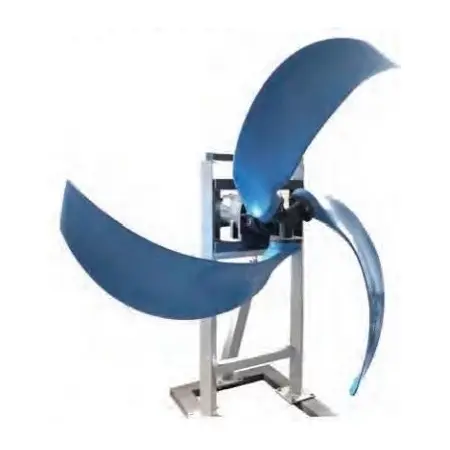
- Low-speed flow propeller — large-diameter blades at low rpm, big circulating volumes for oxidation ditches, lagoons, or channels
I treat them as complementary tools: concentrated energy to blend or disperse, paired with wide-area flow to keep everything moving. That’s why I often specify a “mix then push” layout with properly staggered units of Submersible Mixing and Flow Propeller Equipment.
Which features actually protect uptime and power bills?
- Impeller geometry that resists rags and fibers so efficiency doesn’t decay between cleanings
- Materials matched to chemistry—304 for general duty, 316L or composites where corrosion bites
- Mechanical seal architecture with oil-chamber monitoring and robust submersible motors
- VFD-friendly drives to ride out load swings without over-mixing
- Angle-adjustable mounting so I can tune flow paths after startup
On recent projects I’ve leaned on these details to keep Submersible Mixing and Flow Propeller Equipment stable over multi-year duty cycles, especially in municipal and industrial wastewater where conditions shift.
How do I install and maintain with minimal downtime?
- Guide-rail auto-coupling when I need fast retrieval for routine service without draining
- Fixed hard-mount for small tanks or tough environments where simplicity wins
- Cantilever or beam mounts for deep or irregular basins where angle control matters
Choosing the mount is half the battle; it decides whether your team loves or hates the asset. When I pair the right mount with Submersible Mixing and Flow Propeller Equipment, every reinstall is repeatable and safe.
What performance outcomes should I expect after commissioning?
- Uniform solids distribution that stabilizes clarifiers and dewatering
- Fewer odor events thanks to steady, gentle circulation along walls and corners
- Lower energy per treated volume as flow paths get tuned to the tank instead of fighting it
- Safer maintenance because retrieval is predictable and dry-work friendly
These are the wins I measure when dialing in Submersible Mixing and Flow Propeller Equipment during the first weeks of operation.
How do I future-proof the choice I make today?
- Confirm the mechanical envelope accepts blade swaps or pitch changes
- Use standard, stocked seals and bearings for quick turnaround
- Keep a VFD in play even if you start fixed speed—processes change
- Log baseline amps, vibration, and temperature so trending tells the truth
With those basics in place, I get more life and fewer surprises from my Submersible Mixing and Flow Propeller Equipment.
Am I ready to specify the right package now?
If you’re mapping a new build or fixing a chronic mixing problem, share your tank drawings, media details, and process targets and I’ll help you match the right Submersible Mixing and Flow Propeller Equipment configuration. For a fast quote or a deeper review, contact us today and tell us your deadlines, constraints, and preferred standards—we’ll respond with a practical layout, an energy snapshot, and a clear path to commissioning using the most suitable Submersible Mixing and Flow Propeller Equipment for your plant.