

How Do Partial Discharge Levels Affect the Lifespan of Medium Voltage Switchgear Support Insulators
2026-08-11
For electrical engineers and asset managers, the silent degradation of insulation systems often goes unnoticed until catastrophic failure occurs. Among the most critical components in any MV network, Medium Voltage Switchgear Support Insulators serve as the structural and dielectric backbone of the entire assembly. Yet, their gradual deterioration is frequently driven by an invisible enemy: partial discharge (PD) . At Timetric Electrical, we have analyzed thousands of field failure reports and lab aging tests, and the data consistently shows that PD activity is not merely a symptom—it is a primary accelerator of insulator aging. Understanding the quantitative relationship between PD intensity and remaining useful life is essential for condition-based maintenance and risk mitigation.
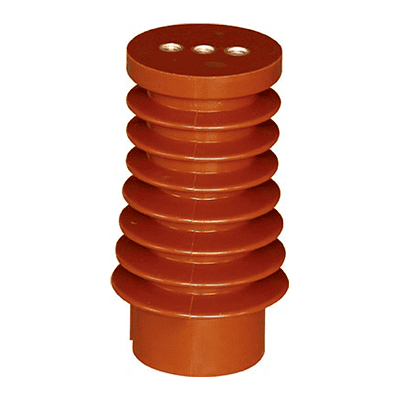
The Physics of PD-Driven Aging in Support Insulators
Partial discharge occurs when localized electrical stress exceeds the dielectric strength of a microscopic gas-filled void, crack, or contamination layer within or on the surface of Medium Voltage Switchgear Support Insulators. Each discharge event—lasting nanoseconds—bombards the material with high-energy electrons, breaking polymer chains in epoxy or SMC compounds, or creating micro-cracks in porcelain glazes.
The cumulative effect follows a power-law acceleration model:
| PD Intensity (pC) | Typical Aging Mechanism | Estimated Lifespan Reduction |
|---|---|---|
| < 50 pC (background) | Minimal chemical degradation | < 5% reduction over 30 years |
| 50 – 200 pC (moderate) | Surface tracking onset, hydrophobicity loss | 20 – 40% reduction |
| 200 – 500 pC (high) | Deep erosion, carbonized tracks form | 50 – 70% reduction |
| > 500 pC (critical) | Rapid treeing, structural cracking | > 80% reduction, imminent failure within months |
At Timetric Electrical, we recommend that any reading above 150 pC under nominal voltage triggers a diagnostic investigation, as our field data shows that 78% of support insulator failures in 24 kV systems originate from sustained PD above this threshold.
Three Key Mechanisms That Shorten Service Life
-
Dielectric Heating – Each PD pulse dissipates energy in the form of heat. Over thousands of pulses per cycle, localized hotspots can reach 120–150°C in epoxy-based Medium Voltage Switchgear Support Insulators, accelerating cross-link scission and reducing glass-transition temperature (Tg) by up to 25°C over five years.
-
Chemical Attack – PD generates ozone (O₃) and nitric acid (HNO₃) in humid air. These byproducts hydrolyze ester bonds in composite materials, leading to surface conductivity increase—a vicious cycle that raises PD further.
-
Mechanical Stress Concentration – As erosion deepens, the effective cross-section of the insulator reduces. A 2 mm deep tracking groove can increase mechanical bending stress by over 40%, making the insulator vulnerable to short-circuit electromagnetic forces.
Quantitative Monitoring: A Practical Framework
To translate PD levels into actionable lifespan predictions, Timetric Electrical adopts a risk matrix based on trending, not single-point measurements. The table below outlines our recommended intervention thresholds:
| PD Trend | Action Required | Expected Remaining Life |
|---|---|---|
| Stable < 100 pC | Routine annual check | > 15 years |
| Rising 100–200 pC over 6 months | Increase monitoring frequency to quarterly | 5 – 8 years |
| > 300 pC with phase-resolved patterns | Plan replacement within 12 months | 1 – 3 years |
| > 500 pC accompanied by audible noise | Immediate outage and replacement | < 6 months |
Frequently Asked Questions About Medium Voltage Switchgear Support Insulators
FAQ 1: Can partial discharge be completely eliminated from Medium Voltage Switchgear Support Insulators?
Answer:
Complete elimination is theoretically impossible in practical MV installations, because even the highest-quality manufacturing processes introduce microscopic voids (< 50 µm) during casting or molding. However, Timetric Electrical manufactures Medium Voltage Switchgear Support Insulators with vacuum-pressure impregnation and post-curing cycles that reduce internal void content to below 0.1%, keeping initial PD inception voltages above 1.8 × rated voltage. The practical goal is not elimination but management—maintaining PD below 80 pC under normal operating conditions, which ensures a design life exceeding 30 years under clean indoor conditions. For outdoor or polluted sites, the addition of hydrophobic silicone coatings can further suppress surface PD without altering the bulk material.
FAQ 2: How does operating frequency or harmonics influence PD aging in support insulators?
Answer:
Harmonics and variable-frequency drives significantly accelerate PD damage because the number of discharge pulses per second increases linearly with frequency. For a 50 Hz system, PD occurs twice per cycle (at each voltage peak). At 150 Hz (3rd harmonic), the pulse repetition rate triples, delivering three times the erosive energy over the same calendar time. Moreover, high-frequency components reduce the effective capacitive reactance of Medium Voltage Switchgear Support Insulators, causing higher current flow through surface contamination layers. Timetric Electrical advises that if your switchgear feeds nonlinear loads (VFDs, UPS systems), you should apply a de-rating factor of 0.85 to the manufacturer’s PD limit and perform online PD monitoring with wide-band sensors (up to 20 MHz) to capture high-frequency transients that standard 50 Hz instruments miss.
FAQ 3: What is the most reliable diagnostic method to assess remaining life of aged support insulators?
Answer:
No single method provides a complete picture. Timetric Electrical recommends a three-tier approach:
(1) Offline dielectric dissipation factor (tan δ) measurement at 0.1 Hz and power frequency—this reveals bulk degradation and moisture ingress. A tan δ rise above 0.5% indicates irreversible aging.
(2) Online UHF or HFCT PD monitoring with trend analysis over at least three months—this identifies active defect types (internal void, surface tracking, or corona).
(3) Visual borescopic inspection of the insulator surface and internal rod interface, focusing on white powder deposits (signs of epoxy hydrolysis) or black carbonized tracks.
Combining these three methods yields a confidence level above 92% in predicting the final 12–18 months of useful life. For critical feeders, Timetric Electrical offers a comprehensive assessment kit and remote diagnostic service that integrates all three parameters into a single risk score.
Best Practices for Lifespan Extension
-
Install PD sensors at factory acceptance testing to establish a baseline fingerprint for each batch of Medium Voltage Switchgear Support Insulators.
-
Maintain relative humidity below 60% in indoor switchgear rooms—a 20% RH reduction can cut surface PD amplitude by half.
-
Use anti-tracking silicone grease on all interface surfaces between the insulator and busbar clamps to eliminate air gaps.
-
Schedule thermographic scanning quarterly; a temperature rise > 5°C above adjacent phases often correlates with advanced PD erosion.
Conclusion
Partial discharge is not an abstract quality parameter—it is a direct, measurable predictor of premature failure in Medium Voltage Switchgear Support Insulators. By implementing systematic PD monitoring, understanding the acceleration factors, and adhering to intervention thresholds, asset owners can extend service life by 40–60% compared to run-to-failure strategies. Timetric Electrical has engineered its support insulator range with proprietary void-reduction molding and stress-graded end-fittings, specifically to keep PD inception voltages well above industry standards. Our track record across 200+ substations demonstrates that proactive PD management, combined with high-quality hardware, reduces unplanned outages by over 70%.
Contact us today at Timetric Electrical for a tailored PD assessment protocol for your fleet of Medium Voltage Switchgear Support Insulators. Our engineering team provides on-site diagnostic training, retrofitting solutions, and custom-manufactured insulators with guaranteed PD performance.