

How Do You Pick the Right Solar PV Fuse in 5 Steps?
2026-10-10
Choosing a Solar Power Protection PV Fuse is not a matter of finding the closest match in a catalog. The fuse must carry the string current every day without nuisance opening, interrupt a fault before the inverter's semiconductors are destroyed, and endure decades of thermal cycling inside a combiner box. A fuse that looks acceptable on a specification sheet may fail in the field. This guide walks through the five decisions that matter, in the order a designer should make them: voltage class first, current rating second, temperature derating third, I2t coordination fourth, and physical compatibility fifth.
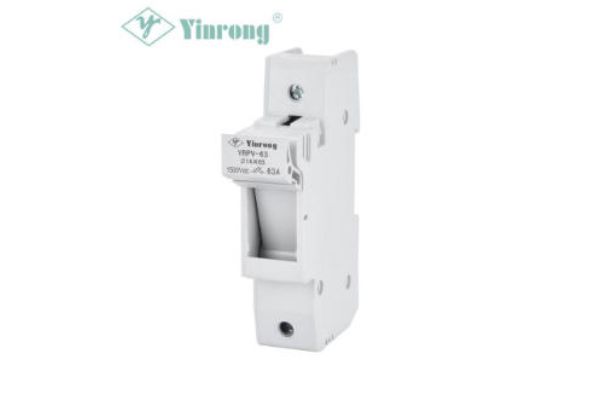
1. Why Must the DC Voltage Rating Be Confirmed Before Anything Else?
The voltage rating is the first decision because it determines whether the fuse can extinguish the arc at all. In an AC circuit, the current crosses zero twice per cycle, which helps the arc go out naturally. In a DC circuit, there is no zero crossing. The arc must be stretched, cooled, and quenched by the fuse's internal design. If the fuse's DC voltage rating is lower than the system voltage, the arc may not extinguish. The fuse can weld shut, vent, or rupture.
The correct reference point is the maximum open-circuit voltage of the string at the coldest expected ambient temperature. This is not the nominal voltage at standard test conditions. Cold temperatures raise the open-circuit voltage of the modules, and this elevated voltage is what the fuse must be able to interrupt. Our factory designs Solar Power Protection PV Fuse links for 1000V DC, 1500V DC, and 2000V DC systems, all tested to the gPV requirements of IEC 60269-6.
Judgment rule: If the maximum system Voc is 1000V DC or below, a 1000V DC fuse is appropriate. If the maximum system Voc exceeds 1000V DC and can reach 1500V DC, a fuse explicitly rated for 1500V DC is required. An AC-rated fuse must never be substituted into a DC circuit.
2. How Is the Current Rating Calculated Without Exceeding Module Limits?
The current rating must be high enough to carry the string's continuous current without nuisance opening, but low enough to protect the module. The industry practice for a Solar Power Protection PV Fuse is to multiply the module's short-circuit current by 1.56 and round up to the next standard rating. This factor combines 1.25 for continuous duty and 1.25 for irradiance enhancement. IEC 62548 uses a comparable approach, though the exact multiplier can differ by region and project specification.
The critical constraint is the module manufacturer's maximum series fuse rating. If the calculated value exceeds that limit, the string configuration or the module selection must be reviewed. Standard gPV ratings in common use include 10 A, 15 A, 20 A, 25 A, and 30 A. For commercial strings, the typical range is 10 A to 30 A. Zhejiang Galaxy Fuse Co., Ltd. produces Solar Power Protection PV Fuse links across this range with verified melting and clearing characteristics.
3. Why Does Temperature Derating Change the Effective Rating?
The 1.56 multiplier assumes a reference ambient temperature. Inside a combiner box, the air temperature can rise far above the outdoor temperature. As ambient temperature increases, the fuse's current-carrying capacity decreases. The effect is not linear, and the derating curve becomes steeper above 30°C. The table below shows typical derating factors for gPV fuses.
| Combiner box internal temperature | Derating factor applied to fuse rating | Example: 20 A fuse effective rating |
| 35°C | 1.00 | 20.0 A |
| 40°C | 0.95 | 19.0 A |
| 50°C | 0.85 | 17.0 A |
| 60°C | 0.75 | 15.0 A |
| 65°C | 0.70 | 14.0 A |
The derated rating must still be greater than or equal to the string's continuous current. If a 20 A fuse in a 50°C box has an effective rating of 17 A, and the string continuous current is 16 A, the fuse is undersized. A higher rating or a different thermal design for the combiner box is required. The fuse holder's thermal performance and the box's ventilation directly affect this calculation. Our factory provides derating curves for each Solar Power Protection PV Fuse family so designers can confirm the effective rating at the expected box temperature.
4. How Is I2t Coordination Verified With the Inverter?
This step is often skipped, and it is the one most directly responsible for inverter damage rather than a blown fuse. Every inverter's semiconductor stage has a rated I2t withstand, which is the maximum thermal energy it can absorb during a fault before permanent damage occurs. The fuse's total I2t, which is the melting I2t plus the arcing I2t, must be lower than the semiconductor's withstand rating.
The verification process requires three pieces of data. First, obtain the inverter manufacturer's I2t withstand curve for the relevant DC input stage. Second, obtain the fuse's I2t data at the system's prospective fault current. Third, confirm that the fuse's total clearing I2t is below the semiconductor's withstand I2t across the expected fault current range. If the margin is thin, a fuse with lower total I2t or a different fuse class should be considered. Zhejiang Galaxy Fuse Co., Ltd. provides I2t data for our Solar Power Protection PV Fuse links at multiple fault current levels.
5. What Physical Compatibility Checks Are Required With the Fuse Holder?
The fuse link and the fuse holder form a system. A link from one manufacturer may not fit or perform correctly in a holder from another, even when the nominal dimensions appear to match. The table below lists the compatibility checks that matter.
| Compatibility check | What to verify | Consequence of mismatch |
| Physical fit | Body diameter and length match holder design | Link will not seat or makes poor contact |
| Contact geometry | End caps or blade contacts align with holder contacts | Increased contact resistance, hot spots |
| Voltage and current rating | Holder rating meets or exceeds link rating | Holder may fail before fuse operates |
| Thermal performance | Holder rated for continuous current at box temperature | Overheating, nuisance opening |
| Standards compliance | Both certified to IEC 60269-6 for gPV applications | Unverified performance, code non-compliance |
Using a mismatched link and holder can raise contact resistance, increase temperature rise, and cause unreliable operation. It is recommended to use a matched combination that has been tested as a system. Our factory offers matched Solar Power Protection PV Fuse links and holders for 1000V DC and 1500V DC systems.
Frequently Asked Questions About Solar PV Fuse Selection
Final Summary and Direct Call to Action
Selecting a Solar Power Protection PV Fuse follows a fixed sequence: voltage class, current rating, temperature derating, I2t coordination, and physical compatibility. Skipping any step creates a risk that may not appear until a fault occurs. The most common errors are sizing to continuous current without checking the DC voltage class, neglecting the temperature rise inside the combiner box, and overlooking I2t coordination with the inverter's semiconductors. Our factory designs and manufactures Solar Power Protection PV Fuse links and matched holders for 1000V DC, 1500V DC, and 2000V DC systems.
Zhejiang Galaxy Fuse Co., Ltd. produces gPV fuse links and holders tested to IEC 60269-6. We provide derating curves, I2t data, and compatibility documentation for every product family.