

How Does a Solar Automatic Transfer Switch Improve Power Continuity?
2026-09-20
As solar energy systems become more widely used in residential, commercial, industrial, and mobile applications, stable power switching has become increasingly important. A Solar Automatic Transfer Switch helps manage the transition between different power sources, such as the utility grid, solar inverter, battery system, or generator. When the normal source becomes unavailable or falls outside the required electrical range, the ATS can automatically transfer the connected load to an available backup source.
For customers looking for reliable power-management equipment, Wenzhou Naka Technology New Energy Co., Ltd. focuses on practical and customizable new-energy electrical solutions. Its Solar Automatic Transfer Switch solutions can be developed around different system structures, installation environments, and load requirements, including support for customized boat-type designs for specialized applications.
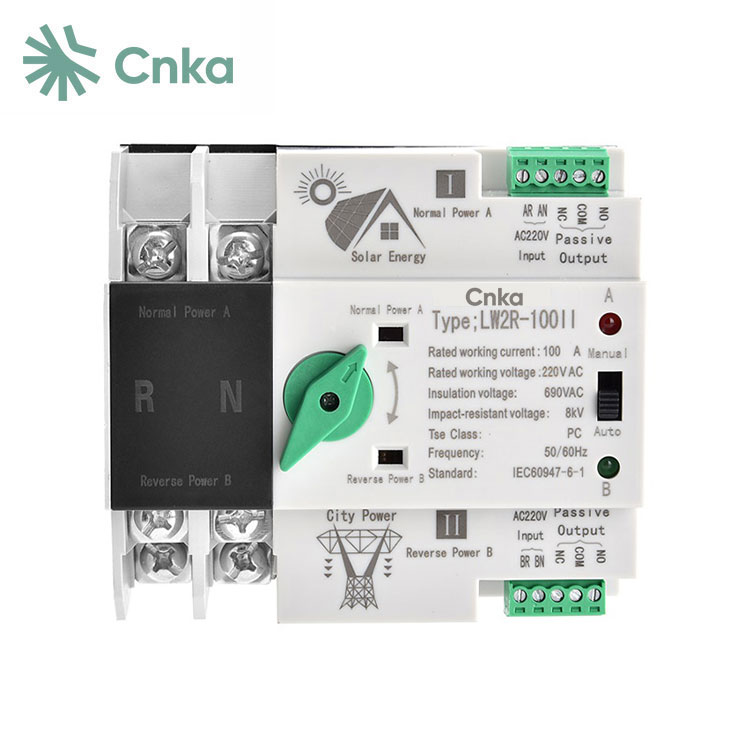
What Is a Solar Automatic Transfer Switch?
A Solar Automatic Transfer Switch is an automatic power-switching device used to transfer electrical loads between two or more available power sources. In a typical solar application, the sources may include:
- Utility grid power
- Solar inverter output
- Battery backup
- Generator power
- Shore power for marine or mobile applications
The ATS continuously monitors the electrical condition of the connected sources. If the primary source fails or becomes unsuitable, the system can transfer the load to the alternative source according to its control logic. When the preferred source returns to a stable condition, the system can automatically transfer back.
This makes an automatic transfer switch different from a conventional manual changeover switch. Instead of requiring an operator to physically change the power source, the transfer process is controlled automatically.
How Does Solar Automatic Transfer Switching Work?
The working principle is relatively straightforward but requires accurate electrical design.
1. Source monitoring
The ATS monitors parameters such as voltage and frequency of the available power sources.
2. Power-source detection
When the normal source becomes unavailable or falls outside the configured operating range, the controller identifies the abnormal condition.
3. Automatic transfer
The switch disconnects the load from the unavailable source and connects it to the alternative qualified source.
4. Stable power supply
The load continues operating from the available backup source, such as a solar inverter, battery system, generator, or another AC source.
5. Automatic retransfer
Once the preferred power source has returned to an acceptable condition, the ATS can transfer the load back automatically.
A key point is that an ATS itself does not generate or store electricity. Its primary role is power-source management and load transfer. The actual backup energy must come from equipment such as batteries, solar inverters, generators, or another power source.
Why Is a Solar Automatic Transfer Switch Important?
1. Improve Power Continuity
For equipment that cannot tolerate frequent interruptions, automatic source transfer can reduce the impact of utility failures or unstable power conditions. This is particularly useful for communication equipment, monitoring systems, industrial controls, refrigeration, emergency equipment, and other essential loads.
2. Reduce Manual Operation
A manual changeover requires someone to identify the power failure and operate the switch. A Solar Automatic Transfer Switch can perform the transfer automatically according to its control settings, making the system more convenient for users.
3. Coordinate Solar and Backup Power
Solar systems may combine photovoltaic generation, batteries, grid power, and generators. An ATS provides an important interface for managing these AC power sources and determining which qualified source supplies the load.
4. Support System Safety
Properly designed transfer equipment helps maintain separation between power sources and reduces the risk of undesirable source interaction or backfeeding. However, ATS equipment must be correctly matched with circuit breakers, grounding arrangements, inverter specifications, and local electrical requirements.
Solar Automatic Transfer Switch vs. Manual Changeover Switch
| Feature | Solar Automatic Transfer Switch | Manual Changeover Switch |
|---|---|---|
| Switching method | Automatic | Manual |
| Operator required | Normally no | Yes |
| Backup power management | Automatic | User controlled |
| Response to power failure | Automatic detection | Manual detection |
| Suitable for critical loads | Yes, when correctly designed | More dependent on operator |
| Customized application | Available with appropriate design | Generally simpler |
The choice depends on the electrical architecture, load requirements, installation environment, and required level of automation.
Where Can It Be Used?
A Solar Automatic Transfer Switch can be incorporated into many types of power systems.
Residential Solar Systems
Homes equipped with solar panels, hybrid inverters, and batteries can use ATS equipment to manage essential loads during utility interruptions.
Commercial Buildings
Hotels, offices, retail facilities, and other commercial buildings may require automatic transfer for lighting, security, communication, refrigeration, or other essential circuits.
Industrial Applications
Factories and production facilities can use automatic source switching to support equipment that requires stable power availability.
Marine and Mobile Applications
Marine electrical systems may need to coordinate shore power, inverter output, battery systems, or generator sources. This is where application-specific customization becomes particularly valuable.
Wenzhou Naka Technology New Energy Co., Ltd. can support boat-type customization, allowing the transfer switch solution to be adapted to the spatial structure, installation method, electrical configuration, and application requirements of different vessels. For boats, yachts, marine service platforms, and other specialized mobile environments, customized dimensions and structural arrangements can help make better use of limited installation space.
What Should Buyers Consider When Selecting an ATS?
Before purchasing a Solar Automatic Transfer Switch, buyers should evaluate several technical factors:
- Rated voltage: Match the switch to the system voltage.
- Rated current: Select a current rating appropriate for the connected load.
- Number of poles: Consider single-phase or three-phase architecture and neutral-switching requirements.
- Power sources: Confirm whether the system uses grid, inverter, generator, battery-backed inverter, or other sources.
- Transfer characteristics: Consider the required transfer mode and switching behavior.
- Installation environment: Indoor, outdoor, industrial, marine, or mobile applications may require different enclosure and structural considerations.
- System compatibility: Check compatibility with the inverter, protection equipment, grounding system, and control requirements.
For marine projects, buyers should also consider vibration, available installation space, environmental exposure, cable arrangement, and the specific electrical architecture of the vessel.
Customized Solutions for Different Solar Applications
Standard products can meet many common requirements, but specialized projects often need more than a standard enclosure or fixed configuration.
This is particularly important for OEM and project-based customers. A customized Solar Automatic Transfer Switch may involve adjustments to:
- Product dimensions
- Terminal configuration
- Rated electrical parameters
- Installation structure
- Control requirements
- Housing arrangement
- Application-specific interfaces
- Boat-type structural design
For Wenzhou Naka Technology New Energy Co., Ltd., customization can therefore become an important part of supplying solar power-transfer equipment for different project environments. Instead of treating every application as identical, the product configuration can be considered according to the customer's actual electrical and installation requirements.
The Practical Value of Automatic Power Switching
The effectiveness of a Solar Automatic Transfer Switch can be summarized through three major results:
More continuity: Loads can automatically move to an available backup source when the primary source fails.
More convenience: Users do not need to manually operate the switch during every power-source change.
More flexibility: The equipment can be integrated into different solar, storage, generator, commercial, industrial, and marine power architectures.
For specialized applications, including boat-type customized solutions, this flexibility can be especially useful when standard electrical products cannot fully match the installation environment.
Choose a Solar Automatic Transfer Switch for Your Application
A reliable solar power system is not only about photovoltaic panels or batteries. Effective source management is equally important when multiple power supplies need to work together. A properly selected Solar Automatic Transfer Switch can provide automatic source transfer, improve power continuity, and simplify system operation.
With a focus on new-energy electrical applications, Wenzhou Naka Technology New Energy Co., Ltd. provides solutions for customers seeking reliable and adaptable transfer-switch products. Whether the project involves residential solar backup, commercial power management, industrial applications, or customized boat-type systems, the right configuration can be developed around specific electrical and installation requirements.
If you are looking for a Solar Automatic Transfer Switch with flexible specifications, OEM/ODM support, or boat-type customization, contact us to discuss your application requirements and develop a suitable power-transfer solution.