Article Summary: This article explains how a Micro Servo Drive enhances precision motion systems, reduces operational instability, improves energy efficiency, and supports compact automation design. It is written to help engineers, system integrators, and equipment manufacturers understand how to select and apply micro servo drive technology effectively in modern industrial environments.
Article Outline
-
Introduction: Why Micro Servo Drives Matter in Modern Automation
-
What is a Micro Servo Drive?
-
Core Working Principles
-
Key Advantages in Industrial Applications
-
Technical Comparison Table
-
Application Scenarios
-
Selection and Integration Guidelines
-
Maintenance and Reliability Considerations
-
Frequently Asked Questions (FAQ)
-
Conclusion and Engineering Insights
Introduction: Why Micro Servo Drives Matter in Modern Automation
Industrial automation has shifted toward compact, high-speed, and high-precision systems. Traditional motor control solutions often struggle with response delay, overshoot, and limited space adaptability. In this environment, the Micro Servo Drive has become a critical component for motion control systems that require accuracy at small scales and stability under dynamic loads.
From robotics to semiconductor equipment and packaging machines, engineers increasingly depend on micro-level servo control to maintain performance consistency. Companies like SEA MOTION focus on delivering advanced motion control solutions designed to meet these evolving requirements.
What is a Micro Servo Drive?
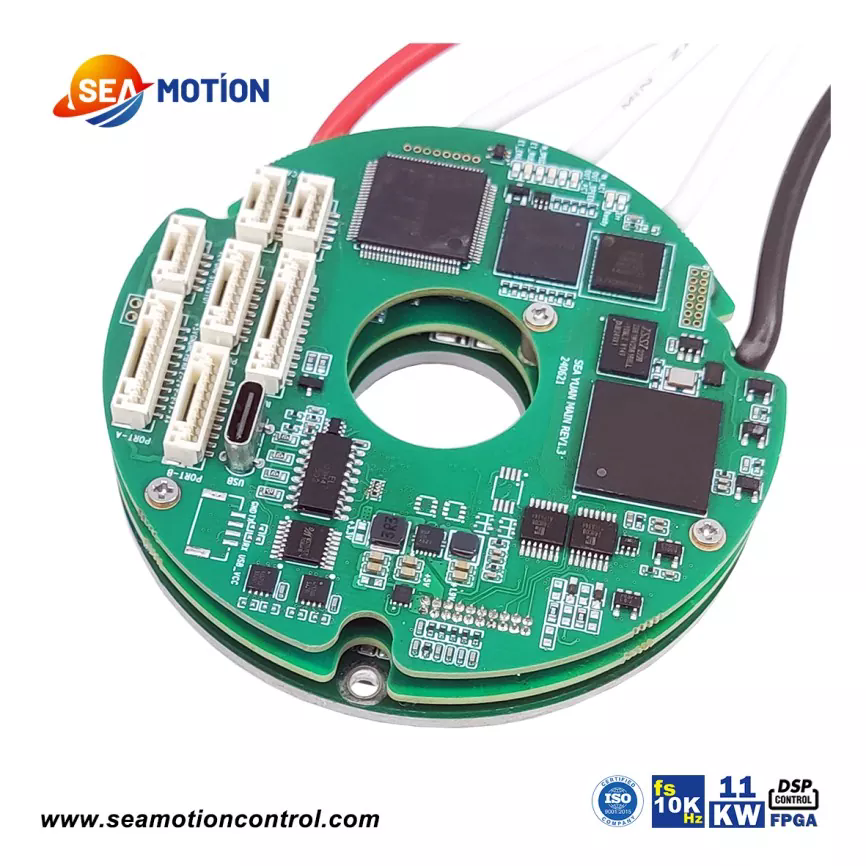
A Micro Servo Drive is a compact electronic controller that regulates the operation of a servo motor by continuously adjusting torque, speed, and position. Unlike standard drives, it is optimized for small footprint applications and high-resolution feedback systems.
It typically works in combination with:
-
Servo motors (AC or DC types)
-
High-resolution encoders or resolvers
-
Real-time control algorithms
-
Communication interfaces such as EtherCAT, CANopen, or Pulse/Direction signals
The goal is not only to move a motor but to ensure precise trajectory control with minimal deviation under varying load conditions.
Core Working Principles
The Micro Servo Drive operates through a closed-loop control system. This means it continuously compares the commanded position or speed with actual feedback and corrects deviations instantly.
Basic Control Loop:
-
Controller sends motion command
-
Drive interprets command and energizes motor phases
-
Encoder sends real-time feedback
-
Drive adjusts output based on error correction
This loop runs thousands of times per second, ensuring near-instant response and minimizing mechanical error.
The precision of this system is heavily dependent on control algorithms such as PID (Proportional-Integral-Derivative) tuning, feedforward compensation, and adaptive filtering techniques.
Key Advantages in Industrial Applications
Micro Servo Drives provide several engineering and operational benefits that directly address common industrial pain points such as vibration, energy waste, and space constraints.
-
High Precision: Sub-millimeter positioning accuracy for sensitive applications.
-
Compact Design: Ideal for space-limited machine architectures.
-
Fast Response: Real-time correction reduces lag and overshoot.
-
Energy Efficiency: Optimized current control reduces unnecessary power consumption.
-
System Integration: Compatible with multi-axis control systems.
These advantages make them suitable for modern smart manufacturing systems where performance density is critical.
Technical Comparison Table
|
Feature
|
Micro Servo Drive
|
Traditional Drive
|
|
Size
|
Ultra-compact
|
Larger footprint
|
|
Precision
|
Very high (closed-loop optimized)
|
Moderate
|
|
Response Speed
|
Fast real-time correction
|
Slower adjustment cycle
|
|
Energy Efficiency
|
Optimized current control
|
Less optimized
|
|
Application Focus
|
High-precision automation
|
General industrial use
|
Application Scenarios
Micro Servo Drives are widely used in industries requiring precise motion control and repeatability. Common applications include:
-
Robotic arms and collaborative robots
-
Packaging machinery
-
Textile equipment
-
CNC auxiliary axes
-
Medical diagnostic systems
-
Electronic assembly lines
In each of these scenarios, performance stability directly impacts production yield and product quality.
Selection and Integration Guidelines
Choosing the right Micro Servo Drive requires evaluating both mechanical and electrical system requirements. Engineers must consider several parameters before integration.
-
Load Characteristics: Inertia, torque, and speed range
-
Control Precision Requirements: Positioning tolerance levels
-
Communication Protocol: Compatibility with PLC or motion controller
-
Environmental Conditions: Temperature, vibration, humidity
-
Motor Matching: Proper sizing between drive and servo motor
Companies like SEA MOTION provide technical support and system matching services to help ensure optimal integration for industrial clients.
Maintenance and Reliability Considerations
Although Micro Servo Drives are designed for durability, proper maintenance ensures long-term stability and performance consistency.
Recommended practices include:
-
Regular inspection of wiring and connectors
-
Monitoring heat dissipation and ventilation
-
Firmware updates for control optimization
-
Preventive cleaning in dust-heavy environments
Failure to maintain drive systems can lead to degraded motion accuracy and reduced equipment lifespan.
Frequently Asked Questions (FAQ)
Q1: What makes a Micro Servo Drive different from a standard drive?
A Micro Servo Drive is optimized for high-resolution feedback and compact installations, offering faster response and higher precision than standard drives.
Q2: Can Micro Servo Drives be used in multi-axis systems?
Yes, they are commonly integrated into multi-axis motion platforms for coordinated movement control.
Q3: Are they suitable for harsh industrial environments?
With proper enclosure and thermal design, they can operate reliably in demanding conditions.
Q4: How important is tuning in servo drive performance?
Extremely important. Proper PID tuning directly affects stability, overshoot, and responsiveness.
Q5: Where can I get professional support for integration?
Specialized providers such as SEA MOTION offer engineering assistance and system-level guidance.
Conclusion: Engineering Value of Micro Servo Drives
Micro Servo Drives are a foundational technology in modern precision automation. Their ability to deliver accurate, fast, and stable motion control in compact designs makes them essential for next-generation industrial systems. As manufacturing demands continue to evolve toward higher efficiency and miniaturization, these drives will remain central to innovation in motion control engineering.
For businesses seeking reliable motion control solutions and technical expertise, SEA MOTION provides advanced Micro Servo Drive systems designed to meet diverse industrial requirements.
For professional consultation, system customization, or product inquiries, contact us at SEA MOTION today and explore how advanced micro servo technology can enhance your automation performance.