

How Industrial Air Conditioner Protects Sensitive Electrical Equipment in E-Houses?
2026-09-02
Most E-House failures are not caused by electrical faults. They are caused by heat and moisture. The VFDs, switchgear, and control panels inside an E-House generate concentrated heat. When that heat is not removed reliably, the equipment derates, trips, or fails prematurely. Worse, when the cooling system fails or cycles improperly, condensation can form on energized components, leading to arc flash events. This guide is written for engineers who need to evaluate Industrial Air Conditioner solutions based on actual risk exposure, not just cooling capacity.
1. What Specific Risks Does an E-House Environment Create for Electrical Equipment?
An E-House is not a typical building. It is a compact, enclosed structure with high density heat sources and limited ventilation. The primary risks are elevated ambient temperature, temperature cycling, and humidity intrusion. When the internal temperature exceeds 40°C, most VFDs derate by 2 percent per degree Celsius. At 55°C, a typical drive loses 30 percent of its current carrying capacity. Temperature cycling causes expansion and contraction of bus bars and connections, leading to loosening and increased contact resistance. Humidity is equally dangerous. When the internal temperature drops below the dew point, condensation forms on surfaces. In our factory, we have inspected E-Houses where condensation caused tracking marks on insulator surfaces. These are the risks that an Industrial Air Conditioner must address.
Critical design consideration: The cooling system must maintain the internal temperature at least 5°C above the external dew point to prevent condensation. This is often more challenging than meeting the maximum temperature limit.
At Ningbo Hicon Industry Co., Ltd., we design our Industrial Air Conditioner units with an integrated dew point control function. The controller monitors both the internal temperature and humidity and adjusts the cooling output to prevent condensation. This feature is not standard on all units, and we recommend that engineers specifically request it when specifying equipment for E-House applications.
2. What Cooling Capacity Is Actually Required for a Given E-House?
The required cooling capacity is determined by three factors: the internal heat gain from electrical equipment, the heat gain through the enclosure walls, and the solar load on the roof. The internal heat gain can be calculated from the equipment's rated power loss, which is typically 3 to 5 percent of the total installed power for VFDs and transformers. The wall and roof heat gain depends on the insulation value of the enclosure and the maximum external temperature. In a typical 40 foot E-House with 100 kW of installed power, the required cooling capacity is usually between 15 and 25 kW. The table below shows the cooling capacity requirements for common E-House configurations.
| E-House size (ft) | Typical installed power (kW) | Estimated heat gain (kW) | Required cooling capacity (kW) | Typical units required |
| 20 ft (standard) | 50 | 8 – 12 | 12 – 16 | 2 x 8 kW |
| 40 ft (standard) | 100 | 15 – 20 | 18 – 25 | 2 x 12 kW or 3 x 8 kW |
| 40 ft (high power) | 200 | 28 – 35 | 32 – 40 | 3 x 12 kW |
| Containerized MV switchgear | 30 | 6 – 8 | 8 – 10 | 1 x 12 kW |
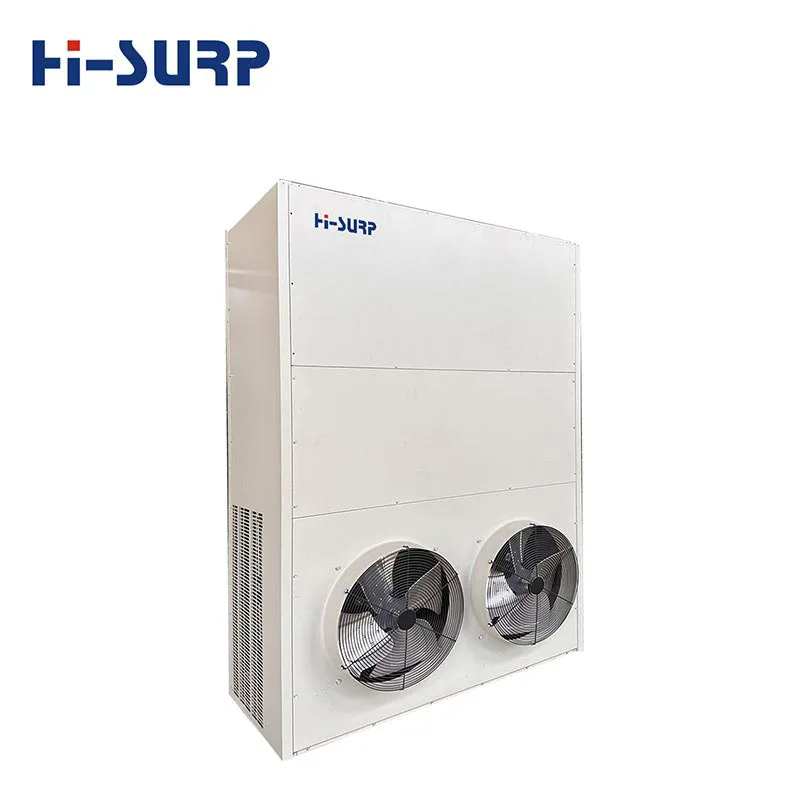
When specifying an Industrial Air Conditioner, it is important to consider the redundancy requirement. In our factory, we recommend a 1+N configuration for critical E-Houses, where N is the number of units required to meet the cooling load. For example, if three 12 kW units are required, we recommend installing four units (N+1). This allows one unit to be taken out of service for maintenance without affecting the cooling capacity. Our Industrial Air Conditioner units are designed for easy installation in standard E-House roof or wall openings.
3. How Do Environmental Conditions Affect Equipment Selection?
An E-House may be located in a desert, a tropical coast, or an arctic region. The Industrial Air Conditioner must operate reliably in the external conditions. The key factors are the maximum external temperature, the solar radiation level, and the presence of corrosive atmospheres. For desert applications, the unit must have a high ambient temperature rating, typically 52°C to 55°C. For coastal applications, the condenser coil must be coated with corrosion resistant material, such as epoxy or e-coat. In our factory, we have supplied Industrial Air Conditioner units for E-Houses in the Middle East, Southeast Asia, and the North Sea. The table below shows the environmental adaptations we apply for different locations.
| Location type | Max ambient temp (°C) | Corrosion risk | Recommended adaptations |
| Desert (Middle East) | 52 – 55 | Low (sand) | High ambient capability, sand filter on condenser |
| Tropical coastal (SE Asia) | 40 – 45 | High (salt) | Epoxy coated condenser coil, stainless steel housing |
| Cold climate (Northern Europe) | 35 (summer) | Moderate | Low ambient startup, crankcase heater |
| Industrial (chemical plant) | 40 – 45 | High (chemical) | Hermetic compressor, corrosion resistant housing |
Ningbo Hicon Industry Co., Ltd. offers a range of Industrial Air Conditioner units that can be configured for each of these environments. We recommend that engineers specify the environmental conditions when requesting a quote, so that the unit can be properly configured. The cost of environmental adaptation is typically 10 to 15 percent of the base unit cost, but it is essential for long term reliability.
4. What Monitoring and Alarm Functions Are Needed for Reliable Operation?
A cooling system that fails without warning is a serious risk. The Industrial Air Conditioner should include monitoring for the following parameters: internal temperature, internal humidity, compressor status, fan status, and coil temperature. These parameters should be available on a local display and should be accessible through a remote monitoring system. The unit should also have alarm outputs for high temperature, low temperature, high humidity, compressor failure, and fan failure. In our factory, we have designed our Industrial Air Conditioner with a built in controller that provides these functions. The controller includes a configurable alarm relay that can be connected to the E-House's supervisory system.
We recommend that the alarm setpoints be configured as follows: high temperature alarm at 38°C, critical high temperature at 45°C, high humidity alarm at 80 percent relative humidity, and low humidity alarm at 30 percent relative humidity. The unit should also provide a runtime counter to help schedule maintenance. In our experience, the most common failure mode for Industrial Air Conditioner units in E-Houses is a dirty condenser coil, which reduces the cooling capacity and causes the unit to run continuously. A simple differential pressure sensor across the condenser coil can detect this condition and generate an alarm.
Frequently Asked Questions About E-House Cooling
Summary for EPC Engineers and Facility Managers
An E-House is only as reliable as its climate control system. The Industrial Air Conditioner must be selected based on the heat load, the environmental conditions, and the required redundancy. It must include monitoring and alarm functions to provide early warning of potential failures. The cost of a properly specified unit is a small fraction of the total project cost, but it protects the entire investment in the electrical equipment. Ningbo Hicon Industry Co., Ltd. supplies Industrial Air Conditioner units that are designed specifically for E-House applications. We provide full engineering support, including heat load calculations and environmental adaptation recommendations.