

How to Manually Charge the Spring Charge Operating Mechanism in a Vacuum Circuit Breaker
2026-06-11
When a control power failure occurs, the Vacuum Circuit Breaker Spring Charge Operating Mechanism must be charged manually to restore switching capability. At Xifa, we train technicians to perform this task safely and efficiently. This guide provides the exact steps, common failure points, and a practical FAQ section.
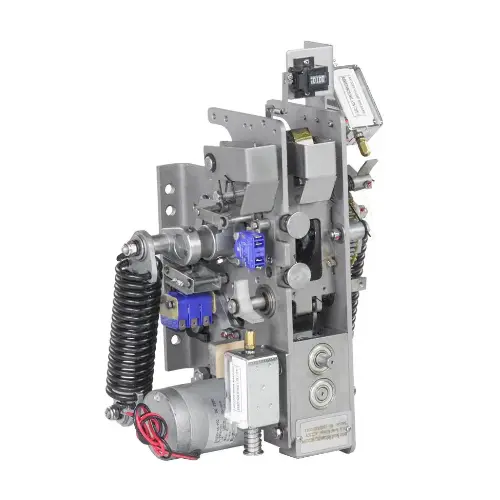
Tools Required for Manual Charging
| Tool | Specification | Purpose |
|---|---|---|
| Manual charging handle | Supplied with breaker (lever type) | Insert into charging socket |
| Personal protective equipment (PPE) | Voltage-rated gloves, safety goggles | Arc flash & pinch protection |
| Voltage detector | Rated for system voltage | Verify de-energized condition |
| Padlock & tag | Standard lockout/tagout kit | Prevent accidental re-closure |
Xifa recommends keeping the original handle stored inside the low-voltage compartment to avoid misplacement.
Step-by-Step Manual Charging Procedure
Follow these six steps to manually charge the Vacuum Circuit Breaker Spring Charge Operating Mechanism:
-
Isolate the breaker – Rack the breaker to the “test/disconnected” position. Apply lockout/tagout.
-
Check spring status indicator – The mechanical flag shows “DISCHARGED” (usually yellow or white).
-
Insert the manual handle – Locate the hexagonal charging socket on the front panel (or side frame for older Xifa models).
-
Pump the handle – Use full, steady strokes (approximately 40–60 N·m torque). Each stroke rotates a gear train.
-
Stop when the indicator changes – The flag switches to “CHARGED” (red or green). You will also hear a distinct “click” from the latch.
-
Remove the handle – Store it securely. The mechanism is now ready for closing.
⚠️ Do not exceed 80 strokes. If the charged flag does not appear after 60 strokes, inspect for mechanical jamming or internal breakage.
Why Manual Charging Fails (Diagnostic Table)
| Symptom | Most Likely Cause | Xifa Recommended Action |
|---|---|---|
| Handle rotates with no resistance | Stripped gear train or broken clutch | Replace the charging gear assembly |
| Handle cannot be inserted fully | Debris in charging socket or bent shaft | Clean with contact cleaner; check alignment |
| Indicator shows charged but breaker won't close | Defective latch or spring release mechanism | Inspect the closing latch and trip bar |
| Excessive force required (≥80 N·m) | Corroded bearings or seized cam | Lubricate with Molykote 55; replace if seized |
Vacuum Circuit Breaker Spring Charge Operating Mechanism – FAQ
Q1: How many strokes are normally required to fully charge the spring mechanism?
A1: For most medium-voltage Vacuum Circuit Breaker Spring Charge Operating Mechanisms, the standard range is 25 to 45 full strokes of the manual handle. Xifa breakers typically reach the “CHARGED” state in 32 strokes. If you exceed 55 strokes without seeing the charged flag, stop immediately. Continuing risks bending the cam follower or over-stressing the charging ratchet. Always refer to the mechanism’s nameplate—some legacy designs require up to 60 strokes.
Q2: Can I manually charge the mechanism while the vacuum circuit breaker is still in the “connected” position (busbars live)?
A2: No. Industry safety standards (including ANSI C37.20.2 and IEC 62271-100) prohibit manual charging when the primary circuit is energized. The arc flash risk is extreme—manual charging involves close proximity to moving parts, and a sudden electrical fault could cause the mechanism to explode. Xifa interlock prevents handle insertion unless the breaker is in the test or disconnected position. If your breaker lacks this interlock, never bypass it. De-energize the bus, ground the cables, and then proceed.
Q3: What is the average lifespan of a manual charging mechanism before the gear train wears out?
A3: A properly maintained Vacuum Circuit Breaker Spring Charge Operating Mechanism from Xifa has a mechanical endurance of 10,000 charge cycles (manual + motor combined). However, the manual charging gear train alone typically wears out after 2,000 to 3,000 manual operations because human pumping introduces side loads and uneven torque. Signs of wear include: increasing stroke count to reach charged state, audible grinding, or metal particles visible on the mechanism floor. Replace the charging gear assembly every 5 years in facilities that rely heavily on manual charging for testing.
When to Call Professionals
If your Vacuum Circuit Breaker Spring Charge Operating Mechanism fails to hold charge after manual charging—or if you hear a continuous hiss (indicating a broken spring or latch)—do not force the breaker into service. Uncontrolled spring discharge can cause severe injury.
Contact Us
For genuine Xifa manual charging handles, replacement gear kits, or on-site training for your Vacuum Circuit Breaker Spring Charge Operating Mechanism, contact us today. Our engineers provide remote diagnostics and same-day quotes for critical spares.