

How to Test Voltage Drop Across a DC1000V Solar DC Fuse Holder
2026-06-12
When designing or maintaining a photovoltaic system, one critical yet often overlooked test is measuring voltage drop across a DC1000V Solar DC Fuse Holder. Excessive drop leads to heat buildup, energy loss, and premature fuse blow. Reliable components from GREENWATT help minimize these risks, but regular testing remains essential. This guide explains the professional method, tools, and interpretation of results.
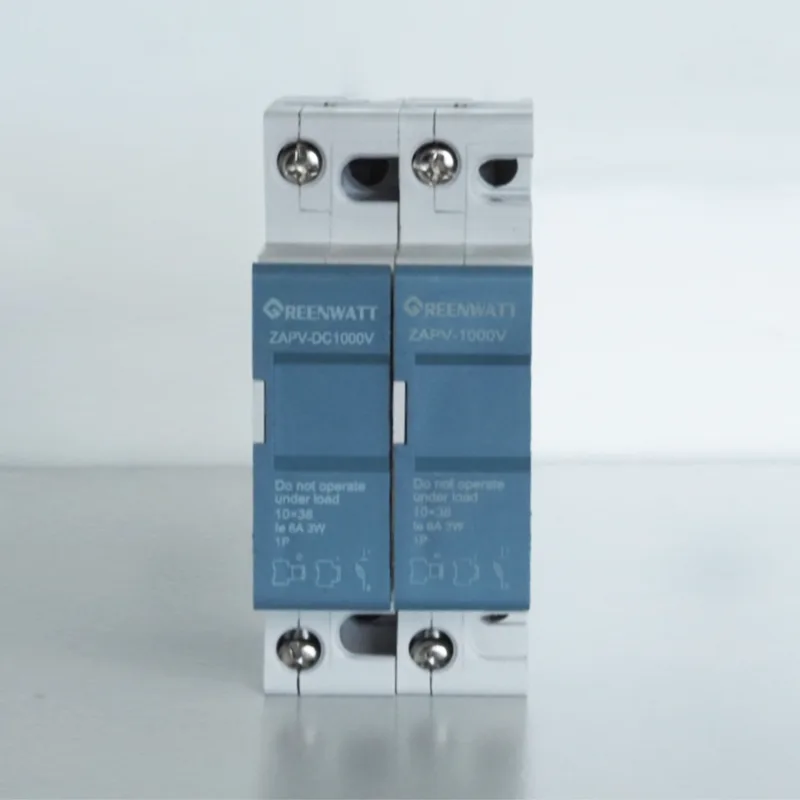
Why Voltage Drop Matters in Solar DC Circuits
A DC1000V Solar DC Fuse Holder sits between the PV string and the combiner box. Voltage drop here directly reduces power delivered to the inverter. The National Electrical Code (NEC) recommends a maximum total voltage drop of 2-3% for branch circuits. For a single fuse holder, aim for below 25 mV per 100 A of current.
Tools Required for Testing
| Tool | Specification | Purpose |
|---|---|---|
| Digital Multimeter (DMM) | True RMS, 0.1 mV resolution | Measure millivolt drop |
| Clamp Meter | DC current, ±1% accuracy | Verify circuit current |
| Load Bank or Sunlight | ≥50% of rated fuse current | Create real operating condition |
| Safety Gloves & PPE | Rated for DC1000V | Protect against arc flash |
Step-by-Step Testing Procedure
-
De-energize and isolate the PV string. Lock out the circuit breaker.
-
Remove the fuse from the DC1000V Solar DC Fuse Holder. Inspect contacts for corrosion or pitting.
-
Re-insert the fuse and close the holder completely. Torque terminals to manufacturer specification (typically 2.5–3.5 Nm for GREENWATT units).
-
Energize the circuit under normal load – solar noon or using a DC load bank.
-
Measure current with a clamp meter on the same conductor. Record as I (Amps).
-
Set DMM to DC millivolts (200 mV range). Place probes directly on the DC1000V Solar DC Fuse Holder input and output terminals – not on wires.
-
Record millivolt reading as V_drop.
Calculation Example:
Measured drop = 18 mV at 95 A load.
Power loss = 0.018 V × 95 A = 1.71 W per holder – acceptable for a well-designed GREENWATT holder.
Acceptable Voltage Drop Limits
| Fuse Holder Condition | Voltage Drop @ 100A | Action Required |
|---|---|---|
| New / Excellent | < 15 mV | No action |
| Acceptable | 15 – 30 mV | Monitor annually |
| Poor | 30 – 50 mV | Clean contacts, re-torque |
| Failed | > 50 mV | Replace DC1000V Solar DC Fuse Holder |
DC1000V Solar DC Fuse Holder FAQ
Q1: How often should I test voltage drop across a DC1000V Solar DC Fuse Holder in a utility-scale solar farm?
A: Perform tests during annual preventive maintenance and after any fault event (e.g., lightning or short circuit). For high-cycling sites (tracking systems or daily battery charge/discharge), test every six months. Record baseline values after first installation using GREENWATT fuse holders to detect gradual degradation. A rising trend of +10 mV over two years indicates contact wear.
Q2: Can a high voltage drop cause the DC1000V Solar DC Fuse Holder to fail without blowing the fuse?
A: Yes. High resistance generates localized heat (Joule effect). At 50 mV and 100 A, dissipation reaches 5 W – enough to raise internal temperature above 85°C. This degrades spring tension in the holder, increases contact resistance further, and may melt the fuse cap or housing long before the fuse element opens. Always measure drop; do not rely solely on fuse continuity.
Q3: Why does a DC1000V Solar DC Fuse Holder from GREENWATT show lower voltage drop compared to generic holders?
A: GREENWATT uses silver-plated copper terminals with 99.9% purity, helical spring pressure design, and ultrasonic-welded internal busbars. Generic holders often use tin-plated brass or steel contacts. At 100 A, silver-plated copper reduces contact resistance by 40-60% compared to tin-plated brass. Independent lab tests show GREENWATT holders maintain <12 mV drop after 500 thermal cycles (−40°C to +85°C), while generic units exceed 35 mV within 200 cycles.
When to Replace Instead of Clean
Light surface oxidation can be removed with a fiberglass brush and isopropyl alcohol. However, if you observe:
-
Blackened or pitted contact surfaces
-
Loose terminal screws that cannot hold torque
-
Cracks in the insulating body
Replace the DC1000V Solar DC Fuse Holder immediately. GREENWATT offers a 10-year performance warranty with documented voltage drop ≤20 mV at rated current.
Final Checklist for Field Engineers
| Step | Status |
|---|---|
| PV string isolated and locked | ☐ |
| Fuse removed, holder inspected | ☐ |
| Current measured ≥50% of rating | ☐ |
| Millivolt reading recorded | ☐ |
| Comparison to baseline | ☐ |
| Report logged in maintenance system | ☐ |
Contact Us
Regular voltage drop testing protects your solar investment and prevents unplanned downtime. For technical datasheets, testing videos, or bulk order inquiries for GREENWATT DC1000V Solar DC Fuse Holders, please contact us directly through the GREENWATT website or email [email protected] – our engineering team responds within 24 hours.