

What Are the Common Failure Modes and Diagnostic Methods for Armored Removable AC Metal Enclosed Switchgear
2026-06-22
Armored Removable AC Metal Enclosed Switchgear is the backbone of medium-voltage distribution networks in substations, industrial plants, and commercial facilities. Its withdrawable breaker design and armored construction offer superior safety and maintainability. However, like all critical electrical assets, this equipment experiences wear, environmental stress, and operational faults over time. For engineers and facility managers, understanding failure modes and applying systematic diagnostic methods is not optional—it is essential for reliability. At Lugao Power, we have spent decades refining diagnostic protocols and retrofit solutions for Armored Removable AC Metal Enclosed Switchgear across diverse operating conditions.
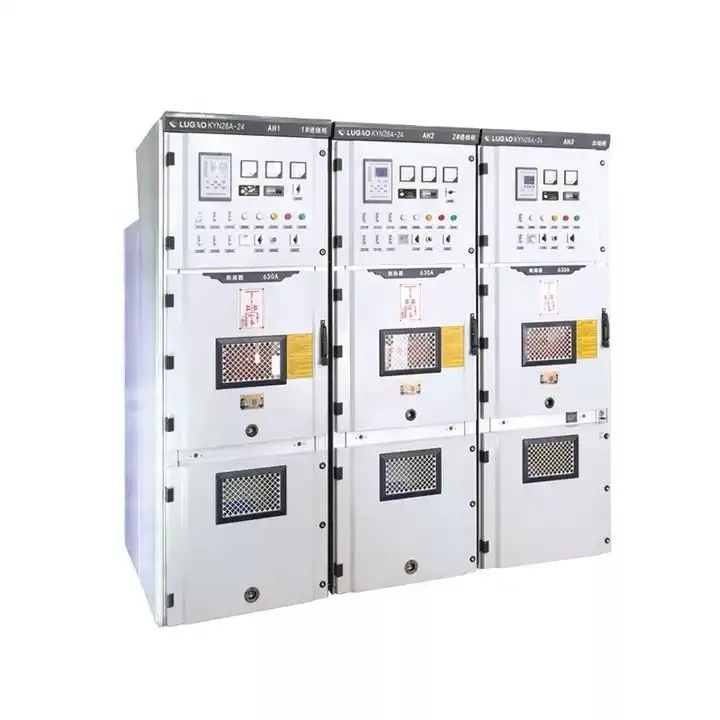
Primary Failure Modes in Armored Removable AC Metal Enclosed Switchgear
Failures rarely occur without warning. They manifest through thermal, mechanical, electrical, or insulation degradation. The table below summarizes the most frequently observed failure modes in field operations.
| Failure Mode | Typical Root Causes | Early Warning Indicators |
|---|---|---|
| Insulation breakdown | Moisture ingress, partial discharge, contamination on bushings or bars | Unusual noise, elevated partial discharge (PD) readings, visible tracking marks |
| Mechanical jamming of withdrawable mechanism | Lack of lubrication, misalignment, deformed guide rails, rust | Increased operating force, abnormal grinding sounds during racking |
| Overheating of primary contacts | Loose bolted connections, worn contact fingers, high resistance at joints | Infrared hot spots, discolored copper, load-dependent temperature rise |
| Secondary control circuit failure | Loose terminal blocks, coil burnout, auxiliary contact oxidation | Breaker fail-to-close/trip, intermittent alarm signals, blown fuses |
| Arc-flash damage due to delayed fault clearance | Protection relay miscoordination, CT saturation, breaker mechanism delay | Tripping time deviation, relay event records, previous minor fault history |
| SF6 or vacuum integrity loss (if applicable) | Leakage at seals, cracked insulating rods, aging gaskets | Pressure drop alarms, low vacuum indicator, increased contact resistance |
Diagnostic Methods: From Routine Checks to Advanced Analytics
Effective diagnosis combines onboard monitoring, periodic offline tests, and condition-based data interpretation. Below is a structured diagnostic approach recommended by Lugao Power for Armored Removable AC Metal Enclosed Switchgear:
| Diagnostic Method | Application | Acceptance Criteria / Typical Thresholds |
|---|---|---|
| Thermography (infrared scanning) | All primary connections and bus joints under load | ΔT ≤ 15°C above ambient; ΔT between phases ≤ 5°C |
| Partial discharge (PD) measurement | Ultrasonic, UHF, or HFCT sensors on cable boxes and busbar compartments | PD intensity < 10 dB above background; no repetitive phase-resolved patterns |
| Dynamic contact resistance measurement (DRM) | Withdrawable breaker primary contacts during racking stroke | Micro-ohm values within 20% of factory baseline; smooth stroke curve without spikes |
| Insulation resistance and PI/DAR tests | Phase-to-phase and phase-to-ground at 5kV or 10kV DC | IR > 1000 MΩ; PI ≥ 2.0 (for 10-minute/1-minute ratio) |
| Timing and travel curve analysis | Breaker open/close operations, auxiliary contact transitions | Close time, open time, and trip-free time within IEC 62271-100 tolerances |
| SF6 gas density monitoring (for GIS-type) | Pressure transducer and temperature-compensated readings | Alarm at 90% rated pressure; lockout at 85% |
| Secondary injection testing | Protection relays, interlocking logic, and trip circuits | Pickup current ±5%; trip time ±3% of set value |
Five Critical Diagnostic Rules for Field Engineers
-
Always de-energize and ground the Armored Removable AC Metal Enclosed Switchgear before performing any withdrawable mechanism inspection.
-
Compare every new measurement against historical baselines—trends matter more than absolute numbers.
-
Use synchronized multi-sensor PD detection (ultrasonic + UHF) to differentiate internal corona from surface discharge.
-
Perform contact resistance tests at both cold and warm conditions (after 2 hours of rated current) to detect thermal expansion issues.
-
Document all racking force measurements with a digital dynamometer to track mechanical wear progression.
Armored Removable AC Metal Enclosed Switchgear FAQ – Common Questions from the Field
FAQ 1: What is the most critical maintenance interval for the withdrawable breaker mechanism in Armored Removable AC Metal Enclosed Switchgear?
For standard service conditions (indoor, clean environment, < 50% relative humidity), Lugao Power recommends a full mechanical inspection and lubrication cycle every 2 years or after 200 racking operations, whichever comes first. For harsh environments (dusty, coastal, or high-humidity zones), shorten this interval to 1 year or 100 operations. The inspection must include cleaning of guide channels, re-greasing with lithium-based EP2 grease, and verification of the "racked-in" and "racked-out" position indicator microswitches. Any stiffness during racking should trigger immediate dismantling of the moving carriage to check for deformed rollers or bent shafts.
FAQ 2: How can I distinguish between a genuine insulation failure and a false partial discharge alarm in Armored Removable AC Metal Enclosed Switchgear?
A genuine insulation failure typically presents with phase-resolved PD patterns that shift with applied voltage and show a clear "double hump" profile in the 0°–90° and 180°–270° quadrants. False alarms often originate from external electromagnetic interference (e.g., variable frequency drives, welding equipment) or loose shielding connections. The reliable method is to perform a time-domain reflectometry (TDR) sweep and compare the PD source location with the physical geometry of the switchgear. Additionally, Lugao Power recommends using a gated PD measurement synchronized with the 50/60 Hz reference—if the signal disappears when the primary voltage is reduced to 80% of rated value, it is most likely a genuine internal discharge originating from a void or contaminated insulator. Always cross-validate with ultrasonic listening; a genuine failure produces a distinct "frying" sound at the fault point.
FAQ 3: What should I do if my Armored Removable AC Metal Enclosed Switchgear shows gradual increase in contact resistance over 18 months without visible arcing?
This is a classic sign of fretting corrosion or loss of contact pressure, often caused by thermal cycling and micro-vibrations from nearby breakers. Do not ignore it—a 30% rise above baseline can lead to catastrophic overheating under fault current. The correct action sequence is: (1) Schedule a planned outage; (2) Withdraw the breaker and inspect the primary disconnect fingers for silver plating wear or black oxidation; (3) Measure contact pressure with a spring scale (should be within ±15% of factory specification); (4) If pressure is low, replace the contact springs rather than simply cleaning the surfaces. For permanent corrective action, Lugao Power offers a contact retrofit kit using beryllium-copper alloy springs that maintain consistent pressure up to 10,000 operations. After replacement, perform a 24-hour continuous current test at 80% rated load while monitoring thermal imaging to validate the repair.
Condition-Based Maintenance Strategy
Moving from time-based to condition-based maintenance reduces unnecessary outages. Lugao Power integrates IoT-enabled PD sensors and contact temperature monitors that feed data to a local gateway. When any parameter crosses the yellow alarm threshold (e.g., PD > 30 dB, temperature rise > 12°C over ambient), the system issues a predictive alert. This approach has extended the average overhaul cycle of Armored Removable AC Metal Enclosed Switchgear from 5 to 8 years in recent utility projects across Southeast Asia and the Middle East.
Final Recommendation
Do not wait for a trip or a flashover to validate your maintenance program. The economic impact of unplanned downtime in a 33kV distribution feeder often exceeds ten times the cost of a comprehensive diagnostic campaign. Standardized testing, careful trend analysis, and immediate correction of mechanical anomalies are the pillars of long-term reliability.
Contact Us – Lugao Power provides full-scope condition assessment, retrofit parts, and on-site training for Armored Removable AC Metal Enclosed Switchgear worldwide. Our engineering team delivers detailed diagnostic reports with prioritized action plans within 48 hours of testing. Reach out to our technical support desk via the contact form on our website or email us directly to schedule a consultation. Let us help you keep your critical switchgear safe, compliant, and operating at peak performance.