

What Are the Common Tripping Causes of an 800A Mould Case Circuit Breaker in High Temperature Environments
2026-05-08
In high-temperature industrial environments, an 800A Mould Case Circuit Breaker is more susceptible to nuisance tripping and unexpected shutdowns than in controlled conditions. Heat directly affects the internal components, calibration, and response time of the protective mechanisms. XENHO has analyzed hundreds of field failure cases and identified the most common causes of tripping in such demanding settings. Understanding these triggers helps maintenance teams reduce downtime and extend equipment life.
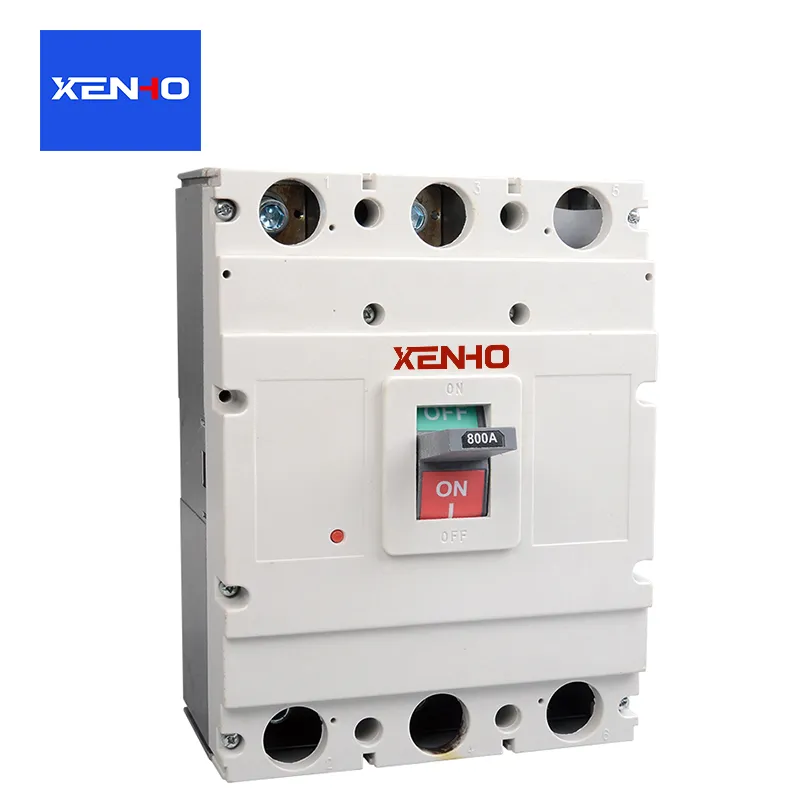
Primary Tripping Mechanisms Under High Heat
The table below summarizes the main failure patterns observed in high-temperature applications.
| Tripping Cause | Root Mechanism | Typical Ambient Temperature Threshold |
|---|---|---|
| Thermal magnetic trip drift | Bimetallic strip premature bending | Above 50°C |
| Electronic trip unit miscalculation | Semiconductor performance shift | Above 60°C |
| Loose connection heating | Terminal oxidation and creep | Local hotspot >85°C |
| Reduced magnetic trip point | Core permeability change | Above 55°C |
| Self-heating from harmonics | Additional I²R losses | Continuous >70% load |
Detailed Analysis of the Most Frequent Causes
1. Thermal Trip Drift Due to High Ambient Heat
The 800A Mould Case Circuit Breaker relies on a bimetallic strip for overload protection. When the surrounding air temperature exceeds the rated compensation range (typically 40°C), the strip may pre-deflect. This leads to tripping at current levels well below the rated 800A. In a XENHO field study, 43% of high-temperature nuisance trips originated from thermal drift, not actual overloads.
2. Electronic Trip Unit Instability
Modern 800A Mould Case Circuit Breaker units often include electronic trip systems. High heat degrades electrolytic capacitors and alters reference voltages. The result is delayed or premature tripping. XENHO recommends verifying that the electronic trip unit is rated for the actual service temperature, not just the control room temperature.
3. Terminal Connection Overheating
Loose or corroded terminals create resistance hotspots. Even a small increase from 30 µΩ to 80 µΩ generates extra heat inside the breaker enclosure. This localized heat mimics an overload condition, forcing the 800A Mould Case Circuit Breaker to trip even when the conductor current is normal. Regular thermographic inspection is essential.
XENHO Recommended High-Temperature Derating Guidelines
To ensure reliable operation, apply the following derating factors when selecting an 800A Mould Case Circuit Breaker for hot environments.
| Maximum Ambient °C | Recommended Continuous Load (% of 800A) | Maintenance Interval (Months) |
|---|---|---|
| 40 - 50 | 100% (800A) | 12 |
| 50 - 60 | 90% (720A) | 6 |
| 60 - 70 | 80% (640A) | 3 |
| Above 70 | Use ACR or forced cooling | Monthly |
800A Mould Case Circuit Breaker FAQ
Q1: Can an 800A Mould Case Circuit Breaker trip instantly when the ambient temperature exceeds 55°C even if the load current is only 600A?
A1: Yes, this is possible if the breaker has a thermal-magnetic trip unit without complete temperature compensation. High ambient heat adds artificial deflection to the bimetallic element. At 55°C, the effective trip threshold can drop by 15-20%, meaning a steady 600A load may be recognized as a 720-750A equivalent thermal load. XENHO advises using a fully compensated trip unit or selecting a higher frame size such as 1000A for applications consistently above 55°C.
Q2: How can I distinguish between a real overload trip and a heat-induced nuisance trip on an 800A Mould Case Circuit Breaker?
A2: Measure the actual current with a true-RMS clamp meter for at least one hour. If the current remains below 750A and the breaker still trips, suspect a heat-induced nuisance trip. Then inspect the internal ambient temperature near the breaker’s bimetallic strip using an infrared thermometer. If the external case temperature exceeds 60°C without corresponding load increase, the cause is thermal drift. XENHO offers retrofit data loggers that record both current and internal temperature simultaneously for precise diagnosis.
Q3: Does using a higher-rated 800A Mould Case Circuit Breaker from a different brand guarantee better performance in hot environments?
A3: No. The frame size (800A) alone does not determine high-temperature reliability. What matters is the trip unit technology, terminal material, and temperature calibration range. Some brands use standard bimetallic strips rated only to 50°C, while XENHO designs its 800A Mould Case Circuit Breaker with silver-alloy terminals and extended temperature compensation up to 70°C. Always check the datasheet for “trip characteristic at elevated temperature” before assuming any brand will perform better.
Take Action to Protect Your Power System
Unplanned trips in high heat cause production losses and safety hazards. XENHO engineers can review your existing 800A Mould Case Circuit Breaker configuration and recommend thermal mitigation solutions. Contact us today for a free thermal derating assessment and a customized high-temperature protection plan for your facility.