
What Are the Key Features of Long-Lasting Concrete Block Molds?
2026-07-22
1. Why Does the Steel Grade Determine the Lifespan of a Mold for Concrete Block?
In our factory, we have manufactured thousands of sets of Mould for Concrete Block. The base steel grade is the single most important factor for longevity. We use tool steel such as 42CrMo or equivalent, which has a hardness of 320 to 360 HB. This ensures the mold can withstand the abrasive action of aggregates and the impact of vibration. A low grade steel will wear out after 50,000 cycles, while our high grade material can exceed 300,000 cycles. Our Quangong Machinery Co., Ltd. has tested steel from various mills, and we found that the chromium content (around 1.5 percent) significantly improves wear resistance. The table below compares our steel properties with standard alternatives.
| Steel grade | Hardness (HB) | Wear resistance (relative) | Expected cycles (standard block) |
| Carbon steel (AISI 1045) | 180 | 1.0 | 30,000 |
| Medium alloy (42CrMo) | 320 | 3.5 | 150,000 |
| Tool steel (SKD11 equivalent) | 380 | 5.0 | 250,000 |
| Our proprietary alloy (QT800) | 400 | 6.0 | 320,000 |
| Property | Our Mould for Concrete Block | Industry average |
| Surface hardness (HRC) | 52 – 56 | 45 – 48 |
| Core hardness (HRC) | 30 – 35 | 25 – 28 |
| Tensile strength (MPa) | 1,100 | 850 |
| Impact toughness (J) | 60 | 40 |
Our factory uses a vacuum degassing process to remove impurities, which prevents micro cracks from forming during hardening. This is why our Mould for Concrete Block can handle the high frequency vibrations of modern block machines without developing fatigue cracks.
2. How Does Surface Treatment Prevent Wear and Corrosion?
Even the best steel will wear if the surface is not protected. Our factory applies a nitriding treatment to the cavity surface of every Mould for Concrete Block. This creates a hard case of 0.3 to 0.5 mm with a hardness of 900 to 1100 HV. Nitriding also improves corrosion resistance, which is important because the concrete mix contains moisture and chemical admixtures. Some manufacturers use chrome plating, but our QGM has found that nitriding provides better adhesion and does not peel off under impact. Additionally, we polish the cavity to a surface finish of Ra 0.8 µm, which reduces the friction that causes paste buildup. A polished mold produces blocks with a smooth surface, reducing the need for a separate finishing step. In a side by side test, our nitrided Mould for Concrete Block showed 40 percent less wear than a chrome plated one after 100,000 cycles.
3. Why Is Dimensional Tolerance Critical for Consistent Block Quality?
A long lasting mold is not just about hardness; it must also maintain its shape over thousands of cycles. Our Mould for Concrete Block is machined with a tolerance of ±0.05 mm for the cavity dimensions, and ±0.02 mm for the critical surfaces that determine block height. This precision ensures that every block has the same size and shape, which is essential for construction projects where blocks are laid dry. Our factory uses a coordinate measuring machine to inspect each mold before it is shipped. We also apply a stress relieving heat treatment to the welded frames to prevent warping over time. A mold that loses its tolerance will produce blocks that are out of square, leading to higher mortar usage and weaker walls. Our Quangong Machinery Co., Ltd. guarantees that our molds will maintain their tolerance for at least 200,000 cycles, provided they are properly maintained.
4. How Does the Mold Design Affect Ejection and Wear Distribution?
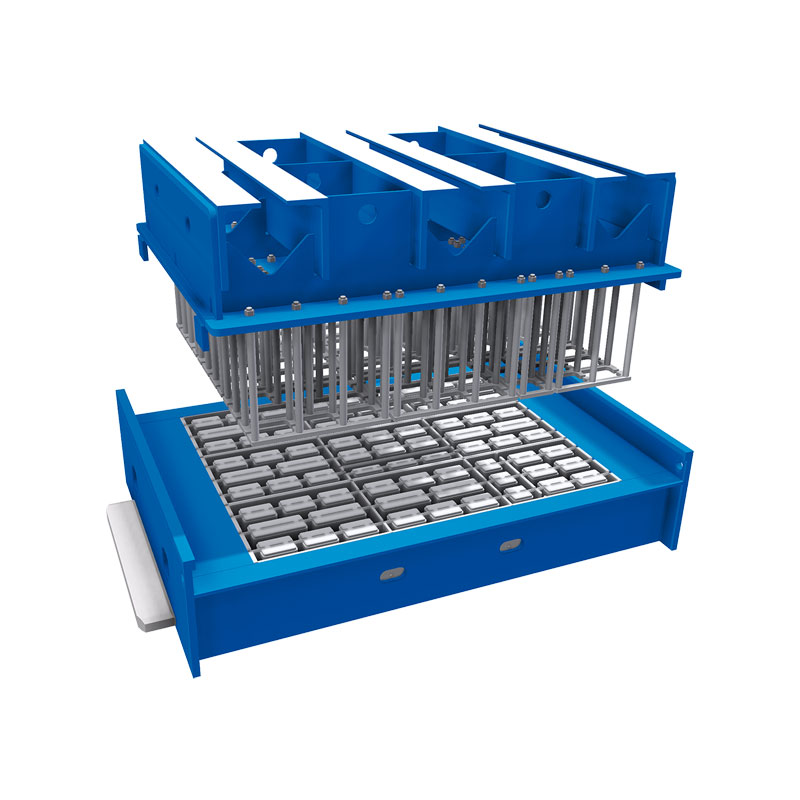
The design of the Mould for Concrete Block includes features that reduce wear and make demolding easier. Our molds have a draft angle of 1.5 to 2 degrees on the side walls, which allows the blocks to release smoothly without scraping the cavity surface. The corners are also radiused to prevent stress concentrations that can lead to cracking. Additionally, we use replaceable wear plates on the sliding parts to extend the life of the main body. The table below shows how our design features contribute to longevity.
| Design feature | Our standard | Benefit for longevity |
| Draft angle (side walls) | 1.5° – 2.0° | Reduces friction during ejection |
| Corner radius | R3 – R5 mm | Prevents stress cracking |
| Wear plates on guides | Yes, replaceable | Extends body life by 50% |
| Cooling channels | Integrated | Reduces thermal fatigue |
| Hardened dowel pins | Yes, 60 HRC | Maintains alignment |
Our Quangong Machinery Co., Ltd. also offers a mold with a segmented design, where the wear parts are individually replaceable. This can reduce maintenance costs significantly, as you only need to replace the worn sections instead of the entire Mould for Concrete Block.
Frequently Asked Questions About Long-Lasting Concrete Block Molds
Final Summary
Long lasting concrete block molds are defined by high quality steel, precise heat treatment, effective surface hardening, and thoughtful design features. These elements combine to provide hundreds of thousands of cycles with consistent block quality. Our factory has built a reputation for producing molds that outlast the competition. We use advanced materials and testing to ensure that every Mould for Concrete Block delivers maximum return on investment. Quangong Machinery Co., Ltd. is committed to supporting your block production with reliable, durable molds.