

What Is the Maximum Short-Circuit Current for an AC Circuit Breaker Curve C 40A 2P 6kA in a Residential Panel
2026-08-21
When selecting overcurrent protection for a home electrical system, the interrupting rating often creates more confusion than the amperage or trip curve. Homeowners and apprentice electricians frequently ask about the 6kA marking on the breaker, yet few understand what that number actually means for daily safety. This guide examines the short-circuit current capacity of the AC Circuit Breaker Curve C 40A 2P 6kA through the lens of real-world residential installations, with practical insights from GreenWatt engineering standards.
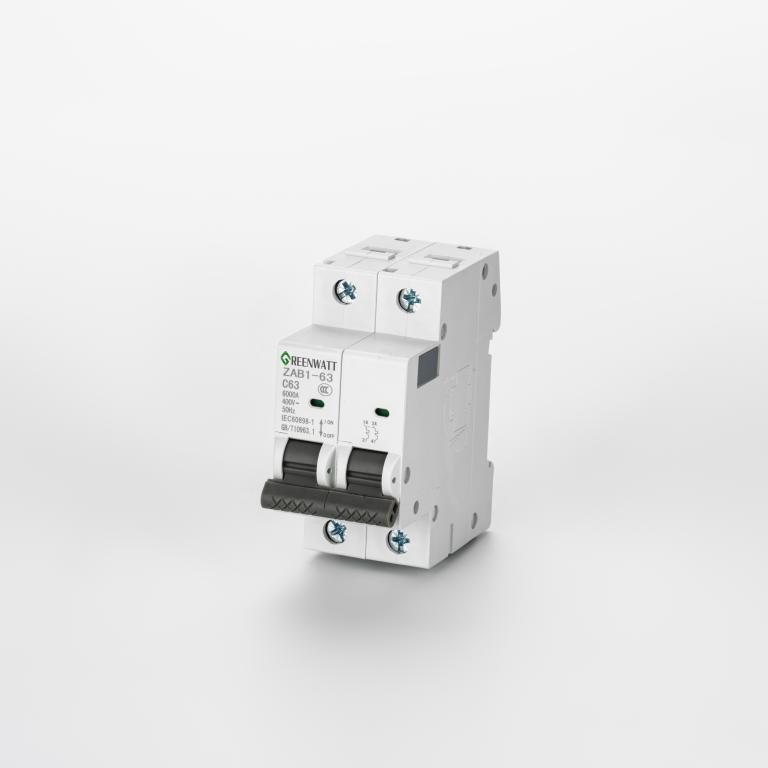
Understanding the 6kA Interrupting Rating
The 6kA designation refers to the maximum prospective short-circuit current that the AC Circuit Breaker Curve C 40A 2P 6kA can safely interrupt without welding its contacts or causing internal arc flash damage. In a residential panel, this rating must exceed the available fault current at the service entrance. Most utility transformers for single-family homes deliver between 2kA and 5kA of fault current at the meter, making 6kA a comfortable safety margin. However, high-density urban apartments or homes with large PV systems can push fault levels toward 7–8kA, requiring a higher-rated device.
How Utility Supply Affects Available Fault Current
The actual short-circuit current reaching your panel depends on three variables: transformer impedance, secondary voltage, and distance from the pole. A typical 25kVA pad-mount transformer with 2.5% impedance produces roughly 5,800A of fault current at 240V split-phase. This falls within the 6kA capacity of the AC Circuit Breaker Curve C 40A 2P 6kA. If your home sits within 50 feet of the transformer, that value can rise to 6,200A—exceeding the breaker’s rating. GreenWatt recommends performing a simple fault-current calculation using the transformer’s nameplate data before committing to any 6kA device.
Comparative Table: Breaker Ratings vs. Residential Fault Levels
| Panel Location | Typical Fault Current (A) | Suitable Breaker Rating | Is 6kA Sufficient? |
|---|---|---|---|
| Suburban home, 150ft from transformer | 2,800 – 3,500 | 6kA | Yes |
| Urban townhouse, 60ft from transformer | 4,200 – 5,100 | 6kA | Yes |
| High-rise apartment, 20ft from transformer | 5,800 – 6,500 | 10kA | No (marginal) |
| Rural property with long overhead lines | 1,200 – 2,000 | 6kA | Yes |
| Home with 10kW solar inverter backfeed | 5,000 – 7,200 | 10kA | Requires verification |
As the table illustrates, the AC Circuit Breaker Curve C 40A 2P 6kA serves most standard residences perfectly, but site-specific measurements remain essential.
The Role of Curve C in Short-Circuit Events
Curve C magnetic trip operates between 5 and 10 times the rated current—meaning this breaker trips magnetically at 200A to 400A for instantaneous faults. During a dead short, the current surge reaches thousands of amperes within half a cycle. The 6kA interrupting rating ensures the breaker can extinguish the resulting arc, while the Curve C characteristic ensures it reacts fast enough to protect downstream wiring. GreenWatt tests every AC Circuit Breaker Curve C 40A 2P 6kA for both thermal and dynamic performance at full fault capacity, exceeding UL 489 requirements.
Step-by-Step: Verifying Your Panel’s Fault Current
-
Obtain the utility transformer kVA rating and impedance percentage from your provider.
-
Calculate the secondary full-load current: (kVA × 1000) / (secondary voltage).
-
Divide full-load current by impedance (as a decimal) to get prospective fault current.
-
Add 15% if you have grid-tied inverters or large motors (compressor, elevator).
-
Compare the result against the 6kA rating of your AC Circuit Breaker Curve C 40A 2P 6kA.
-
If the calculated value exceeds 5.8kA, upgrade to a 10kA version—GreenWatt offers both series for seamless replacement.
Common Installation Mistakes That Reduce Effective Capacity
Using aluminum feeders without proper torque, undersized ground conductors, or oxidized busbar connections can increase impedance and reduce actual fault current—but they also create heat that degrades the breaker’s interrupting mechanism. Even a correctly rated AC Circuit Breaker Curve C 40A 2P 6kA will fail to clear a fault if the panel enclosure lacks proper venting or if moisture penetrates the DIN rail. GreenWatt provides corrosion-resistant terminals and clear torque specifications on every unit to mitigate these risks.
Frequently Asked Questions About This Breaker
Q: Can the AC Circuit Breaker Curve C 40A 2P 6kA handle a direct short between line and neutral at the farthest outlet?
A: Yes, provided the total impedance of the branch circuit (including wire length and termination resistance) does not reduce the fault current below the magnetic trip threshold. At 40A rating, the magnetic element responds within 10 milliseconds to currents above 200A. For a dead short at 50 meters of 10 AWG copper, the initial surge typically reaches 1,200A—well within the 6kA interruption capacity. However, if your wiring run exceeds 80 meters, the resistance may drop the surge to only 150A, causing the thermal element (rather than magnetic) to open, which takes 2–5 seconds—long enough for insulation damage. GreenWatt advises using the 40A 2P only for circuits with total one-way length under 60 meters for reliable short-circuit clearing.
Q: What happens if the available fault current from the utility is 6.5kA—will the AC Circuit Breaker Curve C 40A 2P 6kA explode?
A: The breaker will not explode, but its contacts may weld shut under a through-fault, or the arc chutes could fail to quench the plasma, resulting in a catastrophic panel failure. The 6kA rating is a tested maximum—exceeding it by even 500A reduces the device’s life to a single fault event and voids the GreenWatt warranty. In practice, if your calculation shows 6.3kA or higher, you must install a current-limiting upstream fuse or replace the 2P breaker with a 10kA model. For existing panels, GreenWatt offers a retrofit calculator on our spec sheet to determine the exact safe margin based on your transformer distance and wire gauge.
Q: Does the 6kA rating apply to both poles simultaneously in the AC Circuit Breaker Curve C 40A 2P 6kA?
A: Yes, the interrupting rating is certified for both poles under a common-trip condition. During a line-to-line short (240V across both poles), the arc energy is distributed across two sets of contacts and dual arc chutes, which actually improves clearing performance compared to a single-pole breaker. The 6kA value is validated with both poles carrying equal fault current. However, if one pole sees 6kA while the other carries only 2kA (e.g., a line-to-neutral fault on one leg), the uneven stress can cause premature wear on the higher-current pole. GreenWatt engineers recommend balancing branch loads to within 20% on each pole to ensure the AC Circuit Breaker Curve C 40A 2P 6kA achieves its full rated cycle life—typically 10,000 mechanical operations and 6,000 electrical trips at rated current.
Final Verdict for Residential Use
For the vast majority of U.S. and European homes, the AC Circuit Breaker Curve C 40A 2P 6kA offers more than adequate short-circuit protection, covering everything from HVAC compressors to EV charging outlets. The C-curve gives tolerance for inrush while maintaining rapid response for dangerous faults. GreenWatt integrates high-purity silver alloy contacts and ventilated arc chambers to exceed the 6kA benchmark under repeated stress. Always pair this breaker with a properly sized copper busbar and a torque wrench set to 2.5 N·m for terminal screws.
Need a Site-Specific Safety Verification?
Every residential panel has unique supply characteristics, and guessing your fault current is never worth the risk. GreenWatt provides free load-side fault analysis with every bulk order of the AC Circuit Breaker Curve C 40A 2P 6kA, plus same-day technical support from certified electrical engineers. Whether you are retrofitting an old panel or designing a new smart home system, our team will confirm your interrupting rating, suggest optimal torque values, and ship test certificates with every unit.
Contact us today through the GreenWatt website live chat or call our technical hotline—mention your transformer distance and main breaker size, and we will respond with a tailored recommendation within 4 business hours. Your safety is our circuit. Reach out now for a free consultation and a complimentary set of DIN rail end clips with your first order.
