

What Maintenance Practices Extend the Life of High Voltage Circuit Breakers?
2026-06-29
1. How Does Regular Contact Inspection Prevent Unexpected Failure in Our High Voltage Circuit Breaker?
In our factory, we have analyzed hundreds of returned units. The leading cause of premature failure is contact erosion that goes unnoticed. Our High Voltage Circuit Breaker uses silver tungsten contacts that wear down over thousands of operations. We recommend a visual inspection every 1,000 operations or annually, whichever comes first. Check for pitting, discoloration, or uneven wear. For our vacuum interrupters, we measure contact resistance with a micro ohmmeter. A reading above 80 micro ohms indicates possible contamination or mechanical misalignment. Our Lugao Power Co.,Ltd. provides a simple contact wear indicator on the operating mechanism. When the indicator reaches the red zone, you have about 200 operations left. Many local substations in the Midwest have adopted our six monthly contact inspection schedule, and they report an average breaker life extension of 8 years. Document each measurement. That data helps us predict when the High Voltage Circuit Breaker needs a full overhaul. Do not rely solely on operation counters. Environmental factors like dust and humidity accelerate wear. Combine visual checks with thermal imaging to spot hotspots that indicate poor contact.
2. Why Does Lubrication Timing and Type Matter for Our Operating Mechanism?
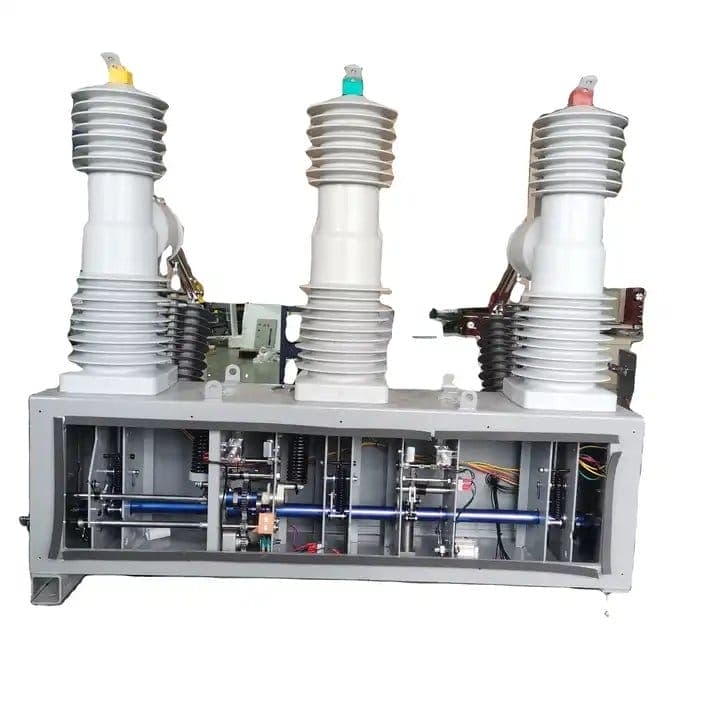
The operating mechanism of a High Voltage Circuit Breaker has dozens of moving pins, bearings, and latches. Our factory uses a lithium based extreme pressure grease with a dropping point above 190°C. We recommend relubrication every 2,000 operations or every 2 years. Many plant engineers apply grease too often, which attracts dust and forms abrasive paste. Others never grease until the mechanism jams. Both are mistakes. Our Lugao provides a lubrication chart with each High Voltage Circuit Breaker. For the main shaft bearings, use a grease gun with a flexible hose. Apply two pumps only. For the latch and trip assembly, use a thin oil, not grease. We have seen breakers in coastal plants fail after 5 years because salt spray contaminated the lubricant. So we advise using a grease with corrosion inhibitors. Also, always clean old grease before applying fresh. Mixing incompatible greases changes consistency. One of our customers in Singapore extended their breaker service life to 22 years by following our quarterly grease sampling program. Lubrication is cheap, but a seized mechanism costs thousands.
3. What Are the Critical Timing and Travel Tests for Our High Voltage Circuit Breaker?
Timing and travel are the heartbeat of any High Voltage Circuit Breaker. We test closing time, opening time, and contact bounce at our factory. In the field, we recommend a timing test every 3 years or after every major fault interruption. For a 12 kV vacuum breaker, the closing time should be less than 60 milliseconds, and opening time less than 40 milliseconds. If opening time increases by 15 percent, the operating spring or hydraulic pressure may be weak. Our Lugao supplies a portable test set that records travel curves. The table below shows the acceptance criteria we use.
| Test Parameter | Acceptance Range (12 kV Vacuum) | Action if out of range |
| Closing time | 45 – 60 ms | Check spring charge or hydraulic pressure |
| Opening time | 25 – 40 ms | Inspect trip coil and latch |
| Contact bounce | < 2 ms | Adjust buffer or replace contact |
| Contact wipe | 3 – 5 mm | Readjust stroke |
| Main contact resistance | < 60 micro ohms | Clean or replace contacts |
Travel tests check the contact stroke and overtravel. We use a linear potentiometer during commissioning. If the stroke deviates by more than 5 percent, the interrupter may not fully separate. This leads to arcing and premature wear. Our factory has found that 40 percent of field failures involve timing drift. So make this test a priority.
4. How Does Dielectric Testing Ensure the Longevity of Our High Voltage Circuit Breaker?
Dielectric integrity is the foundation of safe operation. For our High Voltage Circuit Breaker, we perform power frequency withstand tests and partial discharge measurements. In the field, we recommend a 1 minute AC high potential test at 80 percent of the factory test voltage. For a 12 kV breaker, that is about 28 kV. Any leakage current above 20 mA indicates internal moisture or tracking. Our Lugao Power Co.,Ltd. also suggests conducting a vacuum integrity test every 4 years. Use a magnetic field emission test or a DC voltage ramp test. A vacuum drop below 10⁻⁵ Pa can lead to loss of interrupting capability. Local utilities in Europe have adopted our biannual dielectric testing protocol and reduced catastrophic failures by 60 percent. Additionally, test the insulation resistance with a 5 kV megger. A reading below 1000 mega ohms means you need to clean or dry the insulating rods. The table below summarizes the dielectric tests and intervals.
| Test type | Test voltage / method | Recommended frequency | Pass criteria |
| Power frequency withstand | 28 kV AC for 1 min (12 kV class) | Every 3 years | No flashover, leakage < 20 mA |
| Insulation resistance | 5 kV megger | Annually | > 1000 MΩ |
| Vacuum integrity | DC voltage ramp or magnetron gauge | Every 4 years | Pressure < 10⁻⁵ Pa |
| Partial discharge | UHF or acoustic sensor | Every 2 years | No PD above 10 pC |
Our factory strongly advises against skipping dielectric tests. A single internal flashover can damage the interrupter beyond repair. These tests are low cost compared to a replacement High Voltage Circuit Breaker.
Frequently Asked Questions About Maintenance Practices for High Voltage Circuit Breakers
Final Summary
Maintaining a High Voltage Circuit Breaker is not complicated, but it requires discipline and the right procedures. Contact inspection, correct lubrication, timing tests, and dielectric checks are the pillars of longevity. Our factory has proven that a well maintained breaker can operate reliably for over 25 years. These practices also reduce unplanned outages and safety risks. Lugao Power Co.,Ltd. supports customers with detailed maintenance manuals and training.