

A dependable power distribution system starts with equipment that can handle electrical loads safely, operate consistently, and fit the conditions of its installation environment. A dry type transformer is widely used in commercial buildings, industrial facilities, infrastructure projects, and renewable energy systems because it transfers electrical energy without using liquid insulation as its primary cooling and insulating medium.
However, selecting the wrong transformer can lead to overheating, unnecessary energy losses, unexpected maintenance costs, and avoidable downtime. Understanding transformer construction, capacity requirements, cooling methods, installation conditions, and long-term operating needs helps buyers make informed decisions. This guide explains the practical considerations behind choosing and maintaining a dry type transformer and explores how SYHF can support power distribution projects
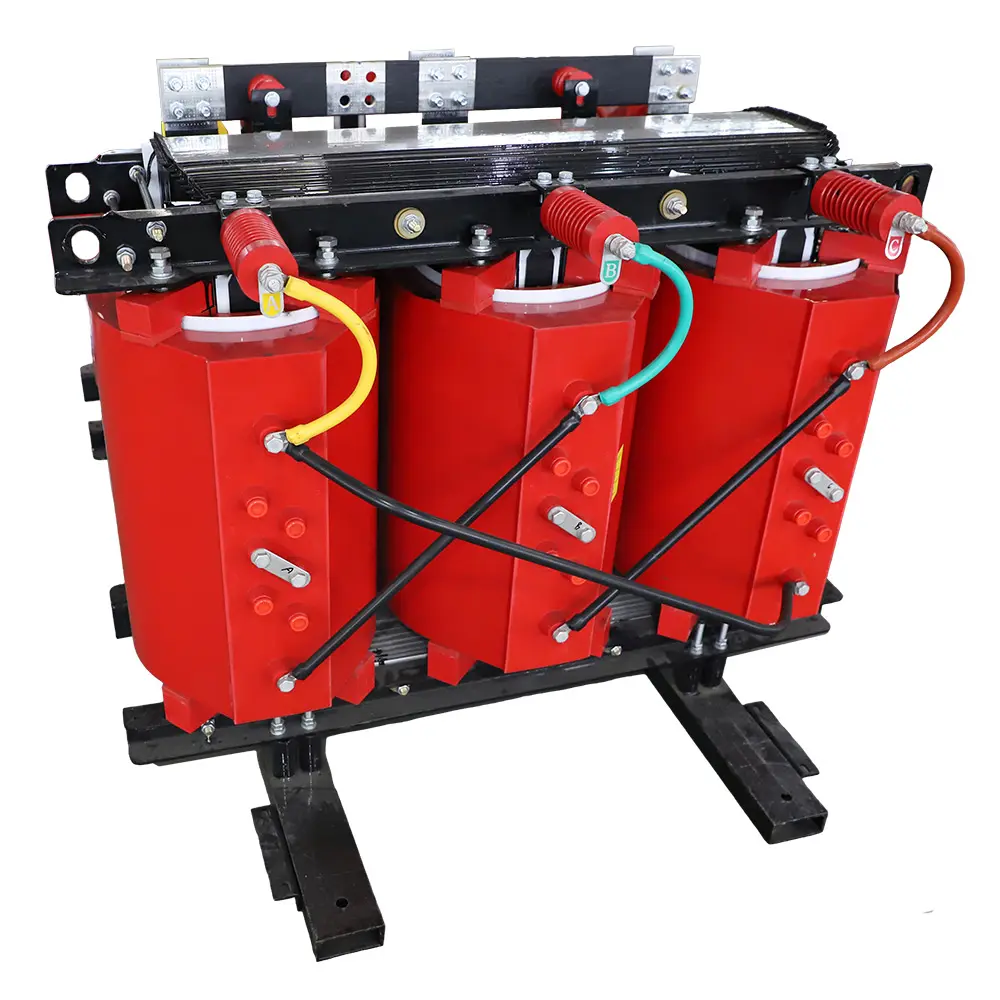
1. What Is a Dry Type Transformer?
A dry type transformer is an electrical transformer that uses air and solid insulation systems rather than an insulating liquid to provide insulation and manage heat. Its primary and secondary windings transfer electrical energy through electromagnetic induction while maintaining the electrical separation required between circuits.
Like other transformers, a dry type unit can step voltage up or down according to the requirements of a power system. It may be used to supply distribution panels, industrial machinery, lighting systems, building services, and other electrical loads.
Dry type transformers are commonly installed indoors, although certain designs are suitable for protected outdoor locations when the manufacturer specifies an appropriate enclosure and environmental rating. Their suitability depends on insulation materials, enclosure design, cooling arrangements, voltage level, and the surrounding operating conditions.
Core Components
- Magnetic core: Provides a low-reluctance path for magnetic flux and is commonly built from laminated electrical steel.
- Primary winding: Receives electrical power from the incoming supply.
- Secondary winding: Delivers power at the required output voltage.
- Solid insulation: Separates conductors and winding sections to help withstand electrical stress.
- Cooling passages: Allow heat to dissipate through natural air circulation or assisted airflow, depending on the design.
- Enclosure and terminals: Provide mechanical protection and safe connection points according to the unit's specified configuration.
The quality and coordination of these components influence reliability, temperature rise, efficiency, noise, and expected service life. Buyers should evaluate the complete design rather than focusing only on the rated capacity or purchase price.
2. How Does a Dry Type Transformer Work?
A dry type transformer operates through electromagnetic induction. When alternating current flows through the primary winding, it creates a changing magnetic field in the core. This changing flux induces a voltage in the secondary winding. The relationship between the winding turns determines the transformation ratio, allowing the equipment to deliver the voltage required by the connected system.
For example, a facility receiving medium-voltage electricity may use a distribution transformer to supply lower-voltage equipment. The exact primary and secondary ratings depend on the utility supply, electrical system design, connected loads, and applicable local requirements.
Where Does the Heat Go?
Electrical resistance in the windings and magnetic losses in the core produce heat during operation. A dry type transformer transfers this heat to the surrounding air through its insulation surfaces, cooling channels, and designed airflow paths. Some models use natural air circulation, while others employ fans to increase cooling capacity under specified operating conditions.
Good ventilation is therefore essential. Even a correctly sized transformer can overheat if it is installed in a cramped room, exposed to excessive ambient temperatures, or surrounded by dust that obstructs cooling passages.
3. Key Benefits for Modern Power Distribution
Reduced Risk of Liquid-Related Leakage
Because a dry type transformer does not rely on an insulating liquid in the same way as a liquid-immersed transformer, it avoids the routine liquid leakage concerns associated with oil-filled equipment. This can simplify certain indoor installations and reduce the need for liquid containment measures specifically intended for transformer oil. Site fire codes and electrical regulations still apply, and the overall safety of the installation depends on the complete equipment and building design.
Practical Indoor Installation
Dry type designs are often considered for office buildings, hospitals, schools, shopping centers, transport facilities, and industrial plants. Their suitability for indoor use can help project teams plan compact electrical rooms, subject to clearance, ventilation, access, and fire-protection requirements.
Maintenance Focused on Inspection and Condition
Routine maintenance generally emphasizes visual inspection, cleaning, connection checks, monitoring, and verification of protective systems rather than liquid sampling and treatment. Actual maintenance requirements vary by insulation system, operating environment, manufacturer recommendations, and applicable regulations.
Reliable Operation Under Suitable Conditions
A correctly specified transformer can provide stable voltage transformation and dependable service over a long operating period. Reliability is supported by appropriate loading, effective cooling, good workmanship, coordinated protection, and a maintenance program that identifies developing problems before they cause a failure.
Design Options for Different Projects
Dry type transformers are available in multiple capacity ranges, voltage configurations, winding arrangements, insulation systems, and enclosure options. This flexibility allows engineers to specify equipment according to electrical performance, available space, environmental exposure, and project standards.
4. Where Are Dry Type Transformers Commonly Used?
Dry type transformers serve a broad range of applications wherever a suitable voltage conversion solution is required. The correct choice depends on the load profile, installation location, fault level, environmental conditions, and applicable electrical standards.
Commercial Buildings
Office towers, hotels, shopping centers, and mixed-use developments use transformers to supply lighting, elevators, HVAC systems, and distribution boards. For these facilities, project teams often pay particular attention to installation space, noise, accessibility, ventilation, and building safety requirements.
Industrial Facilities
Manufacturing plants use transformers to supply production lines, motors, control equipment, process systems, and auxiliary services. Industrial environments may contain dust, vibration, corrosive substances, or elevated ambient temperatures, so the transformer and enclosure must be selected for the actual site conditions.
Hospitals and Public Infrastructure
Healthcare facilities, airports, railway systems, data facilities, and other critical installations may require carefully coordinated power distribution and backup arrangements. Transformer selection should form part of the broader electrical reliability strategy, including emergency power, protective devices, maintenance access, and operational continuity planning.
Renewable Energy and Electrical Upgrades
Solar power facilities, energy storage installations, and industrial electrification projects may use dry type transformers where their electrical ratings and environmental suitability match the application. Engineers should assess harmonics, load variation, inverter characteristics, and thermal performance when specifying transformers for power-electronic systems.
| Application | Key Consideration | Potential Selection Priority |
|---|---|---|
| Commercial buildings | Indoor space and building safety | Suitable enclosure, noise, ventilation, and access |
| Manufacturing plants | Continuous or variable industrial loads | Capacity, thermal performance, and protection |
| Hospitals and public facilities | Operational continuity | Reliability, maintenance access, and system coordination |
| Solar and energy storage | Power-electronic equipment and changing loads | Harmonic capability and application-specific design |
| Infrastructure upgrades | Compatibility with existing equipment | Voltage, connection arrangement, footprint, and standards |
5. What Are the Main Types of Dry Type Transformers?
Different dry type transformer designs address different combinations of insulation, cooling, voltage, and installation requirements. Two common categories are cast-resin transformers and VPI transformers. Their suitability depends on the design details and service environment, not simply the category name.
Cast-Resin Dry Type Transformers
In cast-resin designs, one or more winding sections are encapsulated in resin. This construction can provide mechanical support and protection for the encapsulated winding surfaces. Cast-resin transformers are frequently considered for indoor distribution and locations where environmental exposure is an important design factor.
Buyers should still verify the permitted humidity, condensation, pollution, and temperature conditions. Resin encapsulation does not make every transformer suitable for every harsh environment, nor does it remove the need for appropriate ventilation and inspection.
Vacuum Pressure Impregnated (VPI) Transformers
VPI construction uses a controlled impregnation process to introduce insulating resin or varnish into the winding insulation system. The process helps bind insulation components and improve mechanical integrity. Performance depends on the insulation materials, manufacturing process, design, and specified environmental conditions.
Comparison at a Glance
| Factor | Cast-Resin Design | VPI Design |
|---|---|---|
| Insulation approach | Selected winding sections are encapsulated in resin | Winding insulation is impregnated with resin or varnish |
| Mechanical support | Encapsulation can provide substantial support to treated sections | Impregnation binds insulation materials according to the design |
| Environmental suitability | Must be confirmed against humidity, dust, and temperature requirements | Must be confirmed against humidity, dust, and temperature requirements |
| Maintenance needs | Inspection, cleaning, connection checks, and condition monitoring | Inspection, cleaning, connection checks, and condition monitoring |
| Selection basis | Insulation design, site conditions, electrical ratings, and total cost | Insulation design, site conditions, electrical ratings, and total cost |
Neither construction should be treated as universally superior. The appropriate solution is the one that meets the project's electrical, thermal, environmental, safety, and lifecycle requirements with verified technical documentation.
6. How to Select the Right Dry Type Transformer Capacity
Capacity selection is one of the most important steps in transformer procurement. An undersized unit may experience excessive temperature rise or fail to support the required load. An unnecessarily oversized unit can increase initial cost and may operate less efficiently under certain load conditions. The goal is to select a transformer that meets present needs while accommodating realistic future demand.
Step 1: Confirm the Electrical System Requirements
Identify the primary and secondary voltages, frequency, phase arrangement, connection group, grounding requirements, and system short-circuit conditions. Confirm that the proposed transformer is compatible with upstream and downstream equipment.
Step 2: Calculate the Connected Load
List the equipment expected to operate from the transformer. Record each load's rated power, voltage, power factor, operating pattern, and starting characteristics where relevant. Avoid simply adding nameplate ratings without considering how the equipment will actually operate.
For a balanced three-phase system, apparent power can be calculated using:
S (kVA) = √3 × V (volts) × I (amperes) ÷ 1,000
For a single-phase system, the corresponding relationship is:
S (kVA) = V (volts) × I (amperes) ÷ 1,000
These formulas calculate apparent power from line voltage and current. A qualified engineer should confirm the design load, demand assumptions, power factor, harmonics, and relevant operating conditions before choosing the final rating.
Step 3: Evaluate Load Growth and Operating Patterns
Consider planned machinery additions, building expansion, charging infrastructure, future HVAC requirements, or changes in production. A realistic allowance for growth may prevent premature replacement, but excessive spare capacity can waste capital. Use an engineering load forecast rather than an arbitrary oversized rating.
Step 4: Assess Starting Current and Nonlinear Loads
Motors, compressors, pumps, welders, variable-frequency drives, UPS systems, and other power-electronic equipment can introduce transient demands or harmonic currents. These characteristics may influence transformer selection, voltage regulation, heating, and protection settings. Share the actual load information with the manufacturer or design engineer.
Step 5: Check the Installation Environment
Transformer capacity is not determined by kVA alone. Ambient temperature, altitude, ventilation, enclosure design, and installation clearances can affect permissible loading. Any required derating should be based on the manufacturer's documented guidance and the relevant standards.
7. What Installation Conditions Affect Transformer Reliability?
Even a well-manufactured transformer can underperform when installed in an unsuitable environment. A careful site review before delivery helps reduce commissioning delays and future operating problems.
Ventilation and Heat Dissipation
Provide the clearances and ventilation openings specified by the manufacturer. Avoid placing materials against cooling surfaces or blocking air paths with cable bundles, partitions, or stored items. Where mechanical ventilation is required, verify its capacity and consider how it will operate during a building ventilation failure.
Dust, Moisture, and Contamination
Dust deposits can obstruct cooling passages and may contribute to surface tracking when combined with moisture or conductive contamination. Condensation can damage insulation systems and reduce electrical reliability. If the installation area has high humidity, airborne chemicals, salt, or conductive dust, discuss suitable protection and environmental limits before ordering.
Floor Loading, Clearance, and Access
Check the transformer's dimensions, weight, lifting points, mounting arrangement, cable entry direction, and required service clearance. The floor or supporting structure must safely accommodate the load. Ensure that maintenance staff can access terminals and inspection points without creating unsafe working conditions.
Grounding and Electrical Protection
Protective grounding, overcurrent protection, short-circuit withstand capability, and coordination with the wider electrical system must follow the approved design and applicable codes. Connections should be installed and verified by qualified personnel using the specified procedures and torque values.
Noise and Vibration
Transformer hum may be noticeable in quiet rooms, offices, healthcare environments, and residential-adjacent installations. Consider the manufacturer's noise data, mounting structure, vibration transmission, and nearby occupied spaces during planning.
8. How Can Maintenance Prevent Unexpected Downtime?
Preventive maintenance helps identify changes in operating condition before they develop into costly failures. The inspection interval should be determined by the manufacturer's recommendations, operating history, site conditions, criticality of the load, and local requirements.
Routine Inspection Tasks
- Check for unusual noise, vibration, odor, visible damage, or signs of overheating.
- Inspect cooling passages and ventilation equipment for dust buildup or obstruction.
- Review temperature readings and alarms, where monitoring is available.
- Look for corrosion, moisture, contamination, loose covers, or damaged enclosures.
- Verify that protective devices, sensors, and alarm circuits are maintained according to the approved schedule.
- Have qualified personnel inspect electrical connections and confirm tightening requirements using approved procedures.
- Maintain records of load, ambient temperature, alarms, inspections, and corrective actions.
Common Warning Signs and Possible Causes
| Observed Symptom | Possible Cause | Recommended Response |
|---|---|---|
| Higher-than-normal temperature | Overload, restricted airflow, high ambient temperature, or internal issue | Check load and ventilation; follow the manufacturer's troubleshooting process |
| Unusual noise or vibration | Mounting problems, loose components, electrical conditions, or changing load | Arrange inspection by qualified personnel and compare with normal operating behavior |
| Repeated protective trips | Overcurrent, short circuit, incorrect settings, or equipment fault | Investigate the fault before restoring service; never bypass protection |
| Dust or contamination buildup | Unsuitable room conditions or insufficient cleaning intervals | Review the environment and clean only under approved safe-work procedures |
| Unexpected alarm activation | Sensor issue, abnormal temperature, or operating condition outside limits | Check alarm records and investigate the cause before resetting |
9. Understanding the Total Cost of Ownership
The purchase price is only one part of a transformer's lifetime cost. A lower-priced unit may become more expensive if it has higher losses, requires costly site modifications, lacks appropriate documentation, or is difficult to maintain. Buyers should compare technically equivalent proposals rather than evaluating quotations by price alone.
Key Cost Factors
- Initial purchase price: Includes the transformer configuration, specified accessories, enclosure, and testing requirements.
- Energy losses: Core and winding losses contribute to electricity consumption and heat generation throughout operation.
- Installation work: Transportation, lifting, cabling, ventilation, foundations, and electrical protection may affect project cost.
- Maintenance: Inspection, cleaning, testing, spare parts, and service labor contribute to lifecycle expenditure.
- Downtime exposure: The consequences of a power interruption can be significant in production facilities and critical infrastructure.
- Replacement and expansion: Future capacity needs, equipment compatibility, and the availability of technical support should be considered.
Ask suppliers to provide guaranteed loss data and explain the conditions under which those values apply. Where operating hours and electricity costs are known, an engineer or energy specialist can estimate the financial impact of transformer losses over the expected service life.
Also verify which tests are included in the quotation, which standards the product is designed to meet, what documentation will be supplied, and whether the proposed delivery schedule supports the project plan.
10. What Should Buyers Check Before Ordering?
A structured purchasing process reduces the risk of specification gaps, delivery problems, and commissioning delays. Before placing an order, confirm the following details with the project engineer and supplier.
- Rated capacity in kVA and the expected load profile
- Primary and secondary voltages, frequency, and phase arrangement
- Winding connection and vector group requirements
- Insulation class and permitted temperature rise
- Cooling method and any applicable derating conditions
- Impedance, voltage regulation, and short-circuit requirements
- Specified efficiency or guaranteed no-load and load losses
- Indoor or outdoor location and required enclosure protection
- Ambient temperature, altitude, humidity, dust, and contamination exposure
- Noise limits, installation dimensions, weight, and cable entry arrangement
- Applicable standards, routine tests, and any required special tests
- Drawings, nameplate information, operation manuals, and maintenance documents
- Warranty terms, delivery schedule, spare parts, and technical support arrangements
Provide complete technical requirements as early as possible. If a project has unusual load characteristics, a restricted electrical room, high humidity, or demanding continuity requirements, share those details before the transformer design is finalized. Early coordination helps prevent expensive changes after manufacturing or delivery.
11. Frequently Asked Questions About Dry Type Transformers
Q1: What is the main purpose of a dry type transformer?
Its main purpose is to transfer electrical energy between circuits at different voltage levels through electromagnetic induction. It is commonly used in commercial, industrial, and infrastructure power distribution systems where a dry insulation design suits the installation conditions.
Q2: Is a dry type transformer suitable for indoor installation?
Many dry type transformers are designed for indoor use. However, the installation must meet requirements for ventilation, clearance, temperature, humidity, enclosure protection, fire safety, and electrical access. Always confirm the intended application with the manufacturer.
Q3: What is the difference between a dry type and an oil-immersed transformer?
A dry type transformer uses air and solid insulation rather than an insulating liquid as its primary insulation and cooling medium. An oil-immersed transformer uses liquid insulation and cooling. Their installation requirements, maintenance practices, cooling performance, fire considerations, and costs differ according to the design and application.
Q4: How do I determine the required transformer capacity?
Calculate the expected apparent load, consider demand and load diversity where applicable, evaluate motor starting and nonlinear loads, and allow for realistic future expansion. A qualified electrical engineer should verify the final kVA rating against system voltage, thermal limits, fault conditions, and applicable standards.
Q5: Does a dry type transformer require maintenance?
Yes. Maintenance typically includes inspection, cleaning under safe conditions, ventilation checks, temperature monitoring, connection inspection, and verification of protective devices. The exact schedule depends on the design, operating environment, manufacturer instructions, and applicable regulations.
Q6: Can a dry type transformer operate in a dusty or humid environment?
It depends on the insulation system, enclosure, environmental rating, and the severity of the conditions. Dust and moisture can impair insulation performance and cooling. Describe the site's actual conditions to the supplier so that a suitable design and any necessary protective measures can be specified.
Q7: What causes a dry type transformer to overheat?
Possible causes include excessive loading, restricted airflow, high ambient temperature, harmonic currents, poor electrical connections, or an internal fault. Investigate abnormal temperatures promptly, review operating data, and use qualified personnel to identify the root cause.
Q8: How long can a dry type transformer last?
Service life varies with design quality, insulation temperature, loading, environmental conditions, maintenance, and operating history. There is no single lifespan that applies to every unit. Appropriate specification, installation, and condition monitoring help support long-term reliability.
Q9: What documents should accompany a transformer delivery?
Depending on the contract and project requirements, documentation may include approved drawings, nameplate data, test reports, installation instructions, operation and maintenance manuals, warranty information, and relevant conformity documents. Confirm the required document list before placing the order.
Q10: Why should buyers evaluate the supplier as well as the product?
A supplier's technical capability, manufacturing quality controls, documentation, testing procedures, communication, and after-sales support can affect project execution and long-term serviceability. Evaluating these factors alongside electrical specifications gives buyers a more complete basis for comparing proposals.
12. Conclusion: Making a Confident Dry Type Transformer Decision
A dry type transformer can be an effective solution for reliable power distribution when its electrical ratings, insulation system, cooling method, and enclosure are matched to the real operating environment. The best selection process begins with accurate load information and continues through installation planning, technical verification, commissioning, and preventive maintenance.
Rather than focusing on capacity or initial price alone, buyers should compare efficiency, guaranteed losses, temperature limits, environmental suitability, testing documentation, installation requirements, and long-term support. These factors help reduce avoidable operating risks and create a more dependable electrical system.
For projects requiring a dry type transformer, working with a supplier that can clearly explain product specifications and technical requirements makes the procurement process more straightforward. Review the intended application, share the electrical parameters, and confirm the necessary standards and documents before finalizing the order.
Looking for a Dry Type Transformer for Your Project?
Choosing the right transformer starts with understanding your voltage requirements, load profile, installation environment, and long-term operating goals. SYHF provides a starting point for exploring transformer solutions and discussing project requirements.
Visit the SYHF dry type transformer page to learn more about the product range. If you need help clarifying specifications, evaluating application requirements, or preparing for a project quotation, contact us to discuss your needs and identify the information required for the next step.
