

What Makes a USB Socket Worth Choosing for Modern Workspaces?
2026-05-13
When I plan a meeting room, training center, control desk, hotel workspace, or multimedia classroom, I rarely treat power access as a small detail. A poorly placed outlet can interrupt a presentation, clutter a tabletop, slow down device charging, and make an otherwise premium space feel unfinished. That is why I pay close attention to practical desktop power solutions from manufacturers such as Guangzhou Junnan Audiovisual Technology Co,.Ltd., especially when I need a clean, reliable, and user-friendly USB Socket that supports daily use without making the desk look crowded.
A good socket is not just a place to plug in a cable. In many commercial environments, it becomes part of the user experience. People arrive with laptops, phones, tablets, wireless microphones, conference equipment, chargers, and sometimes several devices at once. If the socket design is inconvenient, the whole room feels less efficient. If the socket is hidden, stable, easy to access, and visually neat, the room immediately feels more professional.
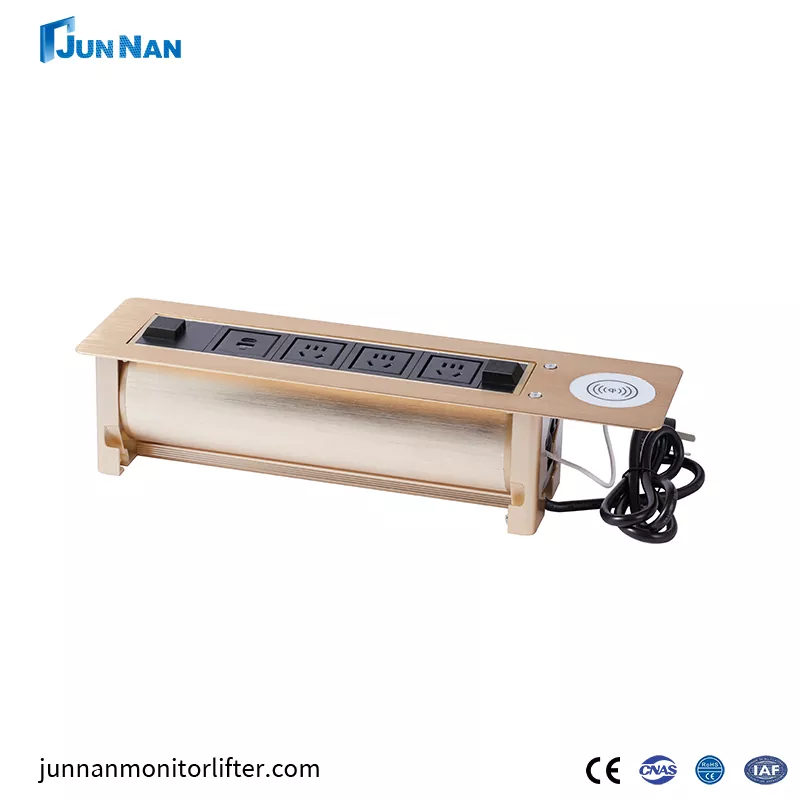
Why Do I Consider a USB Socket More Than a Simple Charging Point?
I consider a USB Socket a practical bridge between furniture, technology, and daily workflow. In a conference room, people do not want to crawl under the table looking for power. In a classroom, teachers do not want charging cables stretched across walking areas. In a hotel or office lounge, guests expect charging access to be obvious, safe, and convenient.
That is why an integrated socket can solve several common problems at the same time:
- It reduces messy cables across the desktop.
- It provides easier access to charging and power supply.
- It helps keep the table surface clean when the socket is not in use.
- It supports phones, tablets, laptops, and meeting devices in one location.
- It improves the overall appearance of conference furniture and office interiors.
For me, the biggest advantage is not only convenience. It is consistency. Once a workspace has a well-designed power access point, users do not need to ask where to charge their devices or how to connect equipment. The room becomes easier to use without extra explanation.
Which Problems Can a Well Designed USB Socket Help Me Avoid?
In real projects, I often see the same issues repeated. A meeting table looks beautiful, but power strips are placed on the floor. A training room has enough chairs, but not enough charging ports. A hotel room has sockets, but they are hidden behind furniture. These details may look small during installation, but they affect daily satisfaction.
A practical USB Socket helps me avoid these pain points:
| Common Problem | Impact on Users | How a USB Socket Helps |
|---|---|---|
| Messy desktop cables | The space looks unorganized and less professional | Integrated installation keeps charging access in one clean area |
| Hard-to-reach wall outlets | Users waste time searching for power | Desktop or embedded access makes charging more convenient |
| Limited charging options | Multiple users compete for one outlet | Multi-port designs support several devices more comfortably |
| Untidy meeting tables | The room feels less premium during client visits | Hidden or pop-up structures preserve a neat surface |
| Unstable temporary power strips | Safety and reliability become concerns | Fixed installation improves stability for frequent use |
When I compare different options, I usually look for a socket that balances appearance, durability, charging convenience, and installation flexibility. The right product should not force the user to adapt to it. It should quietly fit into the room and make everything easier.
What Should I Look for Before Choosing a USB Socket?
Before I choose a USB Socket, I usually start with the actual use scenario rather than the product photo. A socket for a conference table may need a hidden flip-up or pop-up structure. A socket for a hotel desk may need a compact and elegant surface-mounted design. A socket for a multimedia room may need multiple interfaces to support both power and device charging.
Here are the factors I would check carefully:
- Installation style — I need to know whether the socket should be embedded, pop-up, flip-up, or concealed.
- Port configuration — I check whether it includes USB charging, power outlets, wireless charging, or other connection options.
- Desktop appearance — I prefer a design that blends with the table instead of making it look crowded.
- Charging performance — I consider whether the socket can support frequent daily charging without unstable output.
- Material and durability — In commercial spaces, the socket must handle repeated opening, closing, plugging, and unplugging.
- User safety — A stable structure and reliable electrical design matter more than a low purchase price.
- Customization ability — For project buyers, matching the table size, color, interface layout, and installation requirements can be very important.
I do not recommend choosing only by price. A cheap socket that becomes loose, overheats, looks rough, or fails after frequent use can cost more in maintenance and replacement. For project-based procurement, long-term reliability is usually more valuable than saving a small amount at the beginning.
Is a Hidden or Pop Up USB Socket Better for Conference Tables?
For conference tables, I usually prefer a hidden, embedded, or pop-up USB Socket because the table needs to look clean when no one is using it. A visible power strip can make even an expensive meeting room feel temporary. Hidden sockets solve this problem by keeping the interface available only when needed.
A pop-up or flip-up design is especially useful when the room hosts formal meetings, video conferences, training sessions, or presentations. Users can open the socket, connect devices, and close it after use. This keeps the tabletop neat while still offering easy access to power.
In my view, a conference table socket should provide three things at the same time:
- It should be easy to open and use without complicated steps.
- It should stay stable after repeated operation.
- It should match the table design instead of looking like an afterthought.
This is where professional audiovisual and conference equipment manufacturers have an advantage. They usually understand that the socket is part of the whole meeting system, not just an isolated electrical accessory.
Which Spaces Benefit Most from a USB Socket?
I find that a USB Socket is useful in more places than many buyers first expect. It is not limited to office desks. Any environment where people use electronic devices can benefit from integrated power access.
| Application Area | Typical User Need | Recommended Socket Feature |
|---|---|---|
| Conference room | Charging laptops, phones, and meeting equipment | Hidden desktop socket with multiple interfaces |
| Training classroom | Supporting tablets, teaching devices, and student laptops | Durable socket with convenient access |
| Hotel room | Simple charging for guests | Compact socket with USB charging ports |
| Control center | Stable power access for long working hours | Reliable embedded power module |
| Multimedia lecture hall | Powering audiovisual and presentation devices | Multi-function socket with organized cable access |
For project buyers, this flexibility matters. If one supplier can provide different socket styles for different furniture and room types, procurement becomes easier and the final design looks more unified.
What Product Advantages Matter Most to Me in Daily Use?
When I evaluate a USB Socket, I care about how it performs after installation. The product may look attractive in a catalog, but the real test happens when users open it every day, plug in chargers, connect laptops, and expect it to work without trouble.
The product advantages I value most include:
- Clean integration — The socket should fit naturally into the tabletop or furniture surface.
- Convenient charging — USB ports should support common devices used in offices, hotels, and meeting rooms.
- Space saving — A hidden or embedded structure helps reduce desktop clutter.
- Smooth operation — Pop-up or flip-up movement should feel stable and easy to control.
- Professional appearance — The design should support modern interior decoration rather than damage it.
- Project adaptability — The socket should be suitable for different commercial furniture layouts.
In my experience, buyers often focus on the number of ports first. That is understandable, but I also pay close attention to the structure. A well-placed socket with fewer but better-organized interfaces can be more useful than a crowded socket that looks messy and is uncomfortable to operate.
Do Buyers Need Custom USB Socket Solutions for Project Orders?
For single-use home applications, a standard product may be enough. But for commercial projects, I often prefer customized or project-matched solutions. Table size, installation depth, room style, plug standard, color, interface quantity, and charging requirements may vary from one project to another.
A professional supplier can help buyers choose a more suitable configuration instead of forcing one standard model into every environment. This is especially important for conference furniture manufacturers, system integrators, office renovation contractors, hotel project buyers, and audiovisual solution providers.
When I request a quote, I usually prepare several details in advance:
- Where the socket will be installed
- How many units are needed
- What plug standard is required
- Whether USB charging or wireless charging is needed
- Whether the socket should be hidden, pop-up, flip-up, or fixed
- What table material and thickness will be used
- Whether the project needs branding, color matching, or special interface layout
These details help reduce communication time and make the final recommendation more accurate. They also help avoid installation issues after the product arrives.
Why Should I Choose a Professional Manufacturer Instead of a General Supplier?
I prefer working with a professional manufacturer because socket products are closely connected with installation, safety, durability, and user experience. A general supplier may only provide a model number and price, while a manufacturer with experience in conference and audiovisual equipment can better understand how the socket will be used in a real project.
For example, a meeting table socket needs to coordinate with monitors, microphones, lifting displays, tabletop signs, control systems, and other conference equipment. If the supplier understands this environment, the recommendation will usually be more practical.
A manufacturer can also provide better support when buyers need:
- Bulk purchasing for commercial projects
- Customized interface combinations
- Stable product quality for repeated orders
- Guidance for installation and application scenarios
- Consistent appearance across different room types
- After-sales support for project buyers
This is one reason I would pay attention to companies that specialize in audiovisual and conference-related products. Their understanding of desktop integration can make the socket selection more practical and less risky.
What Makes a USB Socket a Smarter Choice for Modern Offices?
A modern office is no longer just a place with desks and chairs. It is a device-heavy environment. People move between conference rooms, workstations, lounges, training areas, and shared spaces. They expect charging access to be simple, visible when needed, and invisible when not needed.
A well-selected USB Socket supports this expectation. It makes the space easier to use and helps companies present a more organized image to employees, guests, and clients. It also reduces the need for temporary power strips, loose chargers, and messy extension cables.
For me, the smartest socket is not the most complicated one. It is the one that quietly solves daily problems. It gives users power where they need it, keeps the desk clean, supports common devices, and fits the project design without creating extra trouble.
How Can I Get the Right USB Socket for My Project?
If I am choosing a socket for a conference room, office desk, hotel project, classroom, or multimedia space, I would not wait until the final installation stage. Power access should be planned early, because it affects furniture design, cable routing, user comfort, and the finished appearance of the room.
A reliable USB Socket can improve the way people use a workspace every day. It can make charging easier, keep desktops cleaner, and give commercial interiors a more polished and professional feel. For buyers who need project support, customized options, or bulk supply, working with an experienced manufacturer can make the selection process much smoother.
If you are looking for a practical socket solution for conference tables, office furniture, hotel desks, training rooms, or audiovisual projects, you can leave an inquiry today. Contact us to discuss your installation needs, preferred socket style, interface configuration, and order quantity, and we will help you choose a suitable USB socket solution for your project.