

What Makes a Water Treatment Pump Control Panel Essential for Reliable Pumping?
2026-09-30
Water treatment systems depend on stable, coordinated pump operation to move, circulate, transfer, and discharge water efficiently. A Water Treatment Pump Control Panel serves as the electrical and automation center that manages pump starting, stopping, protection, monitoring, and sequencing. Depending on the application, it can integrate circuit breakers, contactors, overload protection, PLCs, sensors, variable frequency drives (VFDs), HMIs, and communication interfaces. For treatment plants, wastewater facilities, pumping stations, and industrial water systems, a properly configured panel can make daily operation more controlled, responsive, and easier to maintain.
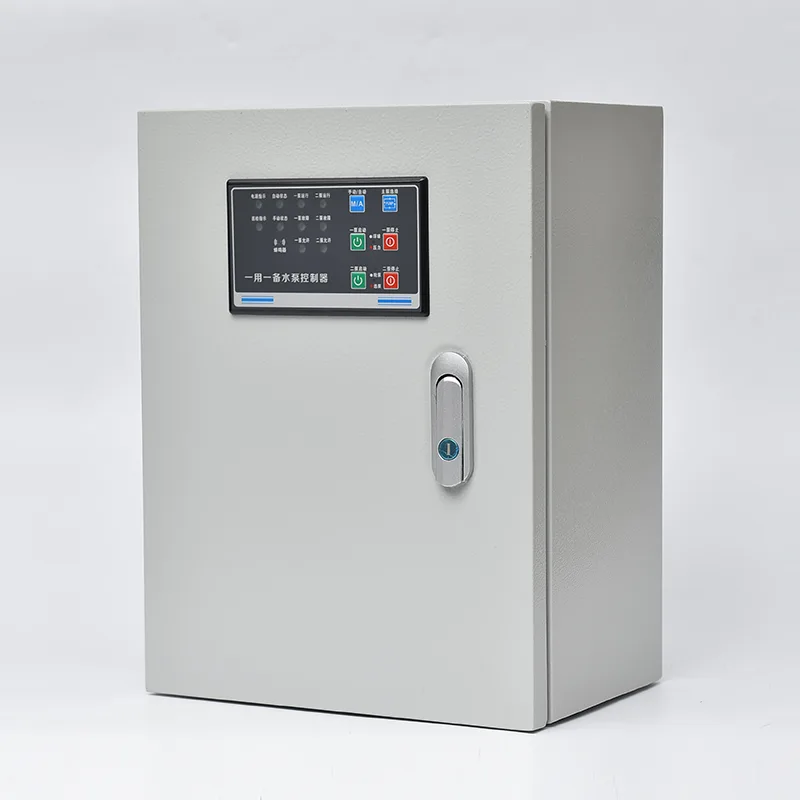
How Does a Water Treatment Pump Control Panel Work?
The basic function is to receive operating information from the water treatment system and convert it into appropriate pump commands. Level, pressure, flow, or other sensor signals can be sent to the controller. The control logic then determines whether a pump should start, stop, speed up, slow down, or switch to another operating mode.
For example, when a tank level rises above a preset point, the panel can start the duty pump. If the water level continues to rise and one pump cannot provide sufficient capacity, a second pump can be activated. When the level returns to the required range, the system can stop or reduce pump operation.
For multi-pump applications, automatic lead-lag sequencing and pump alternation can distribute operating hours more evenly and provide standby capability.
Typical Operating Process
-
Signal detection – Sensors monitor water level, pressure, flow, or equipment status.
-
Logic processing – The PLC or pump controller evaluates the received signals.
-
Pump control – The panel starts, stops, or adjusts pump operation.
-
Protection – Electrical and motor protection functions respond to abnormal conditions.
-
Monitoring – The HMI displays operating status, parameters, and alarms.
-
Communication – The system can exchange information with SCADA or other supervisory systems when required.
This integrated approach reduces the need for constant manual intervention while providing operators with clearer information about system conditions.
Why Is Pump Control Important in Water Treatment?
Pump performance directly affects water movement throughout a treatment process. An incorrectly controlled pump may operate under unsuitable conditions, consume unnecessary energy, or experience excessive mechanical and electrical stress.
A well-designed Water Treatment Pump Control Panel can provide several practical benefits:
| Function | Practical Effect |
|---|---|
| Automatic start/stop | Reduces repetitive manual operation |
| Overload protection | Helps protect motors from excessive current |
| Dry-run protection | Helps prevent pump operation without sufficient water |
| Level control | Matches pumping activity with tank conditions |
| Pressure control | Helps maintain more stable system pressure |
| VFD control | Allows pump speed to respond to changing demand |
| Pump alternation | Helps balance operating hours between pumps |
| Alarm monitoring | Makes abnormal conditions easier to identify |
| Remote communication | Supports centralized monitoring where required |
Modern systems can combine PLC control with VFDs so pump speed can be adjusted according to actual process demand. This can help reduce unnecessary operation and provide smoother pumping performance.
What Components Are Included?
The exact configuration depends on pump capacity, the number of pumps, control requirements, installation conditions, and the treatment process. Common components include:
-
Circuit breakers: Provide basic electrical isolation and protection.
-
Contactors and relays: Control motor switching and related electrical circuits.
-
Overload protection: Helps protect motors from excessive electrical load.
-
PLC or pump controller: Processes signals and executes programmed control logic.
-
VFD: Adjusts motor speed when variable-speed operation is required.
-
Level and pressure sensors: Provide real-time process information.
-
HMI: Gives operators access to operating status, parameters, and alarms.
-
Communication interfaces: Support connections with SCADA, BMS, or other systems.
The combination should be selected according to the actual application rather than simply using a standard cabinet configuration.
Where Can It Be Used?
A Water Treatment Pump Control Panel can be configured for different water-handling applications, including:
Municipal Water Systems
Municipal pumping systems require dependable operation because water demand can change throughout the day. Automatic pressure or level control can help coordinate pump operation according to system requirements.
Wastewater Treatment
Wastewater applications may require level-based pump sequencing, standby pump operation, high-level alarms, and additional protection against challenging operating conditions.
Industrial Water Treatment
Factories may use pumps for raw-water transfer, process-water circulation, filtration, reverse osmosis systems, cooling-water circulation, or wastewater discharge. Customized control logic allows the panel to match different process requirements.
Commercial Water Systems
Commercial buildings, hotels, and other facilities can use pump control panels for water supply, drainage, booster pumping, and tank management.
How Does VFD Control Improve Pump Operation?
Traditional fixed-speed pumps generally operate at a predetermined speed, while actual water demand can vary. A VFD allows the pump motor speed to be adjusted according to pressure, flow, or other control signals.
For example, when water demand decreases, the controller can reduce pump speed. When demand increases, it can increase speed or bring an additional pump online. This approach can provide smoother operation, stable process conditions, and potentially lower energy consumption depending on the pump system and operating profile.
For projects requiring constant pressure, constant flow, or variable demand, VFD integration can therefore be an important consideration when selecting a control panel.
What Makes Customized Control Panels More Practical?
Not every water treatment project has the same pump quantity, motor rating, sensor arrangement, or control sequence. A customized panel can be designed around the actual equipment and operating requirements.
Zhejiang Csivei Automation Co., Ltd. provides Water Treatment Pump Control Panel solutions designed for different pump applications. Its configurations can integrate motor control, protection, PLC-based automation, VFD control, sensing devices, HMI operation, and communication functions according to project requirements.
For buyers, several points should be confirmed before selecting a panel:
-
Number and power rating of pumps
-
Power supply and electrical specifications
-
Duty, standby, or duty-assist pump arrangement
-
Required pressure, flow, and level signals
-
Manual and automatic operating modes
-
VFD or soft-starter requirements
-
Alarm and protection functions
-
HMI and monitoring requirements
-
Communication protocol
-
Indoor or outdoor installation environment
Providing these details helps ensure that the final panel matches the actual water treatment system instead of relying on assumptions.
What Results Can the Right Panel Deliver?
The value of a control panel is not limited to turning a pump on and off. When electrical protection, process signals, automation logic, and monitoring are properly coordinated, the overall pumping system can become easier to operate and maintain.
A suitable Water Treatment Pump Control Panel can help achieve:
More consistent operation: Pumps respond automatically to changing process conditions.
Better equipment protection: Protective functions can identify electrical or operating abnormalities.
Simpler management: HMI interfaces provide operators with accessible operating information.
Flexible control: PLC and VFD technologies can support different pumping strategies.
Improved maintenance visibility: Fault information and operating status can help maintenance personnel identify problems more efficiently.
For water treatment projects where reliability, automation, and controllability are important, the control panel should be considered an integral part of the pumping system rather than an independent electrical cabinet.
Conclusion
A Water Treatment Pump Control Panel connects the electrical, control, protection, and monitoring requirements of a pumping system in one coordinated solution. From single-pump installations to multi-pump treatment facilities, the right configuration can support automatic operation, equipment protection, stable process control, and convenient monitoring.
Zhejiang Csivei Automation Co., Ltd. focuses on customized automation and pump control solutions for water treatment applications. Whether the project requires basic pump start-stop control, multi-pump sequencing, VFD-based regulation, HMI monitoring, or integrated communication, the panel can be configured around specific equipment and process requirements.
If you are planning a new water treatment project or upgrading an existing pumping system, contact us to discuss your pump specifications, control requirements, and customized Water Treatment Pump Control Panel solution.