

What Makes an Automatic Power Factor Controller Essential for Industrial Efficiency?
2026-03-05
In modern industrial and commercial electrical systems, managing power quality is more critical than ever. Reactive power caused by inductive loads such as motors, transformers, and lighting systems can lead to low power factor, resulting in higher electricity bills, energy losses, and strain on equipment. An Automatic Power Factor Controller (APFC) plays a vital role in maintaining system efficiency by automatically monitoring and correcting the power factor in real-time. Zhejiang Geyue Electric Technology Co., Ltd. specializes in high-quality APFC solutions designed to improve energy efficiency and reduce operational costs.
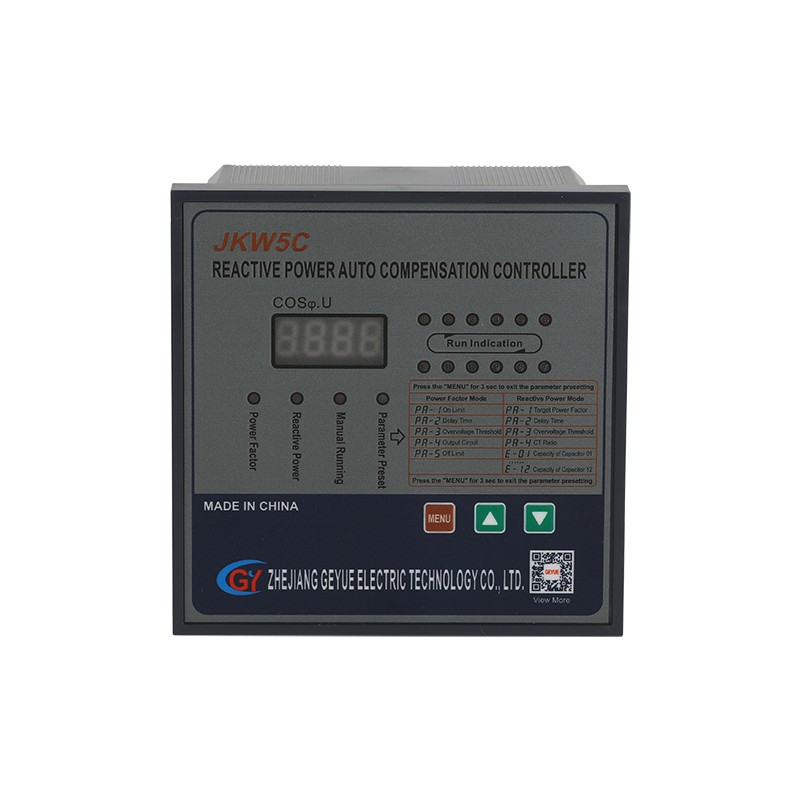
How Does an Automatic Power Factor Controller Work?
An Automatic Power Factor Controller continuously monitors the electrical system's power factor. When the power factor drops below a preset level, the controller automatically switches capacitor banks on or off to compensate for reactive power. This not only optimizes energy usage but also reduces penalties imposed by utility companies for low power factor.
Key Functional Features:
| Feature | Description |
|---|---|
| Real-time monitoring | Continuously measures voltage, current, and power factor. |
| Automatic switching | Engages or disengages capacitor banks as needed. |
| User-configurable settings | Allows customization for different industrial loads. |
| Protection mechanisms | Includes over-voltage, over-current, and short-circuit protection. |
Why Choose an Automatic Power Factor Controller?
-
Energy Savings: By maintaining a high power factor, industries can reduce reactive power consumption, leading to lower electricity bills.
-
Equipment Longevity: Proper power factor reduces electrical stress on motors, transformers, and other equipment, extending their service life.
-
Reduced Losses: Less reactive power means lower line losses, improving overall energy efficiency.
-
Regulatory Compliance: Many utilities impose penalties for low power factor; APFC helps industries avoid these fines.
APFC vs. Manual Power Factor Correction: Which Is Better?
| Aspect | Automatic Power Factor Controller | Manual Correction |
|---|---|---|
| Accuracy | High, adjusts instantly based on load | Low, adjustments are periodic |
| Maintenance | Minimal, automated operation | Frequent, human intervention required |
| Energy Efficiency | Optimal | Suboptimal, may overcompensate or undercompensate |
| Cost Over Time | Saves money through efficiency | Higher operational costs due to inefficiency |
The comparison clearly highlights that Automatic Power Factor Controllers are superior in terms of efficiency, reliability, and long-term savings.
Applications and Importance
APFCs are widely used across industries where inductive loads dominate, including:
-
Manufacturing plants with heavy machinery
-
Commercial complexes with HVAC systems
-
Electrical substations and distribution networks
-
Data centers and high-rise buildings
By maintaining an optimal power factor, APFCs prevent voltage drops, reduce electricity wastage, and enhance the overall stability of electrical networks.
Best Practices for APFC Implementation
-
Conduct a thorough load analysis to determine capacitor requirements.
-
Select a controller compatible with your load type and voltage rating.
-
Regularly inspect capacitor banks and connections for wear or damage.
-
Integrate with a monitoring system for data logging and predictive maintenance.
Benefits Checklist:
-
✅ Reduced electricity bills
-
✅ Enhanced equipment lifespan
-
✅ Compliance with utility regulations
-
✅ Improved operational efficiency
Conclusion
An Automatic Power Factor Controller is not just a technical accessory but a strategic investment for industrial and commercial facilities aiming to optimize energy efficiency and reduce costs. Zhejiang Geyue Electric Technology Co., Ltd. provides advanced APFC solutions that are reliable, easy to integrate, and tailored for diverse applications. Enhance your energy management strategy today and experience long-term savings.
For more information or to request a customized solution, contact us at Zhejiang Geyue Electric Technology Co., Ltd., and our experts will guide you to the best APFC solution for your needs.