

What Makes Dry Type Transformers Self-Extinguishing and Safe?
2026-09-15
1. What Does Self-Extinguishing Mean in the Context of Transformer Insulation?
Self-extinguishing is a material property defined by standardized tests such as UL 94 or IEC 60695. A material is considered self-extinguishing if, after being exposed to a flame and then removed from the flame source, it stops burning within a specified time and does not drip flaming particles that could ignite other materials. In a Dry Type Transformer, the insulation system consists of cast epoxy resin, impregnated paper, and insulating varnishes. These materials are formulated with flame retardant additives that interrupt the combustion chain reaction. When the external flame is removed, the material chars and forms a protective layer that prevents further combustion. This is fundamentally different from a material that continues to burn after the ignition source is removed.
UL 94 classification: The highest rating for self-extinguishing materials is UL 94 V-0. This rating requires that the material self-extinguishes within 10 seconds after two 10-second flame applications, with no dripping that ignites cotton. The cast resin used in our Dry Type Transformer units meets UL 94 V-0.
In our factory, we test the self-extinguishing properties of our cast resin insulation on every batch. The test involves exposing a sample to a calibrated flame for 10 seconds, removing the flame, and measuring the afterflame time. The afterflame time must be less than 10 seconds, and there must be no flaming drips. This test is performed in accordance with IEC 60695-11-10.
2. How Does the Cast Resin Insulation System Prevent Fire Propagation?
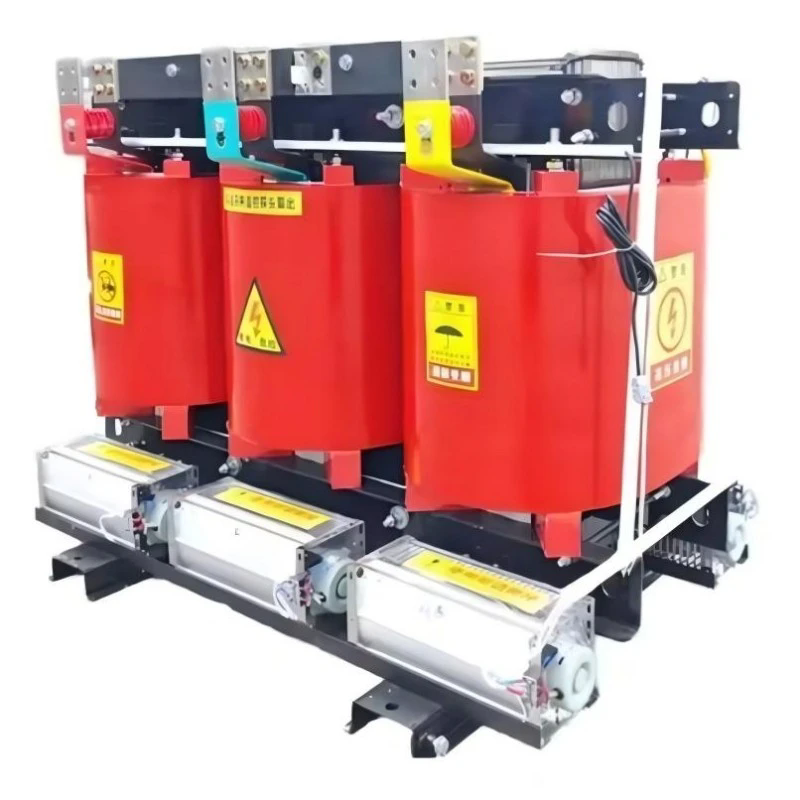
The cast resin insulation system of a Dry Type Transformer serves three functions: electrical insulation, mechanical support, and fire protection. The resin is a filled epoxy system that contains silica or alumina filler. The filler increases the thermal conductivity of the resin, which helps to dissipate heat from the windings. It also reduces the amount of organic material available to burn. The resin is cast under vacuum to eliminate voids and partial discharges. The table below shows the key properties of the cast resin insulation system used in our Dry Type Transformer units.
| Property | Value for our cast resin | Test standard | Safety significance |
| UL 94 rating | V-0 | UL 94 | Self-extinguishing within 10 seconds |
| Oxygen index | > 32% | ASTM D2863 | Requires high oxygen to sustain combustion |
| Thermal conductivity | 0.8 W/mK | ASTM E1530 | Dissipates heat, prevents hot spots |
| Dielectric strength | 20 kV/mm | IEC 60243 | Withstands electrical stress |
| Glass transition temperature | 120°C | DSC | Maintains mechanical properties at operating temperature |
| Smoke density | Low | ASTM E662 | Reduces visibility impairment during evacuation |
The oxygen index is a particularly important parameter. A material with an oxygen index above 32 percent requires an oxygen concentration higher than that of normal air (21 percent) to sustain combustion. This means that in a normal atmosphere, the material cannot sustain a flame. The cast resin in our transformers has an oxygen index of 34 to 36 percent, which provides a significant safety margin.
3. What Thermal Protection Systems Prevent Overheating and Fire?
Self-extinguishing insulation is the passive safety feature. The active safety features are the thermal protection systems that prevent the transformer from reaching a temperature that could cause ignition in the first place. A Dry Type Transformer is equipped with three levels of thermal protection. The first is the temperature sensors embedded in the windings. These are typically PT100 or PTC thermistors that measure the winding temperature directly. The second is the temperature control unit, which displays the temperature and activates alarm and trip contacts at preset thresholds. The third is the cooling system, which uses fans to increase air circulation when the temperature rises. The table below shows the temperature thresholds and the corresponding actions for our Dry Type Transformer units.
| Temperature threshold | Action | Purpose |
| 110°C | Alarm | Warns operator of abnormal temperature |
| 130°C | Fan activation | Increases cooling to reduce temperature |
| 150°C | Trip signal | Disconnects transformer to prevent damage |
| 180°C | Second trip signal (redundant) | Backup protection if primary trip fails |
The temperature control unit also has a communication interface that allows the transformer to be monitored remotely. This is important for facilities that are not continuously staffed. In our factory, we use a redundant trip circuit that requires two independent signals to disconnect the transformer. This prevents nuisance trips while ensuring that the transformer is protected in the event of a genuine over-temperature condition.
4. How Does the Enclosure Design Contain Arc Faults and Prevent Fire Spread?
The enclosure of a Dry Type Transformer is designed to contain arc faults and prevent the spread of fire to the surrounding area. The enclosure is made from sheet steel with a powder coating that resists corrosion. The ventilation openings are designed with louvers that allow air circulation but prevent the escape of hot gases and sparks. The enclosure also has a pressure relief vent that opens in the event of an internal arc fault, directing the hot gases upward and away from personnel. The table below shows the enclosure protection features and their function.
| Enclosure feature | Function | Standard |
| IP rating | IP21 (standard) or IP54 (optional) | IEC 60529 |
| Louvered ventilation | Allows cooling air, blocks sparks | Internal design |
| Pressure relief vent | Directs arc gases upward | Internal design |
| Arc-resistant option | Withstands internal arc fault | IEC 62271-200 |
| Fire-resistant coating | Prevents enclosure from igniting | UL 94 V-0 |
For installations in high-risk areas, we offer an arc-resistant enclosure that is tested to IEC 62271-200. This enclosure is designed to withstand an internal arc fault without allowing the arc to escape and injure personnel or ignite surrounding materials.
Frequently Asked Questions About Dry Type Transformer Safety
Summary for Electrical Safety Engineers and Facility Managers
A Dry Type Transformer is self-extinguishing because its insulation system is formulated with flame retardant additives that prevent sustained combustion. The cast resin insulation has a UL 94 V-0 rating and an oxygen index above 32 percent, which means it cannot sustain a flame in normal air. The thermal protection system prevents overheating by monitoring winding temperature and activating cooling or trip functions at preset thresholds. The enclosure contains arc faults and prevents the spread of fire to the surrounding area. Together, these features make the dry type transformer a safe choice for indoor installation. Lugao Power Co.,Ltd has been manufacturing Dry Type Transformer units for over 18 years and supplies to commercial, industrial, and infrastructure projects worldwide.
Lugao Power Co.,Ltd manufactures Dry Type Transformer units with cast resin insulation, thermal protection, and optional arc-resistant enclosures. We provide full safety documentation, including UL 94 test reports and oxygen index data.