
What Role Does Glass-Fiber Reinforcement Play in Dry Transformer Windings?
2026-09-22
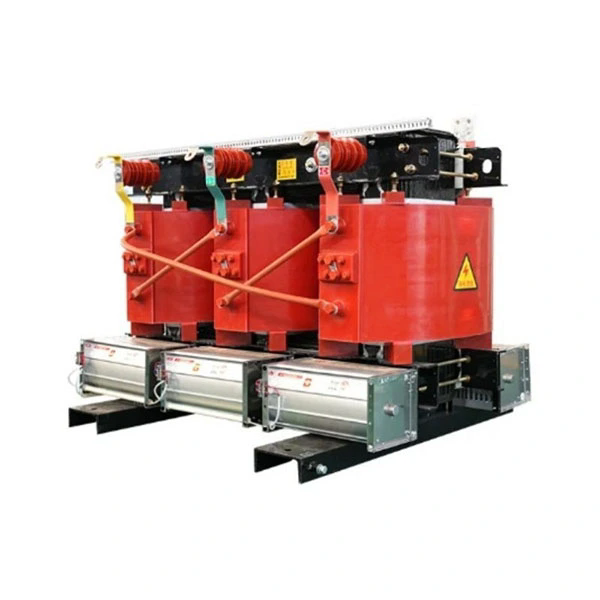
When a Dry Type Transformer is subjected to a short-circuit fault, the winding experiences a mechanical force that can reach 25 times the normal operating load. This force is not steady. It oscillates at twice the line frequency, which means 100 or 120 times per second. The conductor insulation must withstand this cyclic mechanical stress without cracking, delaminating, or loosening. The material that provides this mechanical reinforcement is glass fiber. Without it, the winding would deform, the insulation would fail, and the transformer would be destroyed. This guide explains how glass-fiber reinforcement works, what it contributes to thermal and dielectric performance, and how to specify it correctly for demanding applications.
1. What Mechanical Forces Act on a Dry Type Transformer Winding During a Short Circuit?
The mechanical forces on a transformer winding are produced by the interaction between the current in the winding and the magnetic field. During a short circuit, the current can be 10 to 25 times the rated current. The force is proportional to the square of the current, which means the force can be 100 to 625 times the force at rated current. This force acts in the radial direction, trying to expand the outer winding and compress the inner winding. It also acts in the axial direction, trying to displace the winding turns. The insulation system must resist both the radial and axial forces. Glass-fiber reinforcement is applied in both directions to provide this resistance. The table below shows the typical force levels for a 1,000 kVA Dry Type Transformer at different fault current levels.
| Fault current (multiple of rated) | Radial force (N/mm²) | Axial force (N/mm²) | Required glass-fiber content |
| 10x | 2.5 | 1.8 | 15 – 20% |
| 15x | 5.6 | 4.1 | 20 – 25% |
| 20x | 10.0 | 7.2 | 25 – 30% |
| 25x | 15.6 | 11.3 | 30 – 35% |
In our factory, we design Dry Type Transformer windings with a glass-fiber content of 25 to 30 percent for standard distribution transformers and 30 to 35 percent for transformers that are expected to withstand high fault currents. The glass fiber is applied as a continuous filament winding or as a woven tape, depending on the winding design.
2. How Does Glass-Fiber Reinforcement Improve Thermal Performance?
Glass fiber has a thermal conductivity that is higher than the epoxy resin that surrounds it. The glass fiber acts as a heat conduction path, helping to transfer heat from the conductor to the surface of the winding. This reduces the hot spot temperature and extends the life of the insulation. The thermal expansion coefficient of glass fiber is also much lower than that of the epoxy resin. This means that the glass fiber constrains the thermal expansion of the resin, preventing the formation of cracks during thermal cycling. The table below shows the thermal properties of glass fiber, epoxy resin, and the composite.
| Property | Glass fiber | Epoxy resin | Composite (30% glass) |
| Thermal conductivity (W/mK) | 1.0 – 1.3 | 0.2 – 0.3 | 0.45 – 0.55 |
| Coefficient of thermal expansion (10⁻⁶/K) | 5 – 6 | 50 – 70 | 20 – 25 |
| Maximum continuous temperature (°C) | 550 | 155 (Class F) | 155 – 180 |
| Dielectric strength (kV/mm) | 10 – 15 | 15 – 20 | 12 – 18 |
The composite thermal conductivity of 0.45 to 0.55 W/mK is more than double that of the epoxy resin alone. This improvement reduces the winding hot spot temperature by 10 to 15°C, which can double the life of the insulation according to the Arrhenius equation. Lugao Power Co.,Ltd. uses a vacuum pressure impregnation process to ensure that the glass fiber is fully impregnated with epoxy and that there are no voids between the fiber and the resin.
3. What Role Does Glass-Fiber Reinforcement Play in Dielectric Performance?
Glass fiber is an electrical insulator. Its dielectric strength is comparable to that of the epoxy resin. However, the interface between the glass fiber and the resin is a potential weak point. If the fiber is not fully impregnated, or if there is a void at the interface, the dielectric strength is reduced. The vacuum pressure impregnation process eliminates these voids by impregnating the fiber under vacuum and then curing under pressure. This ensures that the composite has a uniform dielectric strength. The table below shows the dielectric performance of a properly impregnated glass-fiber composite.
| Dielectric property | Glass-fiber composite (30% glass) | Epoxy resin alone |
| Dielectric constant at 50 Hz | 4.2 – 4.8 | 3.8 – 4.2 |
| Dissipation factor at 50 Hz | 0.015 – 0.025 | 0.010 – 0.020 |
| Dielectric strength (kV/mm) | 12 – 18 | 15 – 20 |
| Partial discharge inception voltage (kV) | > 3.5 | > 4.0 |
The dielectric constant of the composite is slightly higher than that of the resin alone because glass fiber has a higher dielectric constant. This is a minor trade-off for the mechanical and thermal benefits. The dissipation factor is also slightly higher, but it remains within acceptable limits for Class F insulation. In our factory, we test the partial discharge inception voltage of every Dry Type Transformer before shipment. The voltage must exceed 3.5 kV to ensure that there are no voids or defects in the insulation.
4. How Is Glass-Fiber Reinforcement Specified for Different Transformer Applications?
The specification of glass-fiber reinforcement depends on the application. For standard indoor Dry Type Transformers, a glass content of 25 percent is sufficient. For outdoor or high-humidity applications, a higher glass content of 30 to 35 percent is recommended because the glass fiber reduces moisture absorption. For transformers that are subject to frequent short circuits, a glass content of 35 percent is recommended to provide additional mechanical strength. The table below shows the recommended glass content for different applications.
| Application | Recommended glass content | Key benefit |
| Standard indoor distribution | 25% | Balanced mechanical and thermal performance |
| Outdoor or high humidity | 30 – 35% | Reduced moisture absorption, better thermal cycling |
| Frequent short circuit | 35% | Maximum mechanical strength |
| High ambient temperature | 30% | Better heat conduction, lower hot spot |
| Marine or offshore | 35% | Corrosion resistance, mechanical durability |
Design verification: After the winding is cast, we perform a mechanical test on a sample to verify that the glass-fiber reinforcement can withstand the calculated short-circuit force. The test applies a static load equal to 1.5 times the calculated force and measures the deformation. The deformation must be less than 0.5 mm.
Frequently Asked Questions About Glass-Fiber Reinforcement in Dry Type Transformers
Summary for Transformer Design Engineers
Glass-fiber reinforcement is essential for the mechanical, thermal, and dielectric performance of a Dry Type Transformer winding. It provides the mechanical strength to withstand short-circuit forces, the thermal conductivity to reduce hot spot temperature, and the dielectric stability to ensure reliable insulation. The glass content should be specified based on the application, with 25 percent for standard indoor use and 30 to 35 percent for demanding environments. Lugao Power Co.,Ltd. has been manufacturing Dry Type Transformer units for over 18 years and uses vacuum pressure impregnation to ensure that the glass fiber is fully bonded to the epoxy resin.
Lugao Power Co.,Ltd. manufactures Dry Type Transformer units with glass-fiber reinforced windings, Class F and Class H insulation systems, and partial discharge tested insulation. We provide full technical data and design verification reports for all of our products.