

Article Summary
The PLC FX1S 30MR is a compact programmable logic controller designed for basic machine automation and straightforward control applications. With 16 digital inputs and 14 relay outputs in the commonly specified AC-powered version, it provides a practical I/O configuration for small production equipment, packaging systems, control panels, and other automated processes.
However, choosing a PLC involves more than checking the number of input and output points. Buyers also need to understand relay output characteristics, power supply requirements, wiring compatibility, programming needs, installation conditions, and long-term maintenance. This guide explains the important considerations when evaluating the PLC FX1S 30MR and helps equipment manufacturers and maintenance teams make a more informed purchasing decision.
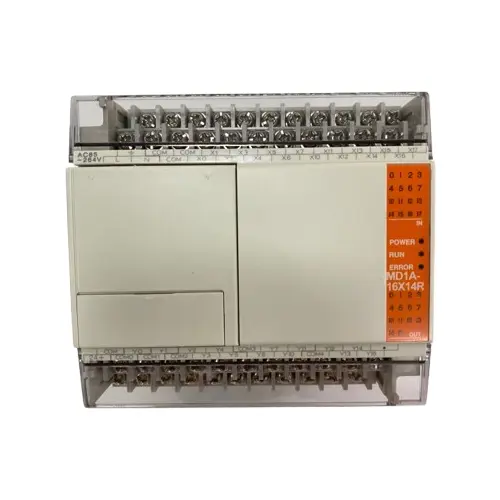
1. What Is the PLC FX1S 30MR?
The PLC FX1S 30MR is a compact programmable logic controller from the Mitsubishi MELSEC FX1S family. It is intended for relatively small automation systems where a straightforward control structure, a compact installation footprint, and practical digital I/O capacity are important.
A programmable logic controller receives signals from connected devices, processes programmed instructions, and controls outputs according to the machine's operating requirements. Typical input devices include push buttons, limit switches, proximity sensors, and other digital sensors. Outputs can control contactors, indicator lamps, solenoid valves, and compatible relay-driven loads.
The model designation provides useful information about the controller. In the commonly referenced FX1S-30MR-ES/UL configuration, the number 30 indicates a 30-point I/O model, while MR identifies the relay output type. The standard configuration has 16 digital inputs and 14 relay outputs.
FX1S-30MR is not sufficient by itself to confirm every electrical detail. Full model suffixes matter. For example, AC-powered and DC-powered versions have different power supply requirements. Always verify the complete nameplate and official documentation before ordering or wiring the unit.
For buyers replacing an existing controller, identifying the exact model is especially important. Two PLCs may look similar but have different power inputs, output technologies, terminal arrangements, or wiring requirements. A correct model match helps reduce installation errors and unexpected machine downtime.
2. Which Technical Specifications Should Buyers Check?
Technical specifications determine whether a PLC can work with the electrical and control architecture of a machine. Before selecting the FX1S 30MR, buyers should review its I/O configuration, supply voltage, output type, physical dimensions, and programming requirements.
Key Specifications of the Common AC-Powered Relay Version
| Specification | Reference Information |
|---|---|
| Product model | FX1S-30MR-ES/UL |
| PLC series | MELSEC FX1S |
| Total I/O points | 30 points |
| Digital input points | 16 points |
| Input signal type | 24V DC sink/source configuration, subject to wiring arrangement |
| Digital output points | 14 points |
| Output type | Relay |
| Power supply | 85–264V AC for the specified ES/UL version |
| Approximate dimensions | 100 × 90 × 75 mm (W × H × D) |
| Approximate mass | 0.45 kg |
The values above refer to the specified AC-powered relay output version. Other FX1S-30MR variants may have different supply arrangements. The exact product label and manufacturer documentation should take priority over a general product description.
Why Do the I/O Points Matter?
The 16 input points allow the controller to monitor multiple operating conditions. For example, a small machine may use inputs for start and stop buttons, safety-related status signals, product detection, position confirmation, and material-level monitoring.
The 14 relay outputs provide control signals for compatible external devices. A machine might use them for motor contactors, pneumatic valve coils, warning lamps, buzzer circuits, and other on/off control functions.
When calculating I/O requirements, do not count only the devices currently installed. Consider future additions, spare points, and signals that may be required during machine upgrades. A controller with no spare I/O capacity can become difficult to modify later.
3. How Does the Relay Output System Work?
One of the most important features of the FX1S 30MR is its relay output configuration. A relay output uses an electrically operated contact to switch an external circuit. This makes it suitable for many general-purpose on/off control applications.
Advantages of Relay Outputs
- Flexible load switching: Relay contacts can be used with compatible AC or DC circuits when voltage and current ratings are respected.
- Electrical separation: The relay switching arrangement provides isolation between the PLC control circuitry and the external load circuit.
- Practical machine control: Relay outputs are commonly used to operate contactors, indicator devices, and suitable solenoid valve circuits.
- Simple control logic: They are suitable for applications where outputs switch on and off at moderate frequencies.
What Are the Limitations of Relay Outputs?
Relay contacts are mechanical components. They have a finite operating life and can wear over time, particularly when switching high-current or inductive loads. Their switching speed is also generally slower than that of transistor outputs.
For this reason, relay output PLCs are not automatically the best option for every application. High-frequency pulse control, rapid repetitive switching, and certain motion-control tasks may require a transistor-output controller or a dedicated motion control solution.
Motors, contactor coils, solenoid valves, and other inductive loads can generate electrical transients when switched. Use suitable suppression and protection components according to the load type and the manufacturer's wiring recommendations. Never assume that a relay output can directly drive every device.
Relay Output Selection Checklist
- Confirm the operating voltage of every connected load.
- Check the rated current for each output and each common terminal group.
- Consider the starting or inrush current of inductive loads.
- Determine how frequently each output will switch.
- Use an appropriately rated external relay or contactor when the load exceeds the PLC output rating.
4. Which Applications Can Use the FX1S 30MR?
The FX1S 30MR is intended for compact control tasks that do not require a large number of I/O points or advanced control functions. Its 16-input and 14-relay-output configuration can be useful in a variety of small industrial machines.
Packaging and Filling Equipment
Small packaging machines often need to coordinate product detection, start-stop controls, conveyor operation, cylinder movement, and alarm indicators. A compact PLC can organize these basic sequences and help operators manage machine cycles more consistently.
Conveyor and Material Handling Systems
Simple conveyor systems use sensors to detect products and control motors through contactors. The PLC can process sensor signals and activate compatible output circuits according to the required sequence.
Small Assembly Machines
Assembly equipment may require position detection, manual operation buttons, pneumatic actuators, and status indicators. A 30-point PLC can be considered when the number of control signals fits within its available I/O capacity.
General Industrial Control Panels
Control panels for basic equipment may use a compact PLC to manage operating sequences, interlocks, alarms, and auxiliary devices. Its small physical size can be useful where panel space is limited.
| Application | Typical Input Signals | Typical Output Functions |
|---|---|---|
| Packaging equipment | Product sensors, start/stop buttons | Conveyor control, valve activation |
| Conveyor systems | Position and detection sensors | Motor contactors, warning lamps |
| Assembly machines | Limit switches, operating buttons | Actuator control, status signals |
| Small control panels | Switches, alarms, feedback signals | Relays, indicators, auxiliary equipment |
Application suitability depends on the machine's actual control requirements. Systems involving complex motion, extensive networking, advanced safety functions, or a large number of I/O points may need a different PLC architecture.
5. How to Evaluate PLC Compatibility Before Purchase
Compatibility is one of the most common challenges when purchasing a replacement PLC. A controller that shares a similar model name may still differ in important electrical or installation details.
1. Confirm the Complete Model Number
Record the full model number from the existing unit, including every suffix. Do not rely only on the front-panel series name. The suffix can identify differences in power supply and product configuration.
2. Check the Power Supply
Confirm whether the existing machine uses an AC-powered or DC-powered PLC. The specified FX1S-30MR-ES/UL version is an AC-powered model, while other FX1S variants may use different power arrangements. Applying the wrong supply voltage can damage equipment and create a serious safety risk.
3. Verify the Output Type
The MR designation indicates relay output. Do not assume that a transistor-output model is a direct replacement. Relay and transistor outputs have different electrical characteristics and may require changes to the external wiring and control circuit.
4. Compare Terminal Layouts
Before replacing a PLC, compare the terminal labels, common terminals, input wiring, output wiring, and grounding arrangement. Even when two units have the same number of I/O points, terminal positions and electrical configurations should be checked carefully.
5. Review the Existing Program
A replacement project should include a review of the original control program, device addresses, interlocks, timers, counters, and communication settings. Confirm that the target controller can support the program and that the correct programming tools and cables are available.
Send the supplier a clear photograph of the existing PLC nameplate, terminal layout, and installation environment. This information can help the supplier identify the required version and reduce the risk of ordering an incompatible replacement.
6. What Should Be Considered During Installation and Wiring?
Correct installation is essential for stable PLC operation. Incorrect wiring, poor grounding, excessive electrical noise, or unsuitable environmental conditions can cause intermittent faults and unexpected machine stops.
Power Wiring
Always follow the wiring diagram for the exact PLC model. Confirm the rated supply voltage before connecting power. Use suitable circuit protection and ensure that the power wiring is correctly separated from low-voltage signal wiring where required.
Input Wiring
Digital inputs commonly connect to push buttons, limit switches, proximity sensors, and other field devices. Check the input voltage, polarity, sink/source arrangement, and common terminal configuration. Incorrect input wiring may prevent the PLC from detecting a signal correctly.
Output Wiring
Relay outputs should be connected according to the specified terminal arrangement and load ratings. External contactors or relays may be necessary for higher-current loads. Provide suitable protection for inductive circuits and avoid exceeding the rated capacity of individual outputs or shared common terminals.
Panel Installation
- Install the PLC in a suitable electrical enclosure.
- Allow sufficient ventilation and clearance for heat dissipation.
- Keep the controller away from excessive moisture, dust, and corrosive substances.
- Route power cables and signal cables appropriately to reduce electrical interference.
- Ensure that terminals are securely connected and clearly identified.
- Leave enough space for inspection, wiring changes, and future maintenance.
PLC installation and maintenance should be performed by qualified personnel. Disconnect and verify the absence of hazardous power before working on wiring. Follow the manufacturer's instructions and applicable electrical safety regulations.
7. How to Improve PLC Reliability and Service Life
A PLC is part of a larger electrical control system. Its reliability depends not only on the controller itself but also on the quality of the power supply, wiring, connected loads, operating environment, and maintenance practices.
Maintain a Suitable Operating Environment
Excessive heat, dust, humidity, vibration, and corrosive gases can affect electronic components and terminal connections. Install the PLC in an enclosure suitable for the actual factory environment and inspect the enclosure periodically.
Protect Relay Contacts
Relay contacts are subject to mechanical and electrical wear. Switching loads beyond their ratings or repeatedly switching heavy inductive loads can shorten contact life. Use external switching devices where necessary and select appropriate protection components.
Keep Program Documentation Updated
Maintain an accurate copy of the control program and document any modifications. Record I/O assignments, wiring changes, parameter settings, and machine operating logic. This information can significantly reduce troubleshooting time when a fault occurs.
Inspect the Control System Regularly
Routine inspections can help identify loose terminals, damaged wires, abnormal temperatures, unusual relay behavior, and unstable power conditions. Maintenance intervals should be determined according to the machine's operating hours and environment.
Prepare for Replacement and Downtime
Because the FX1S family is an older product series, maintenance teams should consider the availability of compatible replacement units, technical documentation, programming tools, and spare parts. Planning ahead is especially important for production lines where unexpected downtime can result in significant costs.
8. FX1S 30MR Compared with Other PLC Configurations
Choosing the correct PLC requires matching the output technology and control capacity to the application. The FX1S 30MR should be evaluated against other configurations based on the machine's actual operating conditions.
| Selection Factor | FX1S 30MR | Transistor Output PLC |
|---|---|---|
| Output technology | Mechanical relay contacts | Electronic transistor switching |
| Typical application | General on/off load control | Fast switching and pulse-oriented tasks |
| Switching frequency | Limited by relay operation and contact life | Generally suitable for faster switching |
| Load compatibility | Compatible AC or DC loads within ratings | DC loads within the specified output ratings |
| Maintenance concern | Mechanical contact wear | Electronic output and thermal limits |
The comparison is general and does not mean that every transistor PLC is a direct replacement for the FX1S 30MR. Exact supply voltage, I/O arrangement, output specifications, program compatibility, and installation requirements must be verified for the selected model.
Consider the Product Lifecycle
An important purchasing consideration is that Mitsubishi Electric lists the FX1S-30MR as discontinued, with a discontinuation date of December 2015. The manufacturer identifies the FX3S-30MR/ES as an alternative model. However, an alternative product should not be treated as a guaranteed plug-and-play replacement.
Before changing to another controller, review the existing program, I/O mapping, wiring, communication requirements, and machine control sequence. A migration plan may be necessary to ensure that the upgraded system operates correctly.
9. How to Select a Reliable PLC Supplier
For industrial buyers, selecting a suitable supplier is just as important as identifying the correct PLC model. A reliable supplier should provide clear product identification, accurate technical information, and responsive communication before and after the purchase.
Check Product Identification and Condition
Ask for the complete model number, nameplate photographs, product condition, and available documentation. For discontinued PLCs, clarify whether the unit is new old stock, refurbished, or used. These categories have different implications for price, warranty, and expected service life.
Request Technical Confirmation
Provide your application details and ask the supplier to confirm the power supply, I/O configuration, output type, and terminal arrangement. A supplier who can discuss these points clearly can help reduce procurement uncertainty.
Evaluate Packaging and Delivery
Industrial electronic products should be packaged to protect them against impact, moisture, and electrostatic damage where applicable. Buyers should also confirm shipping methods, delivery schedules, export documentation, and the process for handling damaged or incorrect goods.
Review After-Sales Support
Ask about warranty terms, return conditions, technical assistance, and product traceability. For older PLC models, support with model identification and replacement planning can be particularly valuable.
Aicheng Electronic Technology Co, Ltd. understands that industrial automation buyers need clear product information and dependable communication throughout the purchasing process. When evaluating the PLC FX1S 30MR, buyers should provide their required model suffix, application details, and technical questions to help confirm product suitability before placing an order.
10. Frequently Asked Questions
Q1: What does PLC FX1S 30MR mean?
PLC FX1S 30MR refers to a compact programmable logic controller in the Mitsubishi MELSEC FX1S family. The 30 indicates a 30-point I/O configuration, while MR identifies the relay output type. The commonly specified version has 16 digital inputs and 14 relay outputs.
Q2: How many input and output points does the FX1S 30MR have?
The standard FX1S-30MR configuration has 16 digital input points and 14 relay output points, providing 30 I/O points in total.
Q3: Is the FX1S 30MR a relay output PLC?
Yes. The MR designation identifies a relay output configuration. Relay outputs can switch compatible AC or DC loads within the specified electrical ratings. The exact load limits should be checked in the hardware manual for the complete model number.
Q4: What power supply does the FX1S-30MR-ES/UL use?
The FX1S-30MR-ES/UL version is an AC-powered model with a specified supply range of 85–264V AC. Other FX1S-30MR variants may use a different power supply, so the full model suffix must be checked before installation.
Q5: Can the FX1S 30MR control motors directly?
It can control suitable motor contactor or relay circuits through its outputs, provided the connected circuit is correctly rated and protected. The PLC relay output should not be assumed to be suitable for directly powering an industrial motor.
Q6: Is the FX1S 30MR suitable for high-speed pulse control?
Its relay outputs are generally not suitable for high-frequency pulse switching because mechanical contacts have operating-speed and service-life limitations. Applications requiring rapid pulses or precise motion control should be evaluated for a suitable transistor-output PLC or dedicated motion controller.
Q7: Is the Mitsubishi FX1S 30MR still in production?
Mitsubishi Electric lists the FX1S-30MR as a discontinued model, with production discontinued in December 2015. Buyers should confirm product condition, stock status, warranty, and replacement options with their supplier.
Q8: What is an alternative to the FX1S 30MR?
Mitsubishi Electric identifies the FX3S-30MR/ES as an alternative model. However, buyers should verify program compatibility, wiring, terminal layout, I/O assignments, and application requirements before making a replacement decision.
Q9: What information should I provide when requesting a quotation?
Provide the complete model number, required quantity, product condition preference, destination country, and any relevant application or replacement details. A clear nameplate photograph can also help the supplier confirm the correct configuration.
Q10: Why should I confirm the full model suffix before ordering?
The suffix can indicate differences in power supply and product configuration. Ordering based only on the shortened FX1S 30MR name may result in a unit that does not match the existing electrical system or installation requirements.
11. Conclusion
The PLC FX1S 30MR is a compact relay-output controller designed for basic industrial automation tasks. Its 16 digital inputs and 14 relay outputs can support a range of small machines and control panels when the I/O capacity, electrical ratings, and application requirements are properly matched.
Before purchasing, buyers should verify the complete model suffix, power supply, output specifications, terminal arrangement, and program requirements. It is also important to consider the product's discontinued status and evaluate replacement planning for long-term equipment maintenance.
Working with an experienced supplier can make model identification and procurement more straightforward. Aicheng Electronic Technology Co, Ltd. welcomes inquiries from industrial buyers, equipment manufacturers, and maintenance teams looking for PLC products and automation components.
Need Help Finding the Right PLC FX1S 30MR?
Looking for PLC FX1S 30MR or a suitable alternative for your industrial automation project? Share your model number, technical requirements, and quantity with Aicheng Electronic Technology Co, Ltd. Our team can help you review product details and discuss your purchasing needs.
Contact Us for Product Details