

Why Are Solar Power Protection PV Fuses Widely Used in Utility-Scale Solar Farms?
2026-09-02
A 100 MW solar farm has over 300,000 photovoltaic modules and 5,000 strings. Each string is a potential source of fault current. When one string is shaded or develops a ground fault, the remaining strings in the combiner box feed current back into the faulted string. This reverse current can be 2 to 3 times the normal operating current, but it is still well below the short-circuit current rating of most circuit breakers. This is why the Solar Power Protection PV Fuse is not just an option—it is a necessity for string-level protection. Standard AC fuses and general-purpose DC fuses do not have the right time-current characteristics or the required breaking capacity for this application.
1. What Makes Photovoltaic Fault Current Different From Other DC Sources?
The I-V curve of a photovoltaic module is fundamentally different from a battery or a rectifier. A PV module is a current-limited source. The short-circuit current is only 10 to 15 percent higher than the operating current under normal conditions. When a string fault occurs, the reverse current from other strings is limited by the number of parallel strings. In a typical combiner box with 16 strings, the maximum fault current is about 15 times the per-string current, but rarely exceeds 300 amperes. This is well below the 1,000 ampere ratings common in industrial DC breakers. The fault current is not high, but it is sustained. A Solar Power Protection PV Fuse is designed to detect and interrupt these low-level but sustained fault currents. In our factory, we test PV fuses to IEC 60269-6, which specifies the gPV utilization category for photovoltaic applications. This category requires the fuse to clear low-magnitude overcurrents without generating excessive arcing energy.
Design consideration: The rated voltage of a Solar Power Protection PV Fuse must be at least the maximum system voltage, which for large solar farms is typically 1,000V DC or 1,500V DC. In our factory, we manufacture gPV fuses with a rated breaking capacity of 33 kA at 1,500V DC. This is sufficient for any utility-scale array configuration. The fuse must also withstand continuous currents up to the rated current at 85°C ambient temperature, because combiner boxes are often exposed to direct sunlight.
2. Why Can't a Standard Circuit Breaker Do the Same Job?
Circuit breakers are generally not suitable for PV string protection for several reasons. First, the low fault current in a PV array may not trip the magnetic element of a circuit breaker. The thermal element may take too long to respond, allowing the fault to persist and cause overheating of the cables and connectors. Second, circuit breakers have moving parts that can be affected by environmental factors such as dust, moisture, and vibration. Third, the cost of a circuit breaker per string is significantly higher than a fuse. For a 100 MW farm with 5,000 strings, the cost difference is substantial.
The table below compares the performance characteristics of Solar Power Protection PV Fuses and miniature circuit breakers in photovoltaic applications.
| Characteristic | PV Fuse (gPV type) | Miniature Circuit Breaker (MCB) | Significance for solar farms |
| Low-current fault clearing (2-3x rated) | Clears within seconds | May not clear (thermal delay) | Prevents cable overheating |
| Breaking capacity at 1500V DC | 33 kA typical | 10 kA typical | Requires higher for large arrays |
| Temperature compensation | Inherent (time-current shifts with temp) | Limited | Works in hot combiner boxes |
| Cost per protected string | Low | 5-10x higher | Significant for 5000+ strings |
| Maintenance requirements | None (single-use) | Periodic testing | Lower O&M cost |
The table shows that for PV string protection, the fuse is technically superior and economically more efficient. This is why the Solar Power Protection PV Fuse has become the standard for utility-scale solar farms worldwide. Zhejiang Galaxy Fuse Co., Ltd. has been manufacturing gPV fuses for over 10 years, and our products are listed in the design guides of major PV inverter manufacturers.
3. What Are the Key Technical Parameters for Selecting a PV Fuse?
Selecting a Solar Power Protection PV Fuse requires matching the fuse rating to the string characteristics and the combiner box design. The critical parameters are the rated current, the rated voltage, the breaking capacity, and the operating temperature range.
The table below provides the selection criteria for a typical 1,500V DC system with 12 strings per combiner box.
| Parameter | Selection criterion | Typical value for 1,500V system | Our typical value |
| Rated current (I_n) | 1.25 to 1.4 times the string short-circuit current (I_sc) | 10 – 15 A | 10A, 12A, 15A, 20A options |
| Rated voltage (U_n) | Must be ≥ system max voltage | 1500V DC | 1500V DC |
| Breaking capacity (I_cu) | Must be ≥ maximum array fault current | ≥ 25 kA | 33 kA at 1500V DC |
| Power dissipation | Affects combiner box temperature rise | < 5W at rated current | 3.5W at 15A |
| Ambient temperature range | Must match combiner box conditions | -40°C to +85°C | -40°C to +90°C |
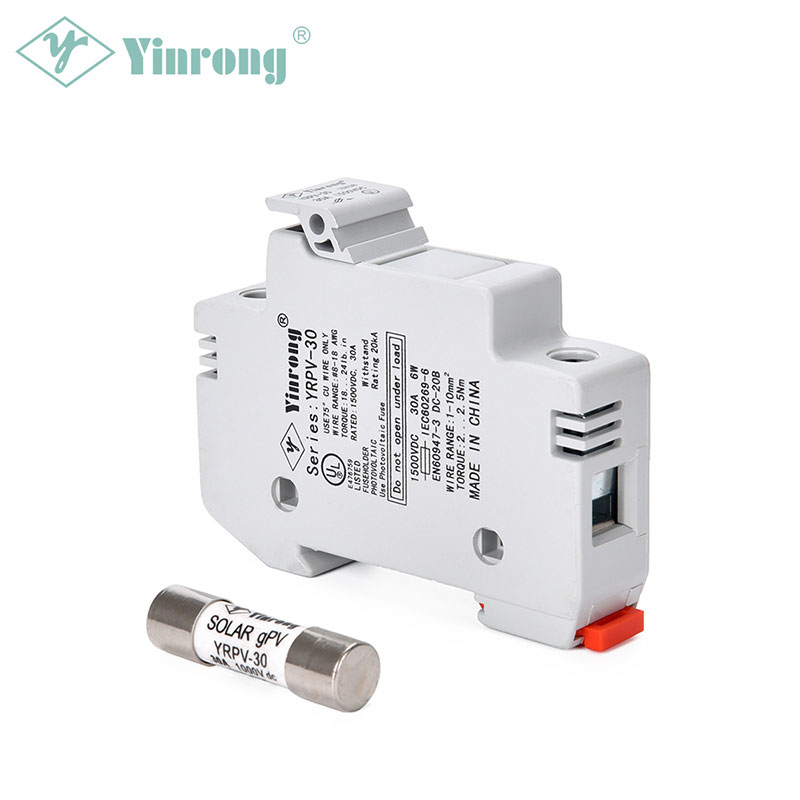
In our factory, we offer Solar Power Protection PV Fuse units with both bolted and clip-on mounting options. The bolted version is recommended for high-vibration environments such as tracking systems. The clip-on version is suitable for fixed-tilt arrays. We also provide a range of gPV fuse holders that are UL Listed and IEC tested. The fuse holders are rated for the same voltage as the fuse and include a microswitch option for remote fuse indication.
4. How Does the gPV Utilization Category Ensure Reliable Protection?
The gPV category in IEC 60269-6 is specifically designed for photovoltaic applications. It ensures that the fuse can clear low overcurrents without overheating, and that it can interrupt high fault currents without generating excessive arc energy. The gPV category also requires that the fuse operate reliably at temperatures up to 90°C, which is common in combiner boxes located in direct sunlight. Our factory manufactures Solar Power Protection PV Fuse units that are third-party tested to the gPV category. The test includes an endurance test of 1,000 cycles at rated current, a breaking capacity test at 33 kA, and a temperature rise test at 1.13 times the rated current. We provide the test reports with every batch.
Zhejiang Galaxy Fuse Co., Ltd. has supplied gPV fuses to over 200 utility-scale solar farms worldwide. Our products are recognized by major inverter manufacturers, and our technical team provides selection support for large projects. We maintain a stock of the most common ratings to support rapid delivery for project deadlines.
Frequently Asked Questions About Solar Power Protection PV Fuses
Summary for Solar Farm Design Engineers
Solar Power Protection PV Fuses are the industry standard for string-level protection in utility-scale solar farms. They are designed specifically for the unique fault characteristics of photovoltaic arrays: low-magnitude sustained fault currents, high DC voltages, and demanding environmental conditions. The gPV category ensures that these fuses will clear faults reliably and without causing collateral damage. When designing a large solar installation, selecting the correct fuse rating and type is as important as selecting the modules and inverters.
Zhejiang Galaxy Fuse Co., Ltd. produces a comprehensive range of Solar Power Protection PV Fuse units for 1,000V and 1,500V systems. Our fuses are IEC 60269-6 certified and UL listed. We provide full technical documentation, including time-current curves and breaking capacity test reports. Our technical team supports design engineers with selection tools and project-specific recommendations.