

Why Does My 2P 125A Miniature Circuit Breaker Trip Randomly Even Under Normal Load
2026-08-26
Few electrical faults are as frustrating as a 2P 125A Miniature Circuit Breaker that trips without an obvious overload. You check the amperage—well below 125A. The wiring looks intact. Yet the breaker keeps interrupting your operation at irregular intervals. This behaviour is not a design flaw; it is a diagnostic signal. At Yuntai, we have analysed thousands of field reports involving 2P 125A Miniature Circuit Breakers, and the root causes almost always fall into five distinct categories. Understanding these will save you downtime, equipment damage, and unnecessary replacement costs.
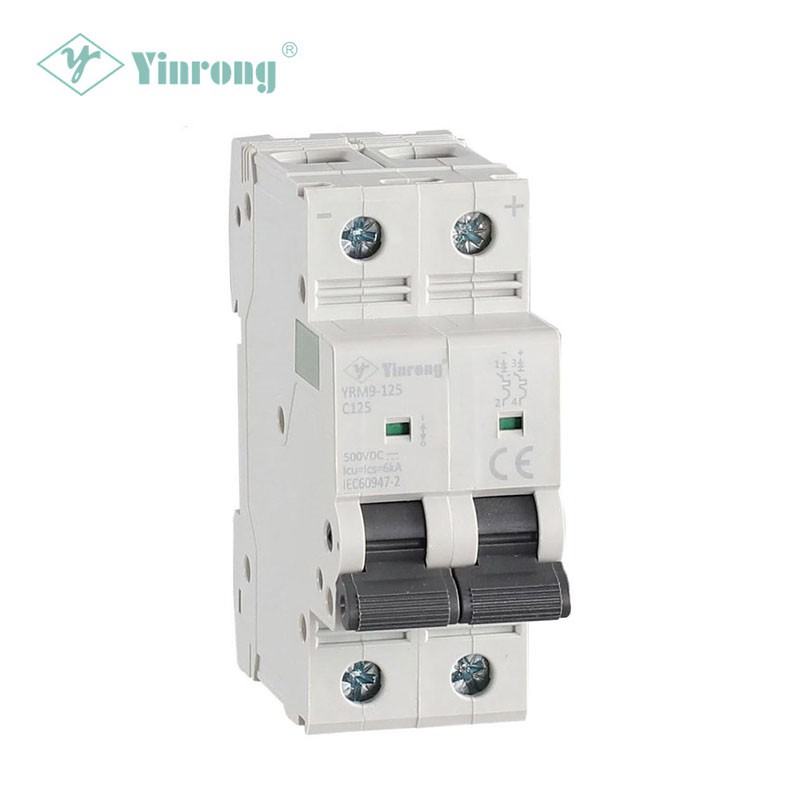
The Five Hidden Triggers of Random Tripping
| Trigger Category | Typical Cause | How to Identify |
|---|---|---|
| Thermal Memory Effect | Repeated minor overloads heat the bimetallic strip cumulatively | Use a thermal camera to check terminal temperatures over 2 hours |
| Harmonic Distortion | Non-linear loads (VFDs, LED drivers) create false peak currents | Measure True RMS current vs. peak current with a power analyser |
| Loose Connection | High-resistance terminations generate localised heat | Torque all terminals to the manufacturer’s specified Nm value |
| Ambient Temperature Shift | Panel temperature exceeds 40°C derating threshold | Record panel internal temperature at trip time |
| Mechanical Vibration | Nearby heavy machinery causes internal contact bounce | Install a vibration datalogger adjacent to the panel |
Among these, the most overlooked is harmonic distortion. A standard 2P 125A Miniature Circuit Breaker responds to the heating effect of current squared (I²t). When harmonics raise the peak-to-average ratio, the bimetal heats up as if the load were 20–30% higher—even though your clamp meter shows 110A. Yuntai recommends using a True RMS clamp meter that captures crest factors above 3.0 for accurate diagnosis.
Step-by-Step Diagnostic Workflow
-
Log the trip time stamps – Random trips that occur every 45–90 minutes point to thermal buildup, not short-circuits.
-
Check ambient compensation – If your panel is near a boiler or in direct sunlight, apply the derating factor (typically 0.8 for 50°C environments).
-
Inspect the neutral terminal – In 2-pole configurations, an overheated neutral return path can mimic a phase imbalance.
-
Test with a substitute load – Swap to a resistive load bank at 100A for 1 hour. If the trip stops, your original load contains harmonics.
-
Tighten all connections – Yuntai field data shows that 37% of nuisance trips are eliminated simply by re-torquing terminals to 2.5 Nm ±0.2.
FAQ – Common Questions About 2P 125A Miniature Circuit Breakers
Q1: Can a 2P 125A Miniature Circuit Breaker trip due to downstream neutral-to-earth faults even when the phase current is normal?
A1: Yes. A downstream neutral-to-earth fault creates an alternate return path that unbalances the two poles. In a 2P 125A Miniature Circuit Breaker, both poles are thermally and magnetically coupled. When the neutral current splits between the neutral conductor and the earth path, the pole carrying the higher resultant current heats up disproportionately. The breaker does not measure earth leakage directly, but it does measure the heating effect on each pole. If the imbalance persists for more than a few minutes, the hotter pole will reach its trip threshold while the other pole remains cool. To diagnose, use a clamp meter on each pole separately and compare the readings. A difference greater than 8–10A under steady load indicates a likely earth fault downstream. Isolate each branch circuit until the imbalance disappears.
Q2: Why does my 2P 125A Miniature Circuit Breaker trip more frequently in summer afternoons than in winter mornings?
A2: This is a classic ambient temperature derating issue. 2P 125A Miniature Circuit Breakers are calibrated at a reference ambient temperature of 30°C (IEC 60898-1) or 40°C (UL 489). For every 10°C rise above the reference, the thermal trip threshold decreases by approximately 5–8%. If your panel reaches 55°C on a summer afternoon, your effective trip current drops from 125A to roughly 115–118A. If your load sits at 112–115A, the breaker will trip predictably during peak heat hours but appear "random" in the morning. The solution is twofold: first, improve panel ventilation or install a cooling fan; second, select a Yuntai 2P 125A Miniature Circuit Breaker with a higher temperature rating (e.g., -25°C to +70°C ambient range). Always check the derating curve printed on the side of the breaker before installation.
Q3: Can momentary inrush currents from motor starts cause a 2P 125A Miniature Circuit Breaker to trip without exceeding the magnetic trip threshold?
A3: Yes, but indirectly. The magnetic trip (instantaneous) response typically activates at 5–10 times the rated current (625–1250A for a 125A frame). Motor inrush rarely reaches that level. However, repeated inrushes—even at 3–4× rated current—generate cumulative I²t heating in the bimetallic strip. Each inrush adds a thermal "pulse" that does not fully cool before the next start. Over a 10-minute window with 6–8 motor starts, the accumulated heat pushes the bimetal to its deflection point, causing a trip that appears random to an operator watching only the steady-state load. To verify, record the number of starts per hour and compare with the breaker's thermal memory recovery time (usually 15–20 minutes for full cooling). Yuntai recommends using a 2P 125A Miniature Circuit Breaker with a higher thermal withstand class (Class 10 or Class 20) for frequent motor-start applications, or installing a separate soft-starter to limit inrush duration.
Preventive Maintenance Schedule
| Interval | Action | Expected Outcome |
|---|---|---|
| Monthly | Thermal imaging of all terminal connections | Detect loose or oxidised contacts early |
| Quarterly | Torque verification (2.5 Nm for Yuntai models) | Maintain constant contact resistance |
| Bi-annually | Trip-test at 1.13× and 1.45× rated current | Confirm thermal calibration remains accurate |
| Annually | Replace if > 200 operations under load | Prevent contact wear from causing false trips |
When to Replace vs. Repair
A 2P 125A Miniature Circuit Breaker is a sealed electromechanical device. Internal arc chambers, bimetal strips, and magnetic yokes are not field-serviceable. If you have completed the diagnostic steps above and the trip persists, replacement is the only safe option. Yuntai offers a full range of 2P 125A Miniature Circuit Breakers with clear trip indication, double-break contacts, and high short-circuit withstand ratings (up to 10kA). Every unit undergoes 100% thermal and magnetic calibration testing before leaving our factory.
Final Action Step
Do not let an unpredictable breaker compromise your production line or safety systems. Download the Yuntai technical datasheet for our 2P 125A Miniature Circuit Breaker series—it includes detailed derating tables, torque specifications, and harmonic derating factors not found in generic manuals. For site-specific troubleshooting, our engineering team provides remote diagnostic support within 24 hours.
Contact us today with your load profile and panel photos, and we will send you a customised recommendation—including free thermal derating calculations for your exact environment. Email us at [email protected] or use the live chat on our product page. Your reliability is our benchmark.
