

Why Does the GV2P32 Series Motor Protection Circuit Breaker Trip Repeatedly Under Normal Load Conditions
2026-08-14
Repeated tripping of a motor protection device under seemingly normal operating conditions is one of the most frustrating and time-consuming issues for maintenance engineers and plant electricians. The GV2P32 Series Motor Protection Circuit Breaker from XUCKY is engineered to provide reliable thermal-magnetic protection for motors up to 32A, but when nuisance tripping occurs, it rarely points to a defective breaker. Instead, it typically signals underlying application mismatches, environmental factors, or installation errors. Understanding these root causes is the first step toward restoring uptime and protecting your motor investment.
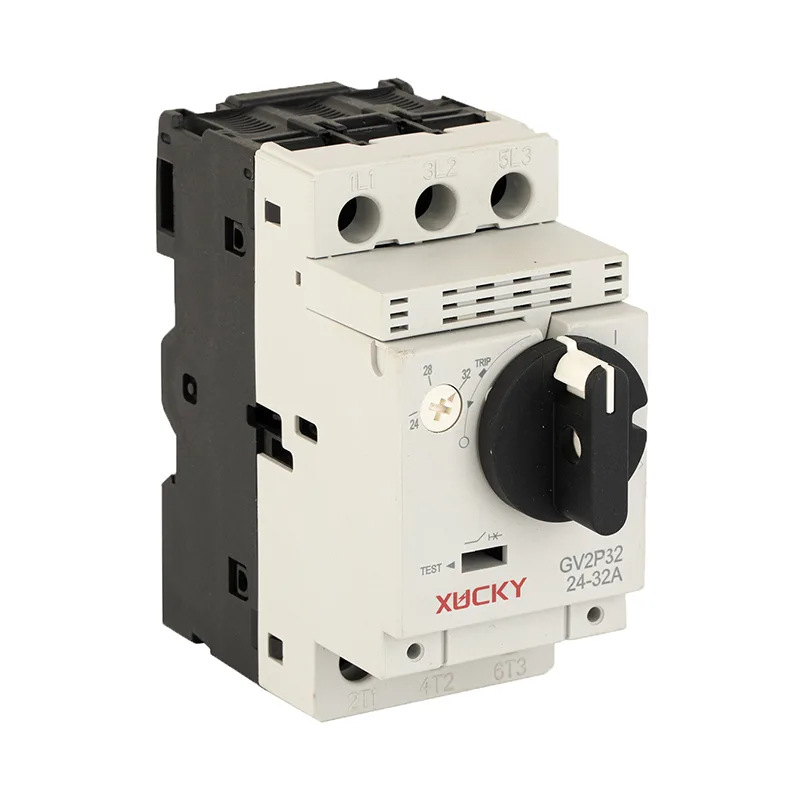
1. Common Root Causes of Nuisance Tripping
Nuisance tripping in the GV2P32 Series Motor Protection Circuit Breaker almost always stems from one of five categories. The table below maps each trigger to its typical symptom and the most effective verification method.
| Root Cause Category | Typical Symptom | Verification Method |
|---|---|---|
| Incorrect thermal setting | Trips after 5–20 minutes of steady running | Compare dial setting to motor FLA (Full Load Amps) |
| Ambient temperature mismatch | Trips faster on hot days, slower in winter | Measure enclosure internal temperature against breaker derating curve |
| Harmonic currents / VFD effects | Erratic tripping with no overload reading | Use true-RMS clamp meter to measure non-sinusoidal current |
| Loose power terminals | Trips intermittently with vibration | Thermal imaging of terminal blocks during load |
| Phase imbalance or voltage sag | Trips only when other large loads start | Record voltage and current over 24 hours with a power logger |
2. The Thermal-Magnetic Trip Mechanism Explained
The GV2P32 Series Motor Protection Circuit Breaker uses a bimetallic thermal element for overload protection and a magnetic coil for short-circuit protection. The thermal element responds to the I²t heating effect of the motor current. Under normal load, the heat generated by the bimetallic strip is balanced with heat dissipation. However, if the ambient temperature inside the panel exceeds 40°C, the XUCKY breaker’s thermal trip threshold effectively lowers—meaning it may trip at 90% of its nominal rating. Conversely, poor ventilation or stacked din-rail mounting can reduce heat dissipation by up to 15%, pushing the internal temperature well beyond design limits.
3. Step-by-Step Troubleshooting Workflow
Follow this logical sequence to isolate the exact cause without blindly replacing the GV2P32 Series Motor Protection Circuit Breaker.
-
Verify the dial setting – Ensure the current setting matches the motor nameplate FLA (not the service factor amps). For example, a 25A motor must be set to 25A, not 28A.
-
Measure actual running current – Use a true-RMS clamp meter on all three phases. If any phase exceeds the dial setting by more than 5% for over 2 minutes, the overload protection is functioning correctly—it is not a nuisance trip.
-
Check ambient temperature – If the enclosure temperature is 50°C, derate the GV2P32 Series Motor Protection Circuit Breaker by 10% per XUCKY’s technical datasheet. You may need to choose the next higher rating (e.g., 32A setting for a 28A motor).
-
Inspect for harmonic distortion – VFD-driven motors often produce 5th and 7th harmonics. These increase RMS current without increasing fundamental-frequency torque. If total harmonic distortion (THD) exceeds 15%, install an output reactor or choose a breaker with a higher magnetic trip threshold.
-
Tighten all power connections – A loose terminal generates localized heat that transfers to the bimetallic strip via the copper busbar. Torque all terminals to XUCKY’s specified value of 2.5 N·m ±10%.
4. When to Replace vs. When to Reconfigure
Many users assume the GV2P32 Series Motor Protection Circuit Breaker has worn out after repeated trips. In practice, the thermal bimetallic element is rated for over 10,000 mechanical operations and 1,500 short-circuit interruptions without significant drift. Replacement is only necessary when:
-
The dial no longer clicks into detent positions.
-
Visible arc damage appears on the contact faces.
-
The magnetic trip operates at less than 10× In (nameplate rating) – test with a primary injection set.
In all other cases, XUCKY recommends re-evaluating the motor starting profile, supply quality, and panel cooling before purchasing a new unit.
5. GV2P32 Series Motor Protection Circuit Breaker – FAQ
Q1: Can a voltage dip cause my GV2P32 Series Motor Protection Circuit Breaker to trip even if the current stays below the dial setting?
A1: Yes. The magnetic trip element responds to peak current, not RMS. A severe voltage dip (e.g., from 400V to 340V) causes the motor to draw a high inrush current that can reach 8–10× FLA for 100–200 ms. Even though the RMS value over 3 seconds may appear normal, the magnetic coil sees the instantaneous peak and can trip if it exceeds the fixed magnetic threshold (approximately 13× In for the GV2P32 Series Motor Protection Circuit Breaker). To resolve this, install a line reactor or a soft starter to limit inrush, or use a XUCKY external current transformer relay that offers adjustable short-circuit pickup.
Q2: How does ambient temperature derating work specifically for the GV2P32 Series Motor Protection Circuit Breaker, and do I need to change the dial setting?
A2: The GV2P32 Series Motor Protection Circuit Breaker is calibrated at 40°C ambient. For every 1°C above 40°C (up to 60°C), the thermal trip current decreases by approximately 1.2%. For example, at 50°C, the effective trip current is 88% of the dial setting. This means a motor with 25A FLA set at 25A will actually trip at 22A (25×0.88). You have two options: (a) ventilate the enclosure to bring ambient back to 40°C, or (b) set the dial to 28.5A (25/0.88) as per XUCKY’s derating formula. Never exceed the maximum dial setting of 32A, and always verify that the magnetic trip threshold remains appropriate for the motor’s locked-rotor current.
Q3: Why does my GV2P32 Series Motor Protection Circuit Breaker trip randomly only when the motor is running at light load (below 60% FLA)?
A3: This is a classic sign of harmonic interference or intermittent phase loss. At light load, the motor’s back-EMF is high, and any small unbalance in supply voltage (e.g., 3–4% negative sequence) produces counter-rotating torque that increases the positive-sequence current on one phase while decreasing it on another. The thermal element of the GV2P32 Series Motor Protection Circuit Breaker averages the three-phase heating effect, but if one phase carries 70% FLA while another carries 55% FLA, the bimetallic strip in the highest-current phase will deflect disproportionately. Use a power quality analyzer to measure negative-sequence voltage. If it exceeds 2%, contact your utility or install a XUCKY phase-monitoring relay that disconnects the motor before the breaker sees the unbalance. Additionally, inspect the neutral and grounding connections—floating neutrals often cause these asymmetric trips.
6. Preventive Maintenance Checklist
To avoid future nuisance trips, implement this monthly 15-minute inspection for every GV2P32 Series Motor Protection Circuit Breaker in your facility:
-
□
Record the enclosure internal temperature and compare to the last three months’ data.
-
□
Tighten all power and control terminals with a torque screwdriver.
-
□
Measure phase currents at 50%, 75%, and 100% load and log any drift.
-
□
Clean dust and debris from ventilation slots (the bimetallic element relies on free air circulation).
-
□
Test the manual trip button to ensure mechanical linkage is free.
Take Action Now – Contact XUCKY for Expert Support
Nuisance tripping is more than an inconvenience—it accelerates contact wear, stresses motor insulation, and reduces production efficiency. The GV2P32 Series Motor Protection Circuit Breaker is a robust device, but every application has unique variables. If you have already performed the steps above and still experience intermittent trips, XUCKY’s application engineering team offers free remote troubleshooting and on-site support for critical installations. Send us your motor nameplate data, a 24-hour current log, and panel photos, and we will deliver a tailored coordination study within 48 hours. Contact us today via our website live chat or email – we guarantee a response from a certified motor protection specialist within 4 business hours. Do not let a simple setting error cost you hours of downtime. Reach out to XUCKY now.