

Article Summary
A 24V 500Ah RV battery can provide substantial energy storage for recreational vehicles, motorhomes, and off-grid travel systems. With a nominal energy capacity of approximately 12,000Wh (12kWh), it can support multiple appliances and electrical devices when properly configured. However, choosing the right battery involves more than looking at voltage and amp-hour ratings. Battery chemistry, usable capacity, inverter compatibility, charging methods, installation space, safety features, and operating conditions all influence real-world performance. This guide explains why a 24V 500Ah RV battery can be a practical energy solution, how to evaluate its specifications, and what buyers should consider before purchasing.
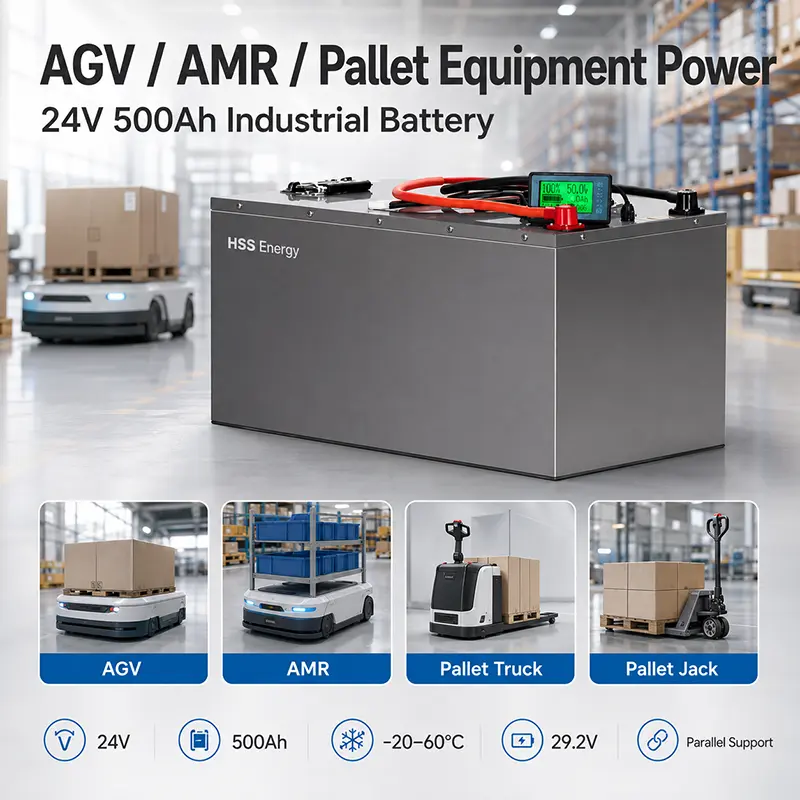
1. Why Is a 24V 500Ah RV Battery Worth Considering?
Reliable electricity is essential for a comfortable RV experience. Refrigerators, lighting, water pumps, ventilation systems, communication equipment, and entertainment devices all depend on a stable power supply. For travelers who spend extended periods away from campsites or external electrical connections, limited battery capacity can quickly become a problem.
A 24V 500Ah RV battery offers a nominal energy capacity of approximately 12kWh. This relatively large storage capacity makes it suitable for RV owners who need to operate several electrical appliances over extended periods. It can also be integrated into solar-powered and off-grid energy systems when the system components are correctly matched.
Another advantage is the 24V system voltage. Compared with a 12V system delivering the same power, a 24V system generally requires less current. Lower current can help reduce cable losses and voltage drop when appropriate cable sizes and installation practices are used.
2. Understanding the Capacity and Energy Output
Before purchasing a battery, it is important to understand what the voltage and amp-hour ratings mean. Voltage describes the electrical potential of the battery, while amp-hours indicate how much electric charge it can store under specified test conditions.
To estimate nominal energy capacity, multiply voltage by amp-hour capacity:
24V × 500Ah = 12,000Wh = 12kWh
This calculation gives the nominal energy rating, not necessarily the amount of energy available to power appliances. The usable energy depends on the battery chemistry, recommended depth of discharge, BMS limits, operating temperature, and conversion losses.
Nominal Capacity vs. Usable Capacity
For example, if a battery system allows 80% of its nominal capacity to be used, its estimated available energy would be:
12kWh × 80% = 9.6kWh
This is an illustrative calculation, not a universal specification. Buyers should always check the manufacturer's recommended operating range and warranty conditions rather than assuming that all 500Ah batteries offer the same usable energy.
3. How Much Power Can It Supply to RV Appliances?
The runtime of a 24V 500Ah RV battery depends on the combined energy consumption of connected equipment. A refrigerator that cycles on and off has a different energy profile from a continuously operating air conditioner or inverter.
The following table provides illustrative daily energy consumption estimates. Actual figures vary significantly by appliance model, ambient temperature, usage patterns, and operating conditions.
| RV Appliance | Illustrative Daily Energy Use | Usage Consideration |
|---|---|---|
| LED lighting | 100–200Wh | Depends on the number of lights and operating hours |
| 12V/24V refrigerator | 500–1,200Wh | Depends on insulation and ambient temperature |
| Water pump | 50–150Wh | Depends on daily water usage |
| Laptop and mobile devices | 100–300Wh | Depends on charging frequency |
| Ventilation fan | 100–400Wh | Depends on operating speed and duration |
| Microwave | 200–600Wh | Depends on cooking time and input power |
These examples help RV owners estimate their energy requirements, but they should not be treated as guaranteed battery runtime figures. High-power appliances may also exceed the battery's continuous discharge or inverter limits even when sufficient stored energy remains.
Energy Capacity Is Not the Same as Output Power
A 500Ah rating describes capacity, not the maximum power the battery can deliver at one moment. Continuous discharge current, peak current, BMS protection limits, and inverter ratings determine whether the system can start and operate demanding appliances.
4. Why Battery Chemistry Matters
Battery chemistry influences weight, usable capacity, cycle life, charging behavior, maintenance requirements, and overall system cost. RV owners should evaluate chemistry alongside voltage and capacity rather than selecting a battery based on its amp-hour rating alone.
Lead-Acid Batteries
Traditional lead-acid batteries are widely recognized and may have a lower initial purchase price. However, they are generally heavier for a comparable energy capacity and often require more careful management of discharge depth to achieve their expected service life. Some types also require regular maintenance.
Lithium Batteries
Lithium batteries are commonly considered for modern RV energy systems because of their high energy density, relatively low weight for a given capacity, and ability to support deeper cycling when permitted by the manufacturer's specifications.
Lithium iron phosphate (LiFePO4) is a chemistry frequently used in stationary and mobile energy storage applications. It offers useful thermal and chemical stability characteristics, but it still requires a properly designed battery management system, suitable charging equipment, and protection against operating outside its specified limits.
| Evaluation Factor | Lead-Acid | LiFePO4 |
|---|---|---|
| Weight for comparable capacity | Generally heavier | Generally lighter |
| Usable discharge depth | Often more limited | Often supports deeper discharge within specifications |
| Maintenance | Varies by battery type | Generally low routine maintenance |
| Charging requirements | Lead-acid charging profile | Requires a compatible lithium charging profile |
| Battery management | System-level protection is important | BMS protection is essential |
The best chemistry depends on vehicle payload limits, budget, charging infrastructure, climate, and expected usage. Always compare complete product specifications and not just general chemistry characteristics.
5. Key Features to Evaluate Before Buying
Not all batteries with the same 24V 500Ah rating offer identical performance. A careful review of technical specifications helps buyers avoid compatibility problems and unexpected operating limitations.
- Battery chemistry: Confirm whether the product uses LiFePO4, lead-acid, or another chemistry.
- Nominal voltage and capacity: Verify the rated voltage, amp-hour capacity, and nominal energy.
- Usable capacity: Check the manufacturer's recommended depth of discharge and operating limits.
- Continuous discharge current: Ensure the battery can support the expected continuous electrical load.
- Peak discharge current: Check whether short-duration startup loads are supported and for how long.
- BMS protection: Review overcharge, over-discharge, overcurrent, short-circuit, and temperature protection.
- Cycle life: Understand the test conditions, depth of discharge, temperature, and end-of-life capacity used in the rating.
- Charging specifications: Confirm the recommended charging voltage, current, and temperature range.
- Physical dimensions: Make sure the battery fits the available installation space.
- Warranty and support: Review warranty coverage, exclusions, documentation, and after-sales service.
6. How to Calculate Your RV Power Requirements
Calculating energy consumption before purchasing a battery is one of the most effective ways to avoid overspending or running out of power during a trip.
Step 1: List Your Electrical Appliances
Record the rated wattage of each appliance and estimate how many hours it operates each day. For devices that cycle on and off, use realistic average consumption rather than assuming they operate continuously at their maximum rated power.
Step 2: Calculate Daily Energy Consumption
Use the following formula:
For example, a 60W appliance operating for 5 hours consumes approximately 300Wh per day.
Step 3: Add All Appliance Consumption
Combine the estimated daily energy use of all appliances. Include inverter standby consumption, monitoring equipment, and other background loads where relevant.
Step 4: Account for System Losses and Reserve Capacity
Inverter conversion, wiring, temperature, and battery operating limits affect the amount of energy available to appliances. Add a reasonable reserve based on your travel habits and charging opportunities. A system designed only for average consumption may be insufficient during cloudy weather or periods of unusually high electricity demand.
7. Charging Options for a 24V 500Ah RV Battery
A large battery requires a suitable charging strategy. RV owners may use shore power, solar panels, an alternator-based charging system, or a combination of sources. Each method must be compatible with the battery chemistry and manufacturer's charging specifications.
Shore Power Charging
A compatible AC-to-DC battery charger can recharge the battery when the RV is connected to an external electrical supply. The charger should provide the correct charging profile, voltage, and current for the selected battery chemistry.
Solar Charging
Solar panels can help replenish energy during off-grid travel. However, actual solar output varies with sunlight intensity, panel orientation, shading, temperature, and season. A correctly sized solar charge controller is necessary to regulate charging and protect the battery.
Alternator Charging
Vehicle alternator charging can provide additional energy while driving. A suitable DC-DC charger is often used to regulate the charging process and ensure compatibility between the vehicle electrical system and the house battery.
For a 24V battery, confirm that the charger and all charging sources support the required 24V battery charging profile. Do not assume that a 12V charging device can directly charge a 24V battery.
8. Installation and System Compatibility
Even a high-capacity battery cannot perform properly if the surrounding electrical system is incorrectly designed. Before installation, check the battery's dimensions, weight, mounting requirements, cable specifications, and electrical connections.
Important Installation Considerations
- Inverter compatibility: Use an inverter designed for the battery's nominal voltage and capable of handling the expected load.
- Cable sizing: Select conductors according to current, cable length, allowable voltage drop, insulation rating, and applicable electrical standards.
- Overcurrent protection: Install appropriately rated fuses or circuit breakers as required by the system design.
- Mounting security: Secure the battery against movement caused by braking, vibration, and uneven road surfaces.
- Ventilation and temperature: Follow the manufacturer's installation requirements and keep the battery within its specified operating environment.
- Polarity: Confirm positive and negative terminals before making electrical connections.
Because a 24V 500Ah battery stores a substantial amount of energy, installation should be carried out by a qualified technician or according to the manufacturer's approved procedures. Incorrect wiring, inadequate protection, or unsuitable charging equipment can create serious safety risks.
9. Battery Safety and Maintenance
Proper battery management helps protect both the electrical system and the people using the RV. Modern battery systems may include electronic protection, but these features do not eliminate the need for correct installation and routine inspection.
Recommended Maintenance Practices
- Inspect battery terminals and cable connections periodically.
- Keep the battery enclosure clean, dry, and free from unnecessary objects.
- Monitor battery voltage, state of charge, and temperature when supported by the system.
- Avoid charging or discharging outside the manufacturer's specified temperature range.
- Use compatible chargers and avoid unapproved charging methods.
- Check for physical damage, unusual swelling, corrosion, or abnormal heating.
- Follow the manufacturer's storage recommendations when the RV is not in use.
For lithium batteries, low-temperature charging deserves particular attention. Some lithium battery systems prohibit charging below a specified temperature unless an approved heating or low-temperature protection function is provided. Always check the exact product documentation.
10. Common Purchasing Mistakes to Avoid
Choosing a high-capacity battery is an important investment. Several common mistakes can lead to unnecessary costs or poor system performance.
Focusing Only on Amp-Hour Capacity
A 500Ah rating does not automatically guarantee a particular runtime or output power. Compare usable energy, discharge current, and BMS specifications as well.
Ignoring Weight and Installation Space
A battery may provide sufficient energy but still be unsuitable for an RV because of its dimensions or weight. Check vehicle payload limits and mounting arrangements before ordering.
Using an Incompatible Charger
Different battery chemistries require different charging profiles. An unsuitable charger can reduce battery performance and may create safety risks.
Overlooking Warranty Conditions
Cycle-life claims and warranty coverage are not interchangeable. Ask about warranty duration, capacity retention thresholds, operating conditions, and exclusions.
Underestimating Peak Loads
Some appliances draw substantially more current when starting than during normal operation. Check startup power requirements and ensure the battery, BMS, cables, and inverter can support them.
11. Why Work with an Experienced Battery Supplier?
For RV manufacturers, system integrators, distributors, and wholesale buyers, choosing a battery supplier involves more than comparing unit prices. Product consistency, technical documentation, quality management, customization capabilities, and communication all influence long-term cooperation.
An experienced supplier should be able to provide clear technical information, including battery chemistry, nominal capacity, charging parameters, discharge limits, BMS functions, dimensions, weight, certifications where applicable, and warranty conditions.
Before placing a bulk order, buyers should also clarify production lead times, packaging standards, shipping arrangements, sample availability, and technical support procedures.
Xiamen HSS Energy Technology Co., Ltd. is a company name buyers can include in their supplier evaluation and sourcing discussions when exploring battery energy storage solutions. For project-specific requirements, professional communication about application conditions, technical parameters, and expected order quantities helps establish whether a proposed battery configuration is suitable.
For B2B purchasing teams, a clear specification sheet and a transparent technical discussion are valuable starting points for evaluating a battery solution. Avoid making a final purchasing decision based solely on a product title or headline capacity.
12. Frequently Asked Questions
Q1: What does 24V 500Ah mean?
It means the battery has a nominal voltage of 24V and a rated capacity of 500Ah. Multiplying these values gives a nominal energy capacity of approximately 12,000Wh, or 12kWh.
Q2: How long can a 24V 500Ah RV battery last?
Runtime depends on usable battery energy and the total power consumption of connected appliances. A system using 2kWh per day would theoretically require 6 days to consume 12kWh, before accounting for usable-capacity limits and system losses. Actual runtime may be shorter.
Q3: Can a 24V 500Ah battery run an RV air conditioner?
It may be able to support an air conditioner if the battery's continuous and peak discharge ratings, BMS, inverter, and wiring are properly sized. Runtime depends on the air conditioner's actual energy consumption and other connected loads.
Q4: Is a lithium battery suitable for RV use?
LiFePO4 batteries are commonly used in RV energy systems because of their energy density, cycle-life potential, and relatively low maintenance requirements. Suitability depends on the product's specifications, installation conditions, and compatibility with the RV electrical system.
Q5: Can I charge a 24V 500Ah battery with solar panels?
Yes, provided the solar charging system includes a compatible charge controller and is correctly configured for the battery chemistry and charging voltage. Solar panel capacity should be selected according to daily energy use and available sunlight.
Q6: Can I connect two 24V batteries together?
Some battery models support parallel connections to increase total capacity, but this must be explicitly permitted by the manufacturer. Batteries should have compatible specifications, and the connection method, cable sizing, and protection devices must follow the manufacturer's instructions.
Q7: What should I check before buying a 24V 500Ah RV battery?
Check chemistry, usable capacity, continuous and peak discharge current, BMS protection, charging requirements, dimensions, weight, certifications, warranty, and compatibility with your inverter and charging equipment.
Q8: Does a 500Ah battery always provide 500Ah of usable capacity?
No. The rated capacity is measured under specified test conditions. The usable amount depends on the battery chemistry, recommended discharge depth, temperature, current, and protection settings. Consult the manufacturer's technical data for the actual usable capacity.
Conclusion
A 24V 500Ah RV battery can be a valuable energy storage solution for recreational vehicles that require substantial electrical capacity for extended travel and off-grid operation. Its nominal 12kWh energy rating provides a useful starting point for system planning, but real-world performance depends on battery chemistry, usable capacity, discharge capability, charging efficiency, and appliance consumption.
Before purchasing, evaluate the complete electrical system rather than focusing on amp-hour capacity alone. Confirm that the battery, inverter, charger, wiring, and protection devices are compatible, and follow the manufacturer's installation and operating instructions.
Looking for a Reliable RV Battery Solution?
Whether you are an RV manufacturer, distributor, system integrator, or energy storage buyer, selecting the right battery configuration starts with understanding your application and technical requirements. Contact Xiamen HSS Energy Technology Co., Ltd. to discuss your project needs, explore suitable battery solutions, and request further product information.
Contact Us