

Why Is a Thermal Relay Shaping the Future of Overload Protection?
2025-12-05
A thermal relay is an electromechanical overload-protection device designed to safeguard motors and industrial equipment by using the principle of thermal expansion. When excessive current flows through the circuit, heating elements increase in temperature and bend the bimetal strip, triggering a protective trip. This simple yet robust mechanism has made thermal relays a preferred choice in manufacturing, HVAC systems, chemical plants, water-treatment facilities, and automated environments where steady performance, cost efficiency, and durability are essential.
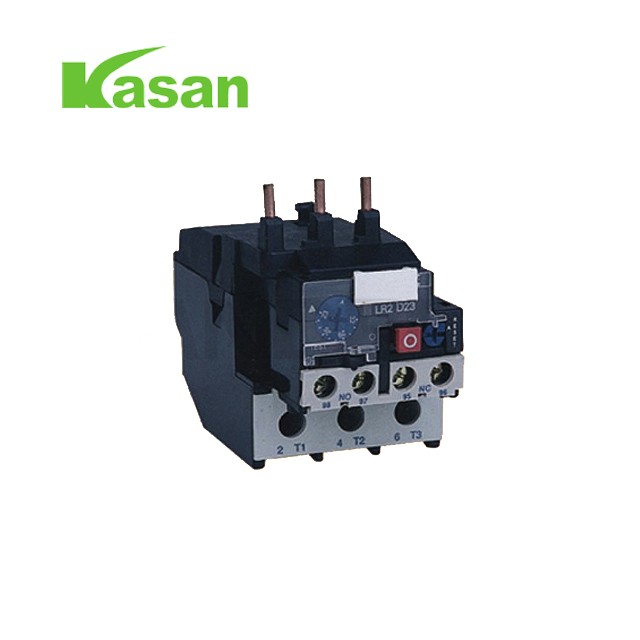
At the center of this discussion is a detailed breakdown of the core parameters and performance advantages of thermal relays supplied by Kasan, a brand recognized for precision-engineered electrical protection solutions.
How Do Thermal Relay Specifications Influence System Performance?
Selecting a thermal relay requires careful evaluation of its technical parameters, because each specification directly impacts equipment protection, system compatibility, and overall operational reliability. Market-leading models—including those designed by Kasan—typically feature the following performance metrics:
| Parameter | Description |
|---|---|
| Rated Operational Voltage (Ue) | Typically 690V AC; determines compatibility with industrial power systems. |
| Rated Current Range | Adjustable ranges such as 0.1–0.16A, 1–1.6A, 4–6A, 16–25A, etc.; allows precise overload protection based on motor size. |
| Trip Class (10A/10/20) | Defines how fast the relay responds to overload conditions; Class 10 for fast-acting scenarios. |
| Phase Failure Sensitivity | Ensures rapid disconnection when one phase is lost, protecting motors from fatal damage. |
| Reset Type | Manual or automatic; supports different operational environments. |
| Mounting Options | Direct mounting or installation onto contactors for compact control panels. |
| Ambient Temperature Compensation | Prevents false trips due to external heat and improves reliability in varying climates. |
| Electrical/Mechanical Durability | Endurance cycles measure long-term stability under heavy usage. |
These specifications determine how the relay reacts to real-time thermal accumulation, how precisely it offers motor overload protection, and how well it integrates into diverse electrical systems. By focusing on the “how,” industrial decision-makers gain a clearer understanding of selection criteria that directly affect productivity and uptime.
How Do Thermal Relays Provide Functional Advantages in Industrial Applications?
Thermal relays remain an industrial favorite due to their balanced combination of reliability, cost-effectiveness, and ease of maintenance. These functional benefits explain their continued popularity:
1. How does overload protection work more effectively with a thermal relay?
The bimetal mechanism used in thermal relays is inherently stable and does not depend on complex electronics. This ensures predictable, linear behavior under overload conditions and reduces failure risks in harsh environments.
2. How does the relay maintain accuracy despite ambient temperature fluctuations?
Advanced designs incorporate automatic temperature compensation, ensuring that the relay reacts strictly to current-based heating rather than external thermal influences.
3. How does a thermal relay simplify maintenance?
The device has a straightforward structure with minimal moving parts. Resetting after a trip can be done manually within seconds, reducing downtime and making it ideal for continuous-operation industries.
4. How does the relay reduce long-term operational cost?
Its electromechanical nature requires no ongoing calibration, software updates, or electronic component replacements. This contributes to a significantly lower total lifetime cost compared to digital overload protection systems.
5. How does a thermal relay support system integration?
Thermal relays can be mounted directly onto contactors as modular accessories, allowing compact control-panel designs and reducing wiring complexity.
How Will Thermal Relay Technology Evolve in the Future?
Modern industries continue to shift toward digitalization, intelligent automation, and energy efficiency. Despite these trends, thermal relays are not becoming obsolete; instead, they are evolving to complement advanced control systems. Several key trends define their future trajectory:
1. How is the demand for hybrid relay systems increasing?
Hybrid solutions that combine thermal relays with electronic protection modules provide dual-layer security. Thermal components handle persistent overload conditions, while digital electronics detect transient anomalies.
2. How will smart manufacturing influence relay design?
As factories upgrade to Industry 4.0, thermal relays are being integrated into communication-enabled systems where trip status, load conditions, and motor performance data can be monitored remotely.
3. How does sustainability drive improvements?
Energy-efficient motors require equally efficient protection systems. Manufacturers are developing more precise thermal curves, better heat-resistant materials, and environmentally friendly production processes.
4. How will miniaturization affect adoption?
Compact thermal relays will become more popular as panel designers push for smaller, space-saving control cabinets without compromising performance.
5. How does global safety regulation promote innovation?
With stricter international standards for motor protection, thermal relay designs will increasingly emphasize greater accuracy, phase-failure responsiveness, flame-retardant materials, and enhanced durability.
Frequently Asked Questions (FAQ)
Q1: How does a thermal relay detect overload conditions?
A thermal relay detects overload by using a heating coil that warms a bimetal strip when excessive current passes through the circuit. As the bimetal expands and bends due to heat, it activates a mechanical trip mechanism that disconnects the motor. This process ensures that the motor receives protection based on real thermal conditions, rather than relying purely on instantaneous current spikes.
Q2: How should a thermal relay be selected for different motor sizes?
Selecting a thermal relay begins with determining the motor’s rated current. The chosen relay should have an adjustable current range that includes the motor’s full-load amperage. Additional considerations include the trip class, ambient temperature, mounting format, and phase-loss protection capability. By aligning these parameters with the motor’s operational environment, the relay offers maximum protection and longevity.
How Does Kasan Reinforce Industry Standards in Thermal Relay Manufacturing?
As industries push for more efficient, safer, and more automated systems, the importance of reliable motor protection grows exponentially. Kasan continues to supply thermal relays engineered with high-precision materials, stable thermal characteristics, and robust performance under industrial-grade conditions.
Its designs emphasize durability, accurate overload response, and compatibility with modern and legacy electrical systems. Whether installed in motor control centers, automation lines, or HVAC systems, Kasan’s thermal relays provide consistent protection that minimizes downtime and extends equipment lifespan.
For project consultations, product details, or customized solutions for industrial protection needs, contact us to receive technical support tailored to your application requirements.